Dolidze David D, Covantsev Serghei, Chechenin Grigorii M, Pichugina Natalia V, Bedina Anastasia V, Bumbu Anna
Department of Clinical Research and Development, Botkin Hospital, Moscow 125284, Russia.
Department of Surgery, Russian Medical Academy of Continuous Professional Education, Moscow 125445, Russia.
World J Clin Oncol. 2024 May 24;15(5):580-586. doi: 10.5306/wjco.v15.i5.580.
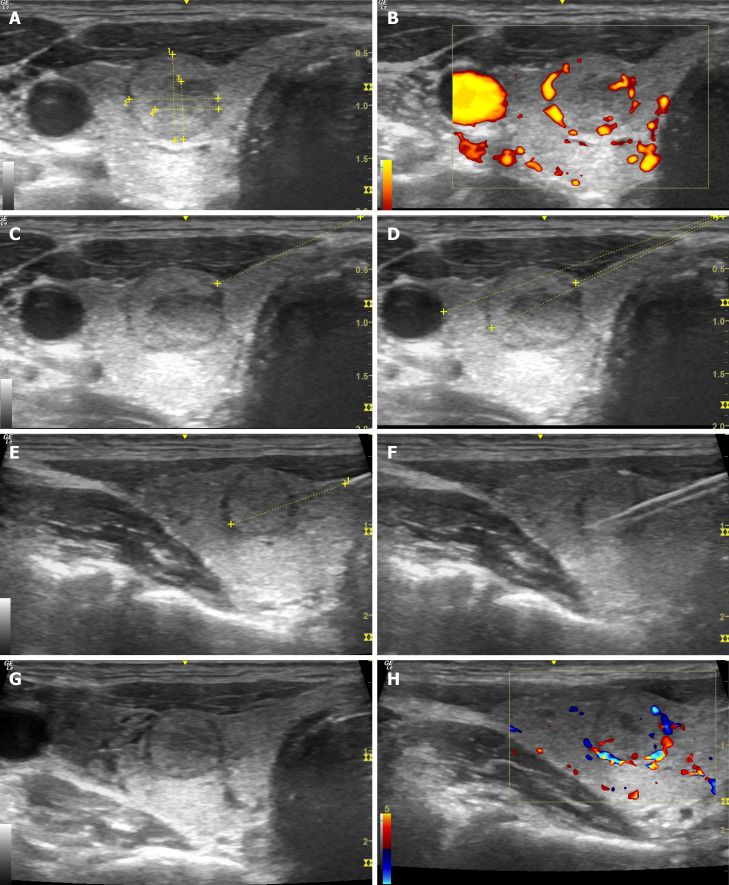
Ultrasound-guided fine-needle aspiration is the standard for evaluating thyroid nodules with a high safety profile and a relatively low number of non-diagnostic cytological findings. Nevertheless, this diagnostic method traditionally has its weak points. Several diagnostic categories such as Bethesda I, III and IV are not reliable for thyroid carcinoma risk assessment. Recent advancements in a core needle biopsy made it possible to use this tool as a new method for thyroid nodules evaluation. The main feature of this method is the use of thin needles (18-21G) and guns with an automatic trigger mechanism. The histological material collected with the use of a core needle biopsy is usually superior to cytological. Therefore, the core needle biopsy can be used as a complementary technique to a standard fine needle aspiration in difficult and dubious cases of thyroid neoplasia with uncertain malignant potential.
超声引导下细针穿刺是评估甲状腺结节的标准方法,其安全性高,非诊断性细胞学结果相对较少。然而,这种诊断方法传统上存在不足之处。贝塞斯达分类中的I、III和IV等几个诊断类别对于甲状腺癌风险评估并不可靠。粗针活检的最新进展使得将该工具用作评估甲状腺结节的新方法成为可能。这种方法的主要特点是使用细针(18 - 21G)和带有自动触发机制的枪。通过粗针活检收集的组织学材料通常优于细胞学材料。因此,在甲状腺肿瘤恶性潜能不确定的疑难病例中,粗针活检可作为标准细针穿刺的补充技术。