Department of Cancer Biology and Genetics, The Ohio State University College of Medicine, Columbus, Ohio.
The City College of New York, City University of New York, New York, New York.
Cancer Res Commun. 2024 Jun 27;4(6):1597-1608. doi: 10.1158/2767-9764.CRC-24-0026.
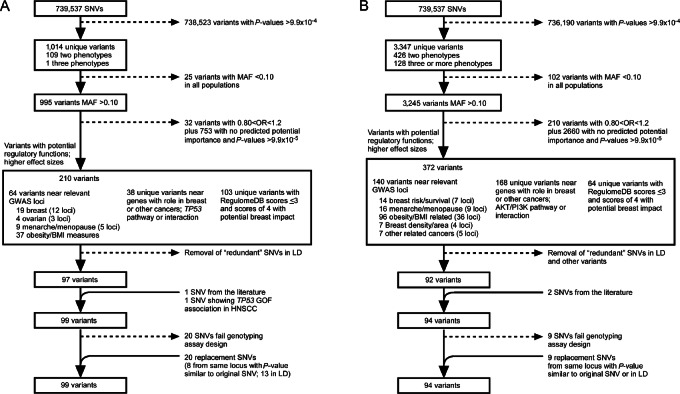
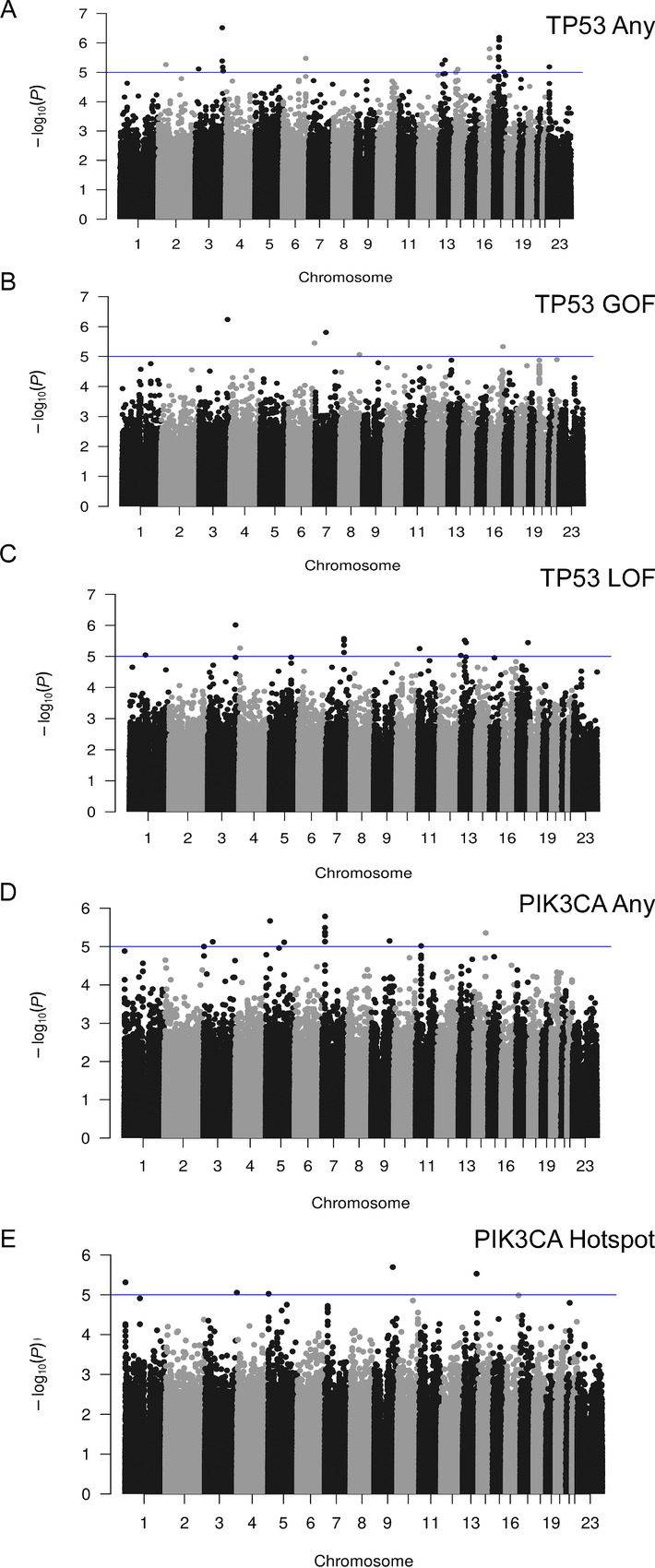
In breast tumors, somatic mutation frequencies in TP53 and PIK3CA vary by tumor subtype and ancestry. Emerging data suggest tumor mutation status is associated with germline variants and genetic ancestry. We aimed to identify germline variants that are associated with somatic TP53 or PIK3CA mutation status in breast tumors. A genome-wide association study was conducted in 2,850 women of European ancestry with breast cancer using TP53 and PIK3CA mutation status (positive or negative) as well as specific functional categories [e.g., TP53 gain-of-function (GOF) and loss-of-function, PIK3CA activating] as phenotypes. Germline variants showing evidence of association were selected for validation analyses and tested in multiple independent datasets. Discovery association analyses found five variants associated with TP53 mutation status with P values <1 × 10⁻⁶ and 33 variants with P values <1 × 10⁻⁵. Forty-four variants were associated with PIK3CA mutation status with P values <1 × 10⁻⁵. In validation analyses, only variants at the ESR1 locus were associated with TP53 mutation status after multiple comparisons corrections. Combined analyses in European and Malaysian populations found ESR1 locus variants rs9383938 and rs9479090 associated with the presence of TP53 mutations overall (P values 2 × 10-11 and 4.6 × 10⁻¹⁰, respectively). rs9383938 also showed association with TP53 GOF mutations (P value 6.1 × 10⁻⁷). rs9479090 showed suggestive evidence (P value 0.02) for association with TP53 mutation status in African ancestry populations. No other variants were significantly associated with TP53 or PIK3CA mutation status. Larger studies are needed to confirm these findings and determine if additional variants contribute to ancestry-specific differences in mutation frequency.
Emerging data show ancestry-specific differences in TP53 and PIK3CA mutation frequency in breast tumors suggesting that germline variants may influence somatic mutational processes. This study identified variants near ESR1 associated with TP53 mutation status and identified additional loci with suggestive association which may provide biological insight into observed differences.
在乳腺癌中,TP53 和 PIK3CA 的体细胞突变频率因肿瘤亚型和种族而异。新出现的数据表明,肿瘤突变状态与种系变异和遗传背景有关。我们旨在确定与乳腺癌中体细胞 TP53 或 PIK3CA 突变状态相关的种系变异。对 2850 名欧洲裔乳腺癌患者进行了全基因组关联研究,使用 TP53 和 PIK3CA 突变状态(阳性或阴性)以及特定的功能类别[例如,TP53 功能获得(GOF)和功能丧失,PIK3CA 激活]作为表型。显示关联证据的种系变异被选择进行验证分析,并在多个独立数据集进行测试。发现与 TP53 突变状态相关的 5 个变体的 P 值 <1×10⁻⁶,与 PIK3CA 突变状态相关的 33 个变体的 P 值 <1×10⁻⁵。44 个变体与 PIK3CA 突变状态相关,P 值 <1×10⁻⁵。在验证分析中,只有 ESR1 基因座的变体在经过多次比较校正后与 TP53 突变状态相关。在欧洲和马来西亚人群的综合分析中,发现 ESR1 基因座变体 rs9383938 和 rs9479090 与 TP53 突变的总体存在相关(P 值分别为 2×10-11 和 4.6×10⁻¹⁰)。rs9383938 还与 TP53 GOF 突变相关(P 值 6.1×10⁻⁷)。rs9479090 显示出与非洲裔人群中 TP53 突变状态相关的暗示性证据(P 值 0.02)。没有其他变体与 TP53 或 PIK3CA 突变状态显著相关。需要更大的研究来证实这些发现,并确定是否有其他变体导致突变频率的种族特异性差异。
新出现的数据表明,乳腺癌中 TP53 和 PIK3CA 的突变频率存在种族特异性差异,这表明种系变异可能影响体细胞突变过程。本研究确定了与 TP53 突变状态相关的 ESR1 附近的变体,并确定了其他具有暗示性关联的基因座,这可能为观察到的差异提供生物学见解。