Primary Healthcare Research Unit, Faculty of Medicine, Memorial University of Newfoundland and Labrador, St. John's, Newfoundland and Labrador, Canada.
Population Health and Applied Health Sciences, Faculty of Medicine, Memorial University of Newfoundland and Labrador, St. John's, Newfoundland and Labrador, Canada.
PLoS One. 2024 Jun 5;19(6):e0300001. doi: 10.1371/journal.pone.0300001. eCollection 2024.
Up to 30% of diagnostic imaging (DI) tests may be unnecessary, leading to increased healthcare costs and the possibility of patient harm. The primary objective of this systematic review was to assess the effect of audit and feedback (AF) interventions directed at healthcare providers on reducing image ordering. The secondary objective was to examine the effect of AF on the appropriateness of DI ordering.
Studies were identified using MEDLINE, EMBASE, CINAHL, Cochrane Central Register of Controlled Trials and ClinicalTrials.gov registry on December 22nd, 2022. Studies were included if they were randomized control trials (RCTs), targeted healthcare professionals, and studied AF as the sole intervention or as the core component of a multi-faceted intervention. Risk of bias for each study was evaluated using the Cochrane risk of bias tool. Meta-analyses were completed using RevMan software and results were displayed in forest plots.
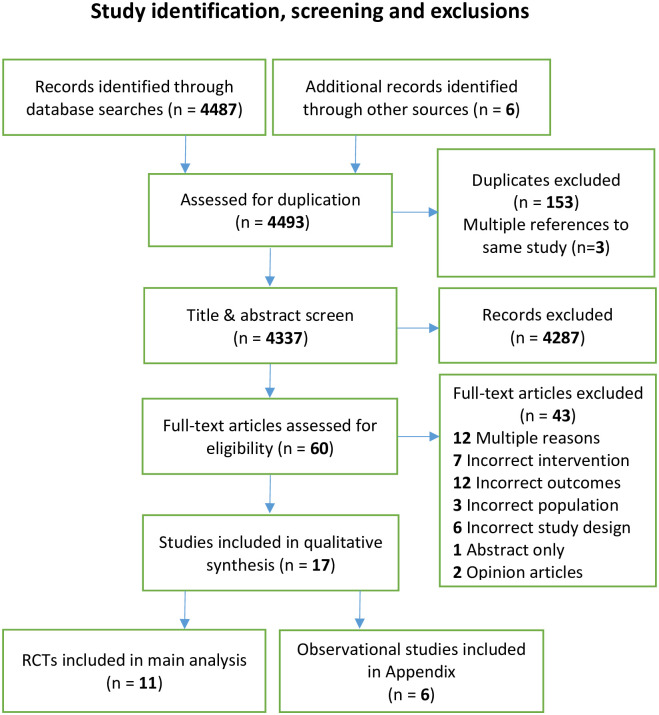
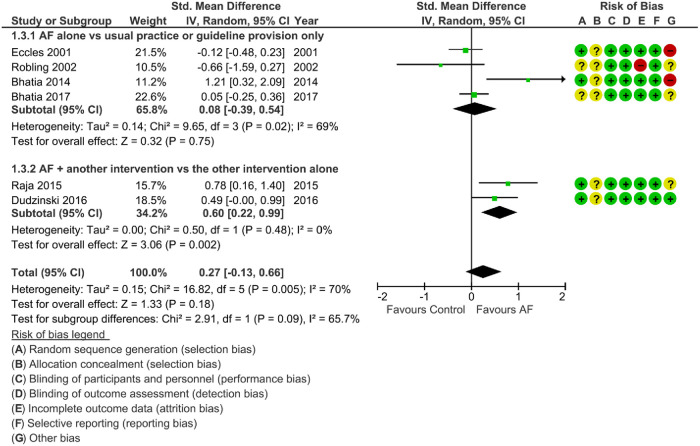
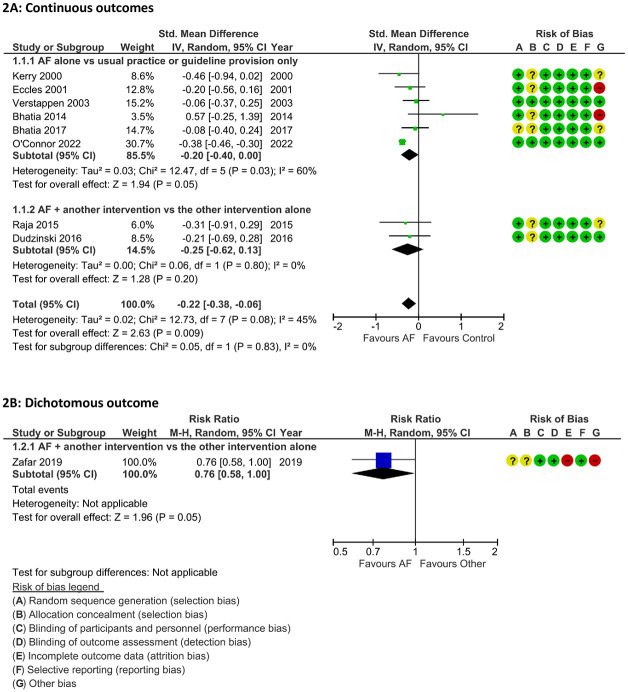
Eleven RCTs enrolling 4311 clinicians or practices were included. AF interventions resulted in 1.5 fewer image test orders per 1000 patients seen than control interventions (95% confidence interval (CI) for the difference -2.6 to -0.4, p-value = 0.009). The effect of AF on appropriateness was not statistically significant, with a 3.2% (95% CI -1.5 to 7.7%, p-value = 0.18) greater likelihood of test orders being considered appropriate with AF vs control interventions. The strength of evidence was rated as moderate for the primary objective but was very low for the appropriateness outcome because of risk of bias, inconsistency in findings, indirectness, and imprecision.
AF interventions are associated with a modest reduction in total DI ordering with moderate certainty, suggesting some benefit of AF. Individual studies document effects of AF on image order appropriateness ranging from a non-significant trend toward worsening to a highly significant improvement, but the weighted average effect size from the meta-analysis is not statistically significant with very low certainty.
多达 30%的诊断影像学 (DI) 检查可能是不必要的,这导致医疗保健成本增加,并有可能对患者造成伤害。本系统评价的主要目的是评估针对医疗保健提供者的审计和反馈 (AF) 干预措施减少影像检查的效果。次要目标是检查 AF 对 DI 检查的适宜性的影响。
我们于 2022 年 12 月 22 日使用 MEDLINE、EMBASE、CINAHL、Cochrane 对照试验中心注册库和 ClinicalTrials.gov 注册库检索了研究。如果研究是随机对照试验 (RCT),针对医疗保健专业人员,并且将 AF 作为唯一干预措施或多方面干预措施的核心组成部分进行研究,则将其纳入研究。使用 Cochrane 偏倚风险工具评估每项研究的偏倚风险。使用 RevMan 软件进行荟萃分析,并以森林图显示结果。
纳入了 11 项 RCT,共纳入 4311 名临床医生或诊所。与对照干预相比,AF 干预使每 1000 名就诊患者的影像检查减少了 1.5 次(差异的 95%置信区间为 -2.6 至 -0.4,p 值 = 0.009)。AF 对适宜性的影响没有统计学意义,AF 与对照干预相比,检查结果被认为更适宜的可能性增加了 3.2%(95%置信区间为 -1.5 至 7.7%,p 值 = 0.18)。由于偏倚风险、结果不一致、间接性和不精确性,主要目标的证据强度被评为中等,但对适宜性结果的证据强度非常低。
AF 干预与适度减少总 DI 检查量相关,具有中等确定性,表明 AF 有一定益处。个别研究记录了 AF 对影像检查适宜性的影响,从无显著趋势恶化到显著改善不等,但荟萃分析的加权平均效应量没有统计学意义,确定性非常低。