Department of Health Management, School of Medicine and Health Management, Tongji Medical College, Huazhong University of Science and Technology, Wuhan, China.
Department of Neurobiology, Care Sciences and Society, Karolinska Institutet, Stockholm, Sweden.
Int J Equity Health. 2024 Jun 5;23(1):115. doi: 10.1186/s12939-024-02196-2.
Since 2020, China has implemented an innovative payment method called Diagnosis-Intervention Packet (DIP) in 71 cities nationwide. This study aims to assess the impact of DIP on medical expenditure, efficiency, and quality for inpatients covered by the Urban Employee Basic Medical Insurance (UEBMI) and Urban and Rural Residents Basic Medical Insurance (URRBMI). It seeks to explore whether there are differences in these effects among inpatients of the two insurance types, thereby further understanding its implications for health equity.
We conducted interrupted time series analyses on outcome variables reflecting medical expenditure, efficiency, and quality for both UEBMI and URRBMI inpatients, based on a dataset comprising 621,125 inpatient reimbursement records spanning from June 2019 to June 2023 in City A. This dataset included 110,656 records for UEBMI inpatients and 510,469 records for URRBMI inpatients.
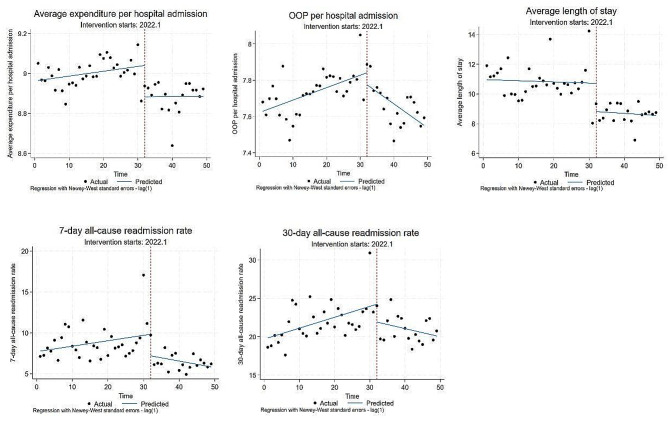
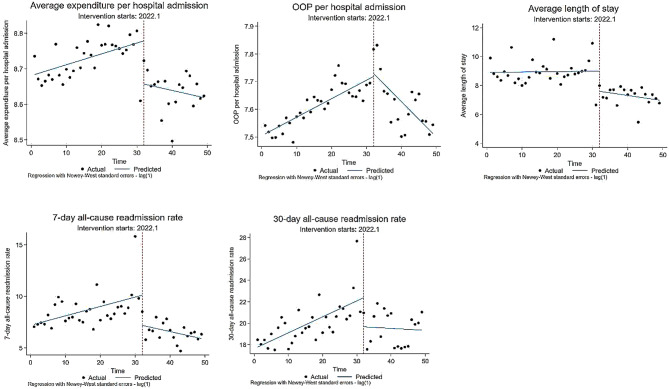
After the reform, the average expenditure per hospital admission for UEBMI inpatients did not significantly differ but continued to follow an upward pattern. In contrast, for URRBMI inpatients, the trend shifted from increasing before the reform to decreasing after the reform, with a decline of 0.5%. The average length of stay for UEBMI showed no significant changes after the reform, whereas there was a noticeable downward trend in the average length of stay for URRBMI. The out-of-pocket expenditure (OOP) per hospital admission, 7-day all-cause readmission rate and 30-day all-cause readmission rate for both UEBMI and URRBMI inpatients showed a downward trend after the reform.
The DIP reform implemented different upper limits on budgets based on the type of medical insurance, leading to varying post-treatment prices for UEBMI and URRBMI inpatients within the same DIP group. After the DIP reform, the average expenditure per hospital admission and the average length of stay remained unchanged for UEBMI inpatients, whereas URRBMI inpatients experienced a decrease. This trend has sparked concerns about hospitals potentially favoring UEBMI inpatients. Encouragingly, both UEBMI and URRBMI inpatients have seen positive outcomes in terms of alleviating patient financial burdens and enhancing the quality of care.
自 2020 年以来,中国在全国 71 个城市实施了一种名为按病种分值付费(DIP)的创新支付方式。本研究旨在评估 DIP 对参加城镇职工基本医疗保险(UEBMI)和城乡居民基本医疗保险(URRBMI)的住院患者的医疗支出、效率和质量的影响。它旨在探索这两种保险类型的住院患者在这些影响方面是否存在差异,从而进一步了解其对健康公平的影响。
我们基于城市 A 从 2019 年 6 月至 2023 年 6 月涵盖 621,125 名住院患者报销记录的数据集,对反映 UEBMI 和 URRBMI 住院患者医疗支出、效率和质量的结果变量进行了中断时间序列分析。该数据集包括 110,656 名 UEBMI 住院患者记录和 510,469 名 URRBMI 住院患者记录。
改革后,UEBMI 住院患者的每次住院平均支出没有显著差异,但仍呈上升趋势。相比之下,URRBMI 住院患者的趋势从改革前的增加变为改革后的减少,减少了 0.5%。改革后,UEBMI 住院患者的平均住院天数没有显著变化,而 URRBMI 住院患者的平均住院天数则呈明显下降趋势。UEBMI 和 URRBMI 住院患者的每次住院自付支出(OOP)、7 天全因再入院率和 30 天全因再入院率均呈下降趋势。
DIP 改革根据医疗保险类型对预算设定了不同的上限,导致同一 DIP 组内 UEBMI 和 URRBMI 住院患者的治疗后价格不同。DIP 改革后,UEBMI 住院患者的每次住院平均支出和平均住院天数保持不变,而 URRBMI 住院患者的支出和平均住院天数则有所减少。这一趋势引发了人们对医院可能更倾向于 UEBMI 住院患者的担忧。令人鼓舞的是,UEBMI 和 URRBMI 住院患者在减轻患者经济负担和提高护理质量方面都取得了积极的结果。