
ω-3 后生元 -10--15-十八碳二烯酸通过下调血管内皮生长因子 A 减轻小鼠接触性超敏反应。
The omega-3 postbiotic -10--15-octadecadienoic acid attenuates contact hypersensitivity in mice through downregulation of vascular endothelial growth factor A.
机构信息
Laboratory of Vaccine Materials and Laboratory of Gut Environmental System, Microbial Research Center for Health and Medicine, National Institutes of Biomedical Innovation, Health and Nutrition (NIBIOHN), Ibaraki, Japan.
Institute of Molecular and Cell Biology, Agency for Science, Technology and Research, Singapore, Singapore.
出版信息
Front Cell Infect Microbiol. 2024 May 22;14:1355679. doi: 10.3389/fcimb.2024.1355679. eCollection 2024.
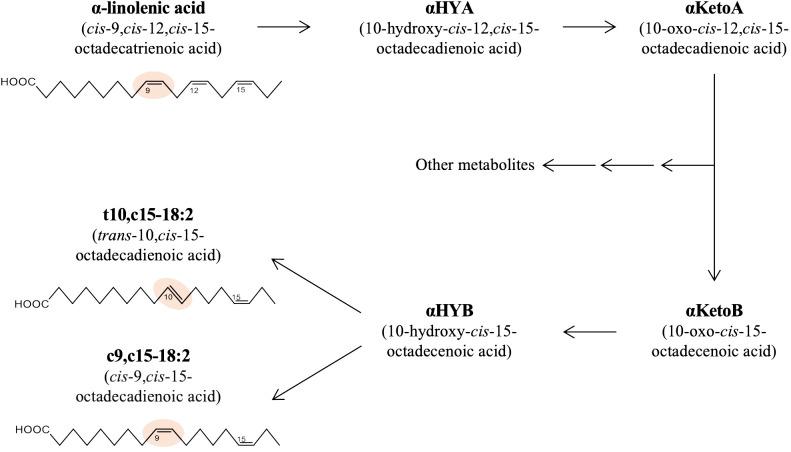
Intestinal bacteria metabolize dietary substances to produce bioactive postbiotics, among which some are recognized for their role in promoting host health. We here explored the postbiotic potential of two omega-3 α-linolenic acid-derived metabolites: -10--15-octadecadienoic acid (t10,c15-18:2) and -9--15-octadecadienoic acid (c9,c15-18:2). Dietary intake of lipids rich in omega-3 α-linolenic acid elevated levels of t10,c15-18:2 and c9,c15-18:2 in the serum and feces of mice, an effect dependent on the presence of intestinal bacteria. Notably, t10,c15-18:2 mitigated skin inflammation in mice that became hypersensitive after exposure to 2,4-dinitrofluorobenzene, an experimental model for allergic contact dermatitis. In particular, t10,c15-18:2-but not c9,c15-18:2-attenuated ear swelling and edema, characteristic symptoms of contact hypersensitivity. The anti-inflammatory effects of t10,c15-18:2 were due to its ability to suppress the release of vascular endothelial growth factor A from keratinocytes, thereby mitigating the enhanced vascular permeability induced by hapten stimulation. Our study identified retinoid X receptor as a functional receptor that mediates the downregulation of skin inflammation upon treatment with t10,c15-18:2. Our results suggest that t10,c15-18:2 holds promise as an omega-3 fatty acid-derived postbiotic with potential therapeutic implications for alleviating the skin edema seen in allergic contact dermatitis-induced inflammation.
肠道细菌将膳食物质代谢为具有生物活性的后生元,其中一些后生元已被证实具有促进宿主健康的作用。在这里,我们探索了两种来源于 ω-3α-亚麻酸的后生元的潜力:-10--15-十八碳二烯酸(t10,c15-18:2)和-9--15-十八碳二烯酸(c9,c15-18:2)。富含 ω-3α-亚麻酸的饮食可增加血清和粪便中 t10,c15-18:2 和 c9,c15-18:2 的水平,这种作用依赖于肠道细菌的存在。值得注意的是,t10,c15-18:2 可减轻对 2,4-二硝基氟苯(一种过敏性接触性皮炎的实验模型)敏感的小鼠的皮肤炎症。特别是,t10,c15-18:2 可减轻耳朵肿胀和水肿,而 c9,c15-18:2 则没有,这些是接触过敏的特征症状。t10,c15-18:2 的抗炎作用归因于其抑制角质形成细胞血管内皮生长因子 A 释放的能力,从而减轻半抗原刺激引起的增强的血管通透性。我们的研究确定视黄醇 X 受体是一种功能性受体,介导 t10,c15-18:2 治疗后皮肤炎症的下调。我们的结果表明,t10,c15-18:2 作为一种具有治疗潜力的 ω-3 脂肪酸衍生后生元,有望缓解过敏性接触性皮炎引起的炎症中的皮肤水肿。



 Zotero 插件