Gordon Center for Medical Imaging, Department of Radiology, Massachusetts General Hospital, Harvard Medical School, Boston, MA, USA.
Athinoula A. Martinos Center for Biomedical Imaging, Department of Radiology, Massachusetts General Hospital, Harvard Medical School, Charlestown, MA, USA.
Nat Commun. 2024 Jun 6;15(1):4809. doi: 10.1038/s41467-024-48462-3.
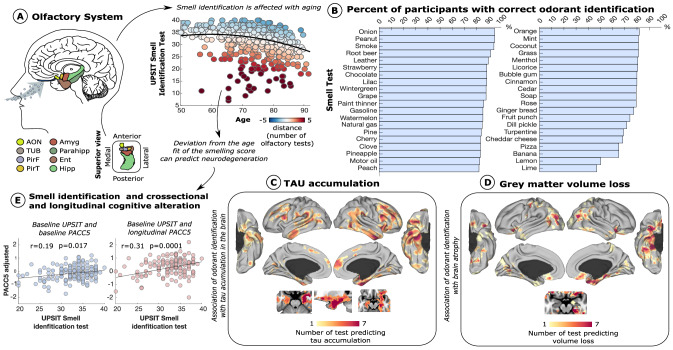
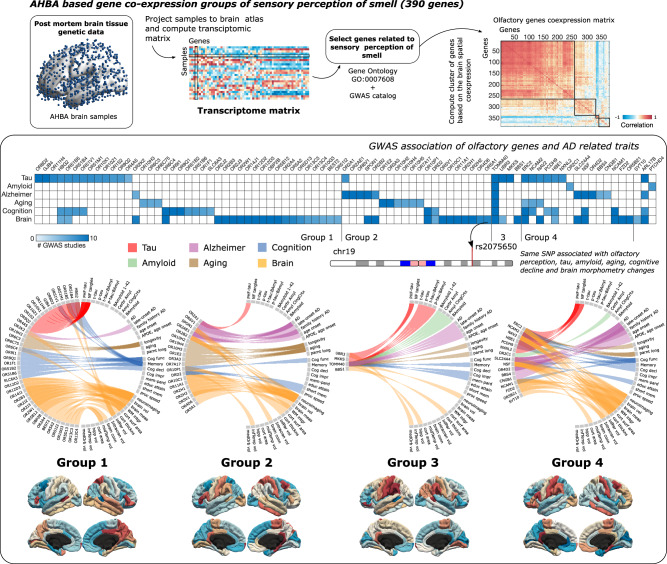
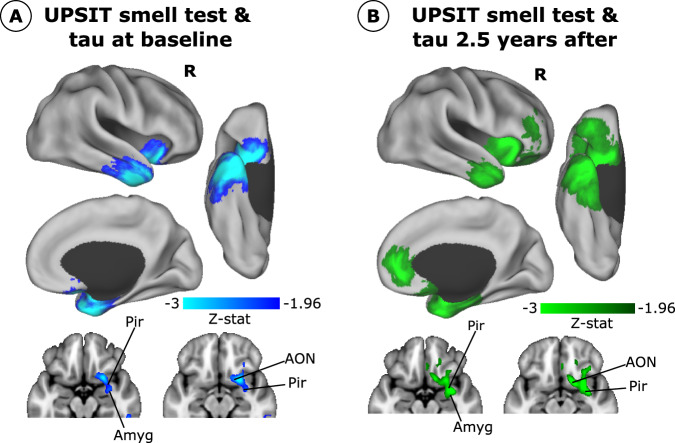
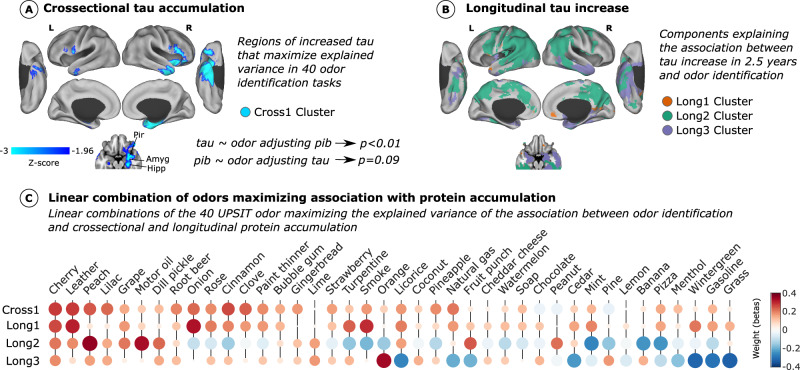
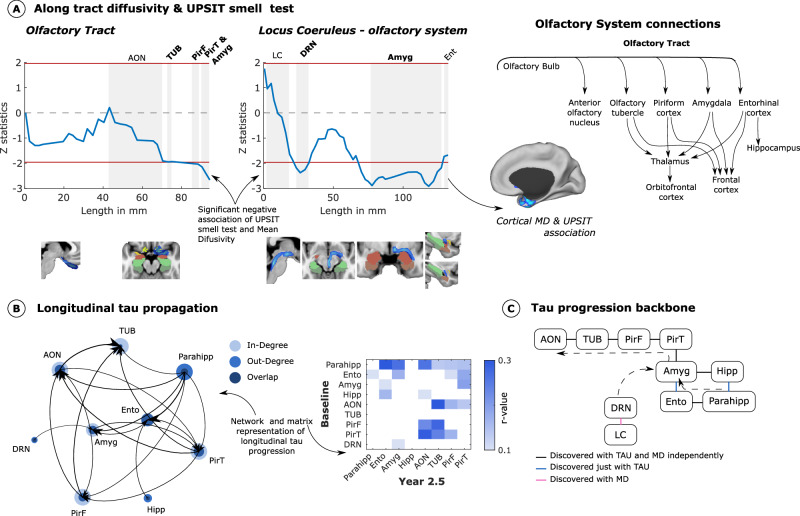
The direct access of olfactory afferents to memory-related cortical systems has inspired theories about the role of the olfactory pathways in the development of cortical neurodegeneration in Alzheimer's disease (AD). In this study, we used baseline olfactory identification measures with longitudinal flortaucipir and PiB PET, diffusion MRI of 89 cognitively normal older adults (73.82 ± 8.44 years; 56% females), and a transcriptomic data atlas to investigate the spatiotemporal spreading and genetic vulnerabilities of AD-related pathology aggregates in the olfactory system. We find that odor identification deficits are predominantly associated with tau accumulation in key areas of the olfactory pathway, with a particularly strong predictive power for longitudinal tau progression. We observe that tau spreads from the medial temporal lobe structures toward the olfactory system, not the reverse. Moreover, we observed a genetic background of odor perception-related genes that might confer vulnerability to tau accumulation along the olfactory system.
嗅觉传入纤维直接进入与记忆相关的皮质系统,这激发了关于嗅觉通路在阿尔茨海默病(AD)皮质神经退行性变发展中的作用的理论。在这项研究中,我们使用基线嗅觉识别测量值、纵向 flortaucipir 和 PiB PET、89 名认知正常的老年人的弥散 MRI(73.82±8.44 岁;56%为女性)以及转录组数据图谱,来研究 AD 相关病理聚集物在嗅觉系统中的时空扩散和遗传易损性。我们发现,嗅觉识别缺陷主要与嗅觉通路关键区域的 tau 积累有关,对纵向 tau 进展具有特别强的预测能力。我们观察到 tau 从内侧颞叶结构向嗅觉系统扩散,而不是相反。此外,我们观察到与嗅觉感知相关的基因的遗传背景,这些基因可能使 tau 沿嗅觉系统积累变得脆弱。