Sun Xiaojie, Shi Rongxing, Shen Yifeng, Qiu Zuyun, Jia Yan, Zhou Qiaoyin, Shi Chong, Li Yunnan, Zhang Weiguang, Li Shiliang, Chen Zhaojun
Beijing University of Chinese Medicine Third Affiliated Hospital, Beijing, China.
Department of Hand and Foot Surgery, Beijing University of Chinese Medicine Third Affiliated Hospital, Beijing, China.
Quant Imaging Med Surg. 2024 Jun 1;14(6):3875-3886. doi: 10.21037/qims-24-81. Epub 2024 May 15.
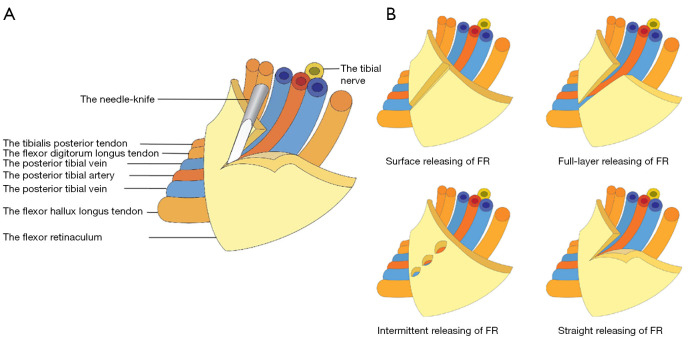
Tarsal tunnel syndrome (TTS) is a condition in which the tibial nerve (TN) (or its terminal branches) is compressed by the flexor retinaculum (FR) and the deep fascia of the abductor hallucis muscle at the tarsal tunnel, causing symptoms that negatively impact the patient's quality of life, including numbness, a sensation of a foreign object, coldness, and pain. FR release via microtrauma using needle-knife has proven to be effective in China and is widely used by clinicians. The traditional acupotomy, however, is the "blind knife" treatment, which cannot guarantee patient safety due to risk of injury to important structures, particularly the neurovascular bundle. Compared with the conventional treatments, ultrasound-guided percutaneous FR release possesses noteworthy advantages including high efficacy and safety.
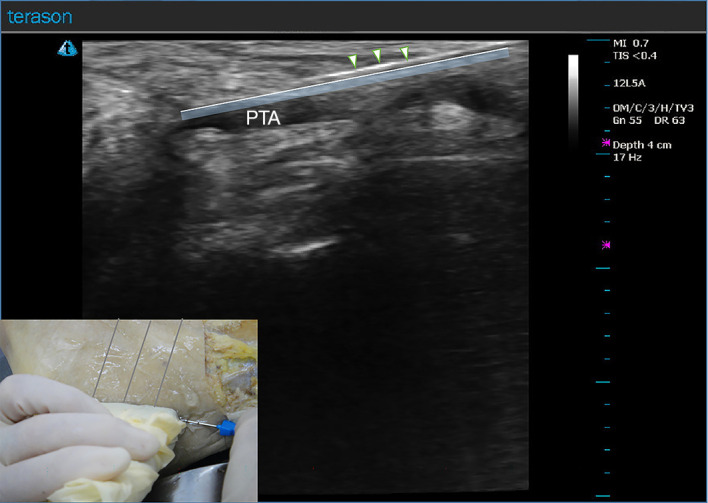
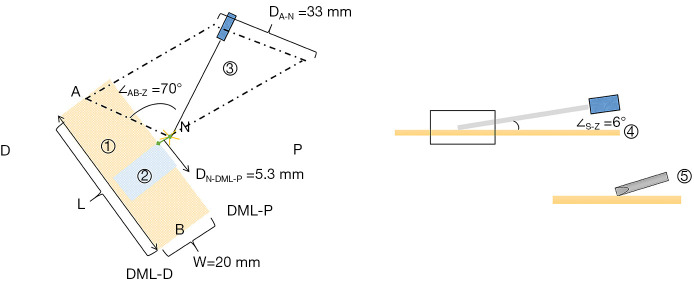
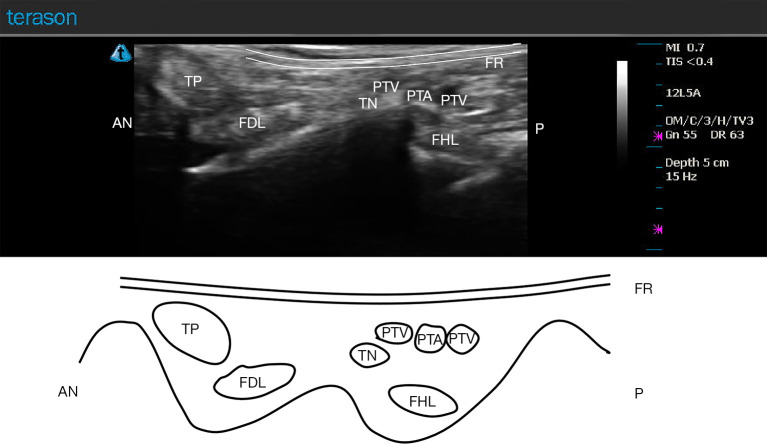
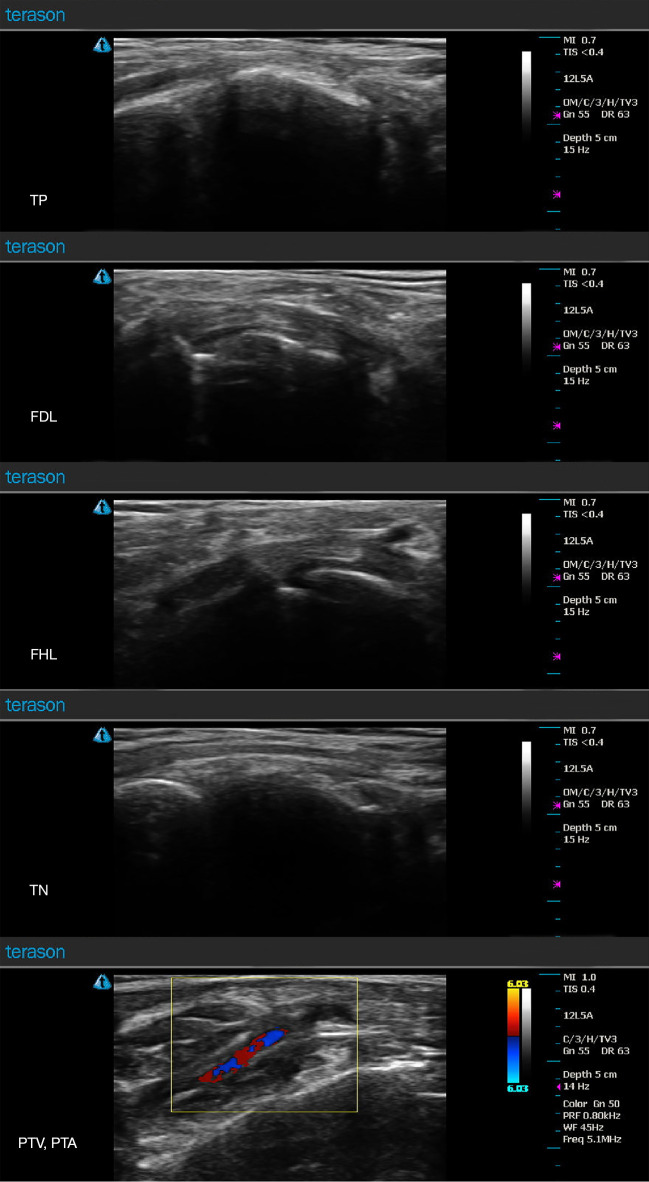
Percutaneous release of the FR was performed on 51 formalin-fixed specimens. The specimens were divided into two groups: an ultrasound-guided acupotomy pushing group comprising 20 legs (group U) and a nonultrasound-guided acupotomy pushing group comprising 31 legs (group N). After high-frequency ultrasound exploration, those with clear vascular imaging were included in group U; otherwise, they were included in group N. The FR was released percutaneously, soft tissue was dissected layer by layer, and anatomical data were recorded.
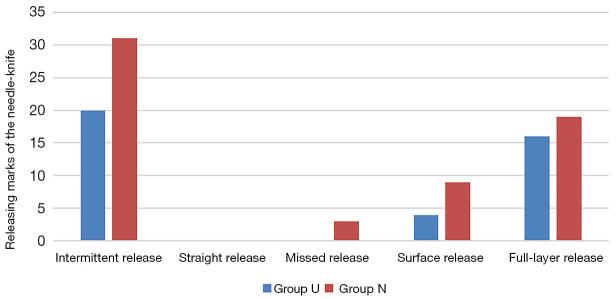
There no cases of injury in group U (0%) and four in group N (12.9%). Among the different intervention methods, there were no significant differences in tissue injury types (χ=2.80; P=0.09). The percentage of released FR in group U was 80.00% while that in group N was 61.29% (χ=1.977; P=0.16), which did not represent a significant difference between the two groups. However, group U had a significantly greater release length than that in the group N (=3.359; P=0.002), indicating that the flexor release length guided by ultrasound is significantly greater than the unguided one.
Ultrasound-guided percutaneous release of the FR using a needle-knife can provide greater length and percentage of released FR while maintaining a comparable safety rate to the unguided procedure.
跗管综合征(TTS)是一种胫神经(TN)(或其终末分支)在跗管处被屈肌支持带(FR)和拇展肌深筋膜压迫的病症,会引发对患者生活质量产生负面影响的症状,包括麻木、异物感、发冷和疼痛。在中国,使用针刀通过微创伤进行FR松解已被证明是有效的,并且被临床医生广泛应用。然而,传统针刀是“盲刀”治疗,由于存在损伤重要结构(特别是神经血管束)的风险,无法保证患者安全。与传统治疗方法相比,超声引导下经皮FR松解具有显著优势,包括高效性和安全性。
对51个经福尔马林固定的标本进行FR的经皮松解。标本分为两组:超声引导针刀推进组,包含20条腿(U组);非超声引导针刀推进组,包含31条腿(N组)。经过高频超声探查后,血管成像清晰的纳入U组;否则纳入N组。经皮松解FR,逐层解剖软组织,并记录解剖数据。
U组无损伤病例(0%),N组有4例(12.9%)。在不同干预方法中,组织损伤类型无显著差异(χ=2.80;P=0.09)。U组FR松解百分比为80.00%,N组为61.29%(χ=1.977;P=0.16),两组间无显著差异。然而,U组的松解长度显著大于N组(=3.359;P=0.002),表明超声引导下的屈肌松解长度显著大于非引导下的长度。
超声引导下使用针刀经皮松解FR,在保持与非引导手术相当的安全率的同时,可提供更大的FR松解长度和百分比。