The First Clinical Medical College, Jinan University, Guangzhou, China.
Department of Cardiology, The First Affiliated Hospital of Jinan University, Guangzhou, China.
Front Public Health. 2024 May 23;12:1378444. doi: 10.3389/fpubh.2024.1378444. eCollection 2024.
An increasing body of research has demonstrated a correlation between pollutants from the environment and the development of cardiovascular diseases (CVD). However, the impact of volatile organic chemicals (VOC) on CVD remains unknown and needs further investigation.
This study assessed whether exposure to VOC was associated with CVD in the general population.
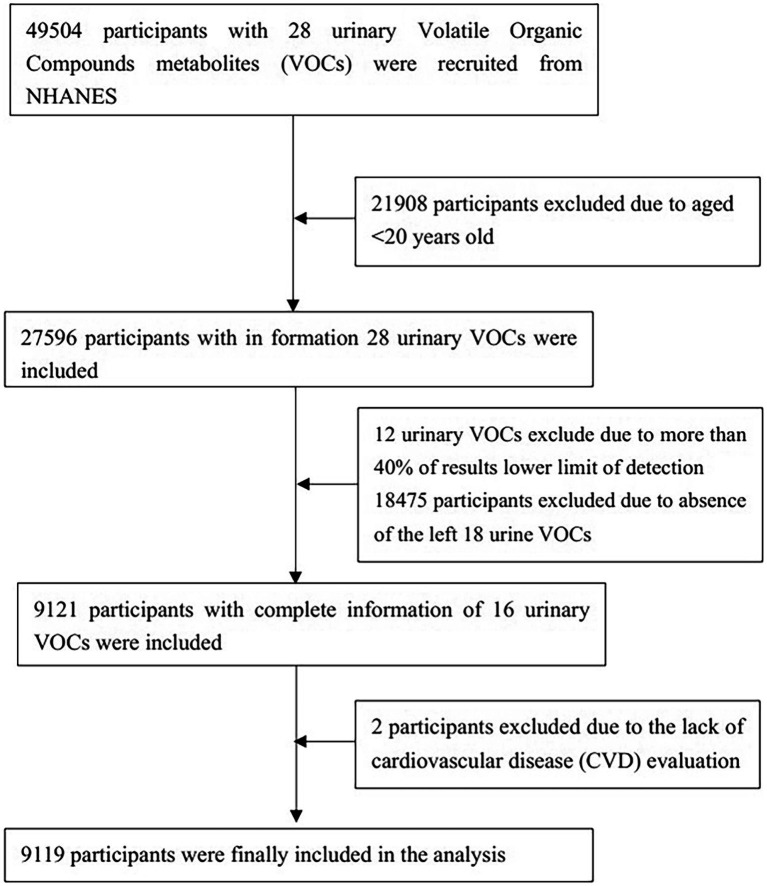
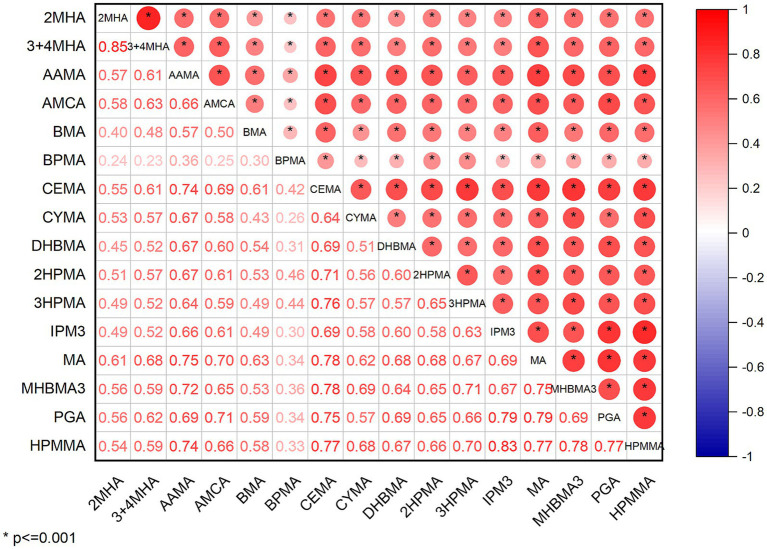
A cross-sectional analysis was conducted utilizing data from five survey cycles (2005-2006, 2011-2012, 2013-2014, 2015-2016, and 2017-2018) of the National Health and Nutrition Examination Survey (NHANES) program. We analyzed the association between urinary VOC metabolites (VOCs) and participants by multiple logistic regression models, further Bayesian Kernel Machine Regression (BKMR) models and Weighted Quantile Sum (WQS) regression were performed for mixture exposure analysis.
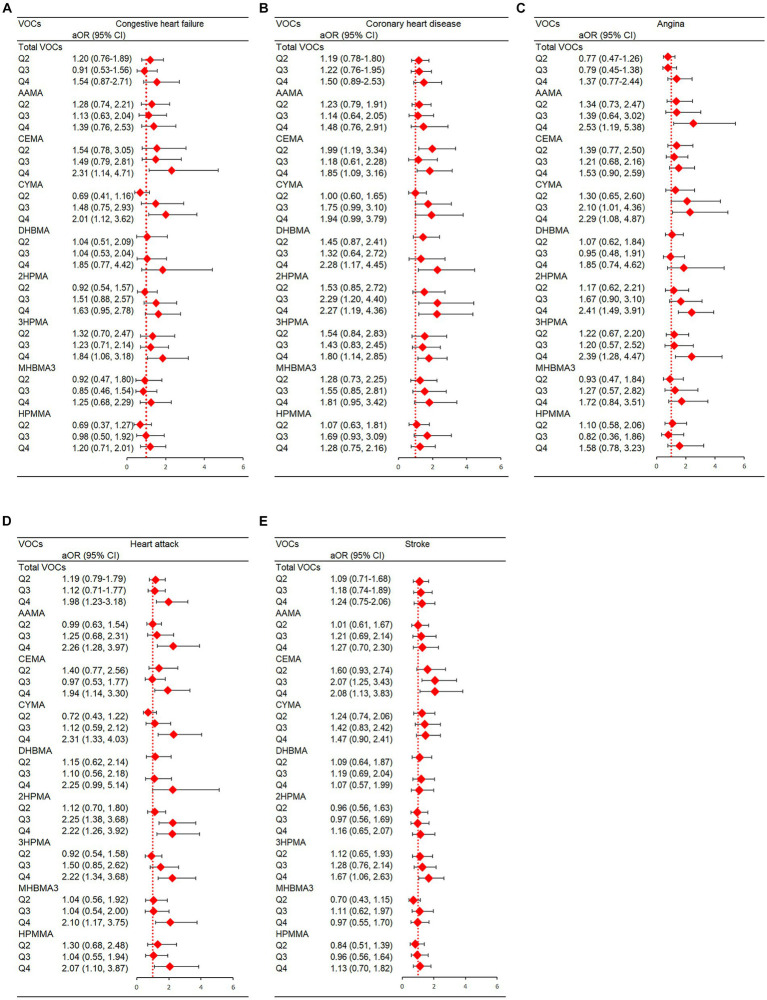
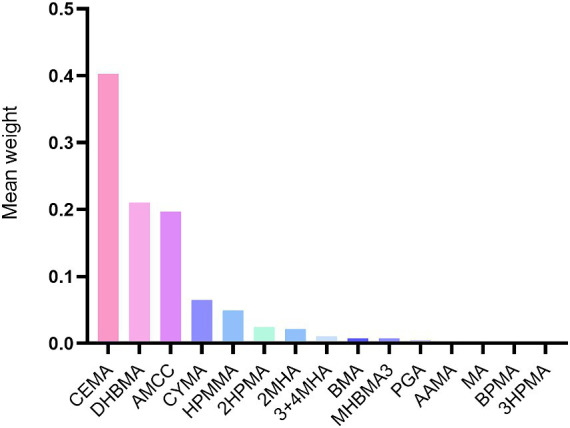
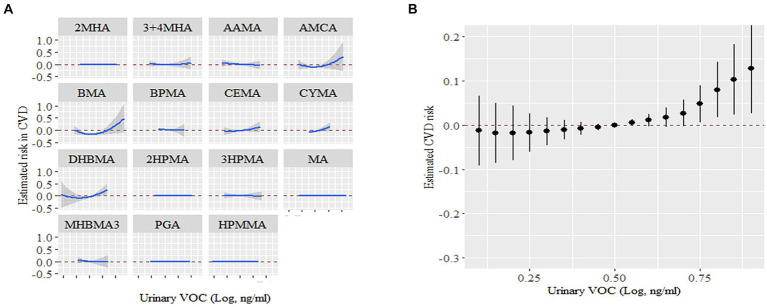
Total VOCs were found to be positively linked with CVD in multivariable-adjusted models (p for trend = 0.025), independent of established CVD risk variables, such as hypertension, diabetes, drinking and smoking, and total cholesterol levels. Compared with the reference quartile of total VOCs levels, the multivariable-adjusted odds ratios in increasing quartiles were 1.01 [95% confidence interval (CI): 0.78-1.31], 1.26 (95% CI: 1.05-1.21) and 1.75 (95% CI: 1.36-1.64) for total CVD. Similar positive associations were found when considering individual VOCs, including AAMA, CEMA, CYMA, 2HPMA, 3HPMA, IPM3 and MHBMA3 (acrolein, acrylamide, acrylonitrile, propylene oxide, isoprene, and 1,3-butadiene). In BKMR analysis, the overall effect of a mixture is significantly related to VOCs when all chemicals reach or exceed the 75th percentile. Moreover, in the WQS models, the most influential VOCs were found to be CEMA (40.30%), DHBMA (21.00%), and AMCC (19.70%).
The results of our study indicated that VOC was all found to have a significant association with CVD when comparing results from different models. These findings hold significant potential for public health implications and offer valuable insights for future research directions.
越来越多的研究表明,环境污染物与心血管疾病(CVD)的发展之间存在关联。然而,挥发性有机化合物(VOC)对 CVD 的影响尚不清楚,需要进一步研究。
本研究评估了接触 VOC 是否与普通人群中的 CVD 相关。
利用国家健康和营养检查调查(NHANES)计划五个调查周期(2005-2006 年、2011-2012 年、2013-2014 年、2015-2016 年和 2017-2018 年)的数据进行了横断面分析。我们通过多变量逻辑回归模型分析了尿液 VOC 代谢物(VOC)与参与者之间的关联,进一步使用贝叶斯核机回归(BKMR)模型和加权分位数总和(WQS)回归进行了混合暴露分析。
在多变量调整模型中,总 VOC 与 CVD 呈正相关(趋势 P 值=0.025),与高血压、糖尿病、饮酒和吸烟以及总胆固醇水平等已确立的 CVD 风险变量无关。与总 VOC 水平参考四分位数相比,四分位数增加的多变量调整比值比分别为 1.01[95%置信区间(CI):0.78-1.31]、1.26(95%CI:1.05-1.21)和 1.75(95%CI:1.36-1.64),用于总 CVD。当考虑单个 VOC 时,也发现了类似的正相关,包括 AAMA、CEMA、CYMA、2HPMA、3HPMA、IPM3 和 MHBMA3(丙烯醛、丙烯酰胺、丙烯腈、环氧丙烷、异戊二烯和 1,3-丁二烯)。在 BKMR 分析中,当所有化学物质达到或超过第 75 百分位数时,混合物的总体效应与 VOC 显著相关。此外,在 WQS 模型中,发现最具影响力的 VOC 是 CEMA(40.30%)、DHBMA(21.00%)和 AMCC(19.70%)。
本研究结果表明,在比较不同模型的结果时,VOC 与 CVD 之间存在显著关联。这些发现对公共卫生具有重要意义,并为未来的研究方向提供了有价值的见解。