Department of Obstetrics and Gynaecology, The First Affiliated Hospital of Sun Yat-sen University, Guangzhou, 510080, China.
Guangdong Provincial Clinical Research Center for Obstetrical and Gynaecological Diseases, Guangzhou, China.
Lipids Health Dis. 2024 Jun 7;23(1):170. doi: 10.1186/s12944-024-02168-z.
Gestational diabetes mellitus (GDM) prevalence is on the rise globally. Offspring of diabetic mothers face increased risk of neonatal hypoglycaemia (NH), and women with GDM have abnormal lipid profiles. However, there is no consensus on the link between maternal blood lipids and NH in infants from mothers with GDM. This study aimed to explore how maternal blood lipids affect NH.
A retrospective cohort study was conducted at the First Affiliated Hospital of Sun Yat-sen University. Information on participants' baseline characteristics and maternal metabolic profiles of glucose and lipids was collected. Significant variables from the univariate analysis were included in logistic regression, which was used to construct the predictive model for NH. A nomogram was constructed for visualizing the model and assessed using the area under the receiver operating characteristic (ROC) curve (AUC).
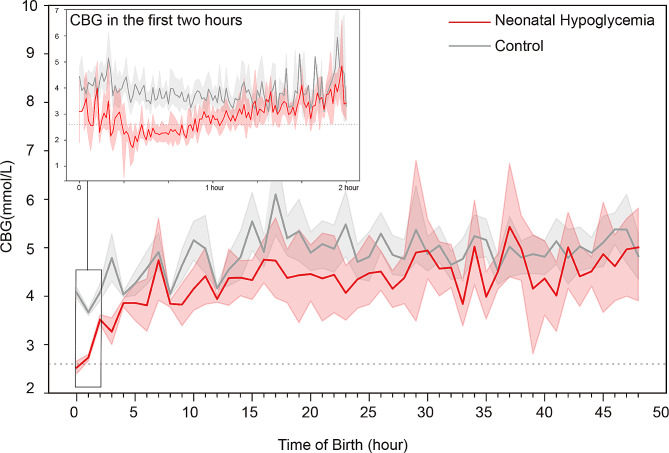
Neonatal capillary blood glucose (CBG) decreased rapidly in the first hour after birth, increased gradually from the first to the second hour, and then remained stable. In the NH group, 86.11% (502/583) of hypoglycaemia cases occurred within the first two hours after birth. Multivariate logistic regression suggested that the lipid indices of maternal apoprotein B/apoprotein A1 (Apo-B/Apo-A1) (odds ratio (OR) = 1.36, 95% confidence intervals (CIs): 1.049-1.764, P = 0.02) and apoprotein E (Apo-E) (OR = 1.014, 95% CIs: 1.004-1.024, P = 0.004) were positively associated with NH in neonates from mothers with GDM. Triglycerides (TGs) (OR = 0.883, 95% CIs: 0.788-0.986, P = 0.028) were inversely associated with NH. Maternal glycated haemoglobin (HbA1c), age, twin pregnancy and caesarean delivery also had predictive value of NH. The AUC of the nomogram derived from these factors for the prediction model of NH was 0.657 (95% CIs: 0.630-0.684).
The present study revealed that the Apo-B/Apo-A1 and Apo-E levels were associated with an increased risk of NH. A nomogram was developed to forecast the risk of NH in babies born to mothers with GDM, incorporating maternal blood lipids, HbA1c, age, twin pregnancy, and caesarean section. The trajectory of glycaemia for neonates indicates the need for intensive CBG monitoring within 2 h of birth for neonates from mothers with GDM.
全球范围内,妊娠糖尿病(GDM)的患病率呈上升趋势。糖尿病母亲的后代发生新生儿低血糖(NH)的风险增加,且 GDM 患者的血脂谱异常。然而,关于 GDM 母亲的血脂与新生儿 NH 之间的联系尚无共识。本研究旨在探讨母体血脂如何影响 NH。
中山大学附属第一医院进行了一项回顾性队列研究。收集了参与者的基线特征和母体血糖和血脂代谢谱的信息。对单因素分析中具有显著意义的变量进行逻辑回归分析,构建用于预测 NH 的模型。使用接受者操作特征(ROC)曲线下面积(AUC)来构建并评估列线图。
新生儿毛细血管血糖(CBG)在出生后 1 小时内迅速下降,第 1 小时至第 2 小时逐渐升高,然后保持稳定。在 NH 组中,86.11%(502/583)例低血糖发生在出生后 2 小时内。多因素 logistic 回归提示,GDM 母亲的载脂蛋白 B/载脂蛋白 A1(Apo-B/Apo-A1)(比值比(OR)=1.36,95%置信区间(CI):1.049-1.764,P=0.02)和载脂蛋白 E(Apo-E)(OR=1.014,95%CI:1.004-1.024,P=0.004)与新生儿 NH 呈正相关。甘油三酯(TGs)(OR=0.883,95%CI:0.788-0.986,P=0.028)与 NH 呈负相关。母体糖化血红蛋白(HbA1c)、年龄、双胎妊娠和剖宫产分娩对 NH 也具有预测价值。基于这些因素的列线图预测模型对 NH 的 AUC 为 0.657(95%CI:0.630-0.684)。
本研究揭示了 Apo-B/Apo-A1 和 Apo-E 水平与 NH 风险增加相关。建立了一个列线图,用于预测 GDM 母亲所生孩子的 NH 风险,该模型结合了母体血脂、HbA1c、年龄、双胎妊娠和剖宫产。新生儿血糖变化轨迹表明,需要对 GDM 母亲所生孩子在出生后 2 小时内进行密集的 CBG 监测。