Leuthner Tess C, Zhang Sharon, Kohrn Brendan F, Stapleton Heather M, Baugh L Ryan
Department of Biology, Duke University, Durham, North Carolina, USA.
Nicholas School of the Environment, Duke University, Durham, North Carolina, USA.
bioRxiv. 2024 Jun 2:2024.05.29.596269. doi: 10.1101/2024.05.29.596269.
There are >14,500 structurally diverse per- and polyfluoroalkyl substances (PFAS). Despite knowledge that these "forever chemicals" are in 99% of humans, mechanisms of toxicity and adverse health effects are incompletely known. Furthermore, the contribution of genetic variation to PFAS susceptibility and health consequences is unknown.
We determined the toxicity of a structurally distinct set of PFAS in twelve genetically diverse strains of the genetic model system .
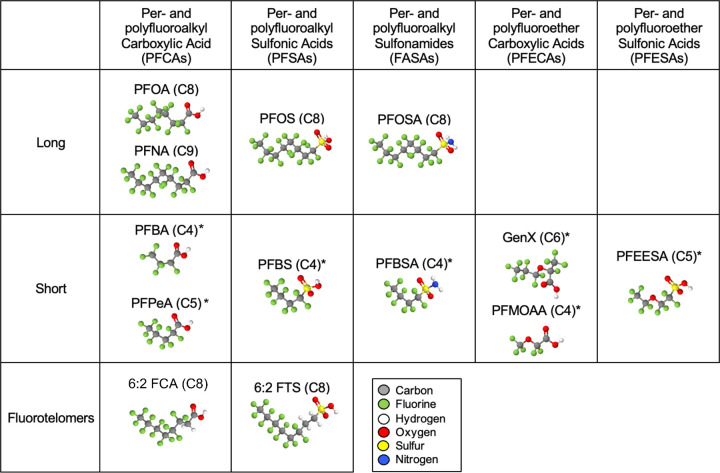
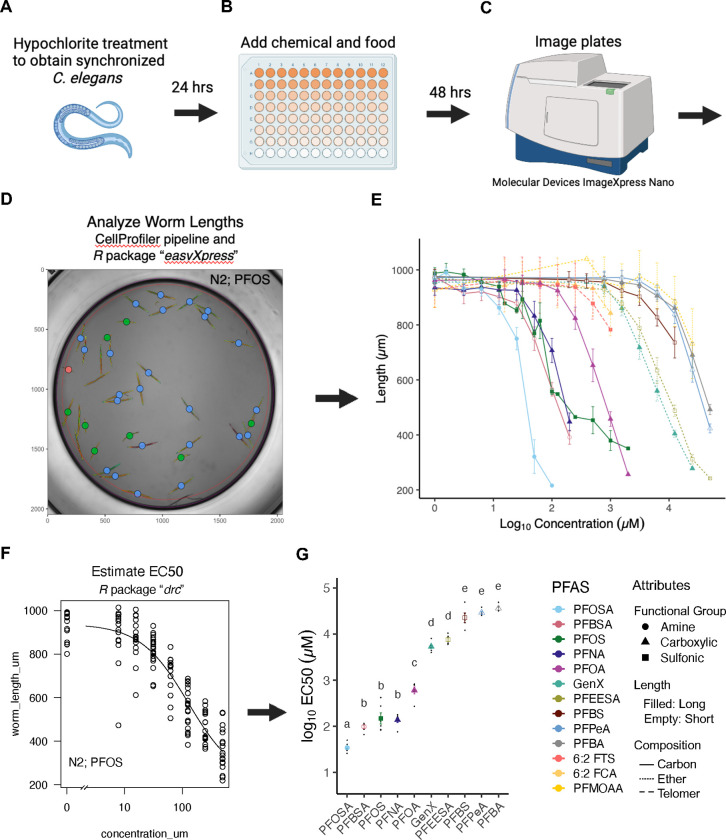
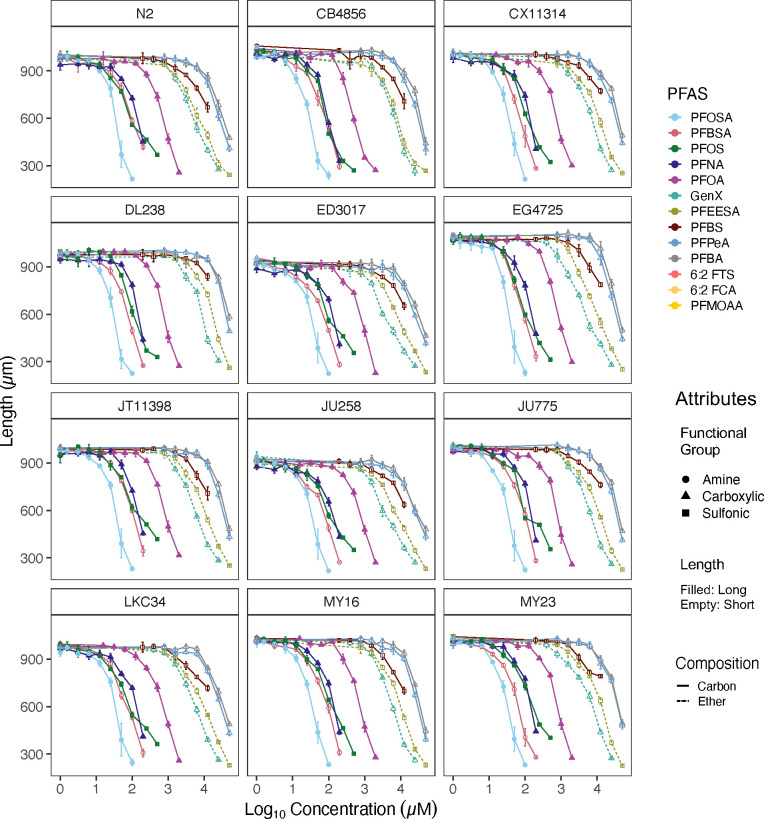
Dose-response curves for four perfluoroalkyl carboxylic acids (PFNA, PFOA, PFPeA, and PFBA), two perfluoroalkyl sulfonic acids (PFOS and PFBS), two perfluoroalkyl sulfonamides (PFOSA and PFBSA), two fluoroether carboxylic acids (GenX and PFMOAA), one fluoroether sulfonic acid (PFEESA), and two fluorotelomers (6:2 FCA and 6:2 FTS) were determined in the laboratory reference strain, N2, and eleven genetically diverse wild strains. Body length was quantified by image analysis at each dose after 48 hr of developmental exposure of L1 arrest-synchronized larvae to estimate effective concentration values (EC50).
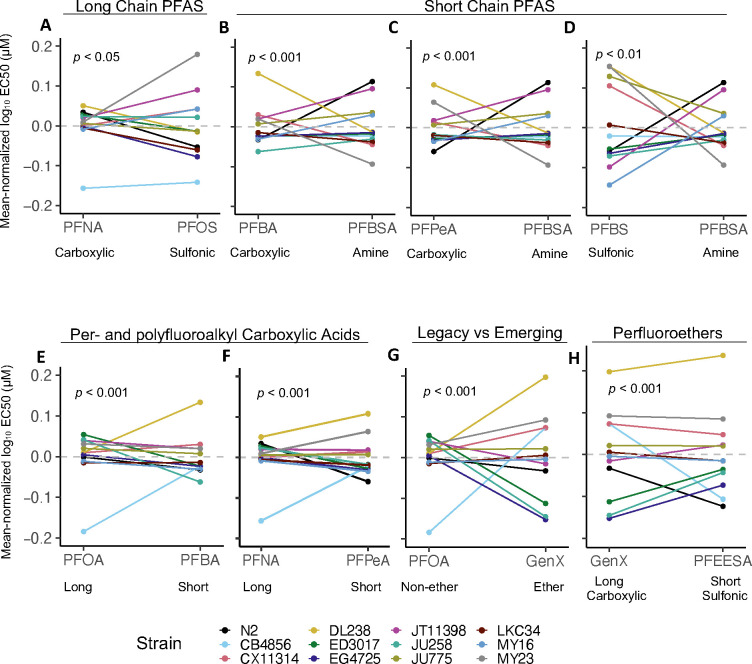
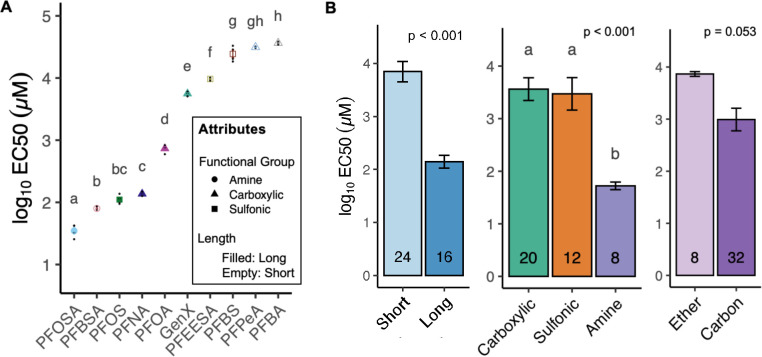
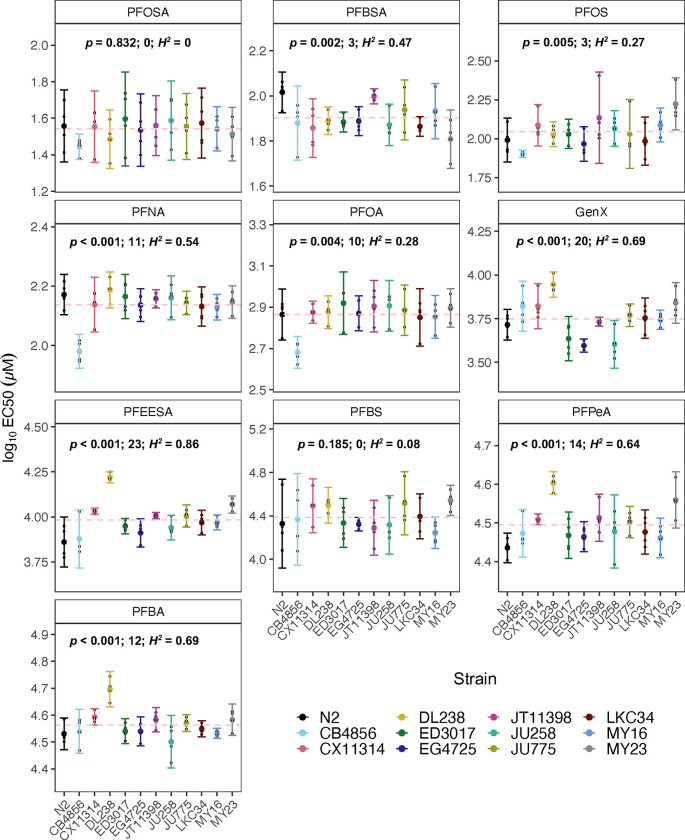
There was a significant range in toxicity among PFAS: PFOSA > PFBSA ≈ PFOS ≈ PFNA > PFOA > GenX ≈ PFEESA > PFBS ≈ PFPeA ≈ PFBA. Long-chain PFAS had greater toxicity than short-chain, and fluorosulfonamides were more toxic than carboxylic and sulfonic acids. Genetic variation explained variation in susceptibility to PFBSA, PFOS, PFBA, PFOA, GenX, PFEESA, PFPeA, and PFBA. There was significant variation in toxicity among strains due to chain length, functional group, and between legacy and emerging PFAS.
respond to legacy and emerging PFAS of diverse structures, and this depends on specific structures and genetic variation. Harnessing the natural genetic diversity of and the structural complexity of PFAS is a powerful New Approach Methodology (NAM) to investigate structure-activity relationships and mechanisms of toxicity which may inform regulation of other PFAS to improve human and environmental health.
全氟和多氟烷基物质(PFAS)在结构上有超过14500种不同类型。尽管已知这些“永久性化学物质”存在于99%的人体内,但其毒性机制和对健康的不良影响仍不完全清楚。此外,基因变异对PFAS易感性和健康后果的影响尚不清楚。
我们在基因模型系统的12种基因不同的品系中确定了一组结构不同的PFAS的毒性。
在实验室参考品系N2和11种基因不同的野生品系中,测定了四种全氟烷基羧酸(全氟壬酸、全氟辛酸、全氟戊酸和全氟丁酸)、两种全氟烷基磺酸(全氟辛烷磺酸和全氟丁烷磺酸)、两种全氟烷基磺酰胺(全氟辛烷磺酰胺和全氟丁烷磺酰胺)、两种氟醚羧酸(GenX和全氟甲氧基丙烯酸)、一种氟醚磺酸(全氟乙氧基乙基磺酸)以及两种氟调聚物(6:2氟代柠檬酸和6:2氟代磺酸)的剂量反应曲线。在L1期停滞同步化幼虫发育暴露48小时后,通过图像分析对每个剂量下的体长进行量化,以估计有效浓度值(EC50)。
PFAS之间的毒性存在显著差异:全氟辛烷磺酰胺>全氟丁烷磺酰胺≈全氟辛烷磺酸≈全氟壬酸>全氟辛酸>GenX≈全氟乙氧基乙基磺酸>全氟丁烷磺酸≈全氟戊酸≈全氟丁酸。长链PFAS的毒性大于短链,氟磺酰胺的毒性大于羧酸和磺酸。基因变异解释了对全氟丁烷磺酰胺、全氟辛烷磺酸、全氟丁酸、全氟辛酸、GenX、全氟乙氧基乙基磺酸、全氟戊酸和全氟丁酸易感性的差异。由于链长、官能团以及传统PFAS和新型PFAS之间的差异,品系间的毒性存在显著差异。
对不同结构的传统PFAS和新型PFAS有不同反应,这取决于特定结构和基因变异。利用该模型系统的自然遗传多样性和PFAS的结构复杂性是一种强大的新方法学(NAM),可用于研究结构-活性关系和毒性机制,这可能为其他PFAS的监管提供参考,以改善人类和环境健康。