The Third School of Clinical Medicine (School of Rehabilitation Medicine), Zhejiang Chinese Medical University, Hangzhou, People's Republic of China.
Department of Medical Ultrasound, Shanghai Tenth People's Hospital, Shanghai, People's Republic of China.
Clin Interv Aging. 2024 Jun 4;19:1005-1015. doi: 10.2147/CIA.S454068. eCollection 2024.
The risk of falls among the elderly significantly increases, which has become a serious public health concern. Falls can not only lead to serious complications such as fractures and brain injuries but also limit their mobility function, reducing quality of life. Foot intrinsic muscles (FIMs) are an essential part of foot core stability even overall postural stability. This study aimed to investigate the effects of aging on the function of FIMs and to explore the influence of FIMs on postural control in the elderly.
56 healthy old participants (60-75 years) and 57 healthy young participants (18-29 years) joined this study. An ergoFet dynamometer was used to determine foot muscle strength (Doming, T, T and T), and ankle muscle strength (plantarflexion and dorsiflexion). The morphology of FIMs and extrinsic foot muscle was determined using a Doppler ultrasound system, whereas the postural stability was assessed through Limits of Stability test. Independent samples -test was used to determine the differences in strength and morphological parameters and Spearman correlation analysis was used to determine whether an association existed between muscle strength and postural stability parameters in the elderly.
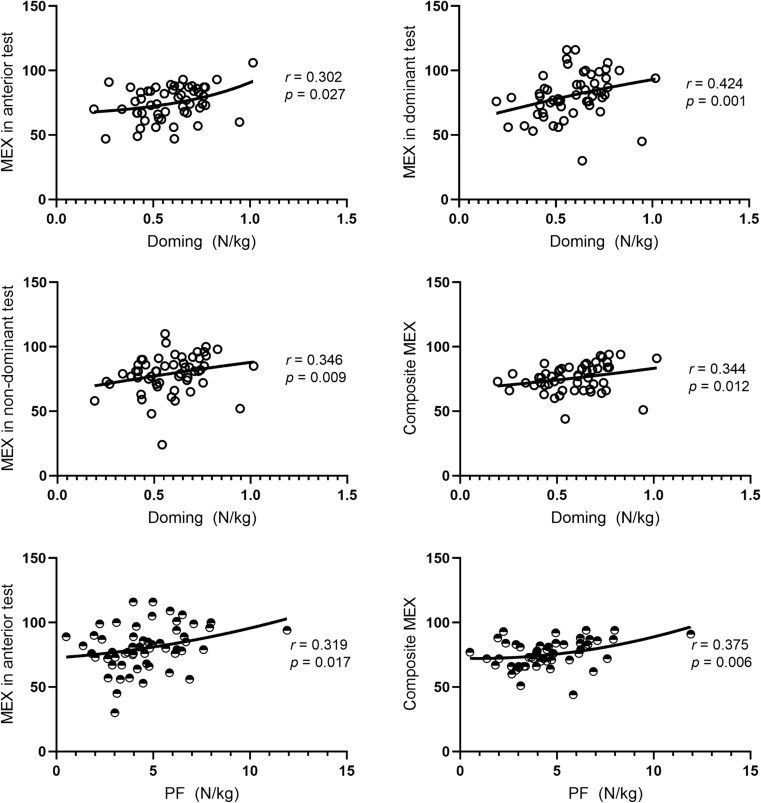
Compared with young adults, foot muscle strength and ankle muscle strength (Doming, T, T, T, dorsiflexion, and plantarflexion, all p <0.05) and the morphology of foot muscles (all p <0.05) were significantly reduced in the elderly. The strength of FIMs and the limit of stability (r = 0.302-0.424, all p <0.05) were significantly correlated in the elderly.
Compared with young adults, the weakness of strength as well as the morphological decline of the intrinsic and extrinsic foot muscles were found in the elderly. In addition, a correlation was observed between FIM's strength and postural stability in the elderly, suggesting their potential role in posture stability.
老年人跌倒的风险显著增加,这已成为一个严重的公共卫生问题。跌倒不仅会导致骨折和脑损伤等严重并发症,还会限制他们的活动功能,降低生活质量。足部内在肌(FIMs)是足部核心稳定性甚至整体姿势稳定性的重要组成部分。本研究旨在探讨衰老对 FIMs 功能的影响,并探讨 FIMs 对老年人姿势控制的影响。
本研究纳入了 56 名健康的老年人(60-75 岁)和 57 名健康的年轻人(18-29 岁)。使用 ergoFet 动态测力仪测定足部肌肉力量(Doming、T、T 和 T)和踝关节肌肉力量(跖屈和背屈)。使用多普勒超声系统测定 FIMs 和外在足部肌肉的形态,使用稳定性极限测试评估姿势稳定性。采用独立样本 t 检验比较老年人和年轻人之间的力量和形态参数差异,采用 Spearman 相关分析老年人肌肉力量与姿势稳定性参数之间是否存在相关性。
与年轻人相比,老年人的足部肌肉力量和踝关节肌肉力量(Doming、T、T、T、背屈和跖屈,均 p<0.05)以及足部肌肉形态(均 p<0.05)均显著降低。老年人的 FIMs 力量与稳定性极限(r=0.302-0.424,均 p<0.05)显著相关。
与年轻人相比,老年人的力量减弱以及内在和外在足部肌肉的形态下降。此外,老年人的 FIMs 力量与姿势稳定性之间存在相关性,提示其在姿势稳定性中的潜在作用。