Jakovljevic Mihajlo, Timofeyev Yuriy, Zhuravleva Tatyana
UNESCO-TWAS, The World Academy of Sciences, Trieste, Italy.
Shaanxi University of Technology, Hanzhong, People's Republic of China.
Risk Manag Healthc Policy. 2024 Jun 4;17:1477-1491. doi: 10.2147/RMHP.S465167. eCollection 2024.
This study aims to identify medical care transformations during the COVID-19 pandemic and to assess the economic efficiency of these care transformations.
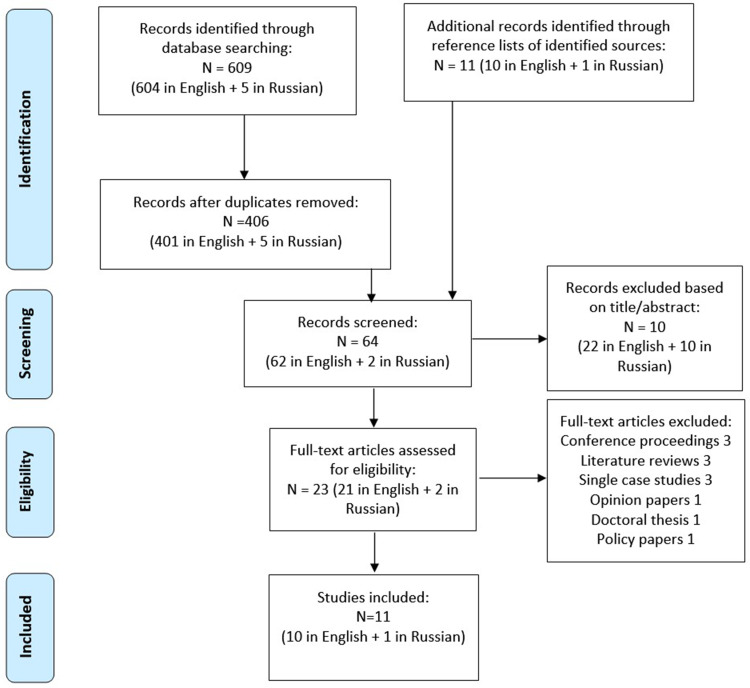
A systematic review was conducted in accordance with the Preferred Reporting Items for Systematic Reviewing and Meta-Analysis (PRISMA) guidelines. The databases used in the search protocol included PubMed, RSCI, and Google Scholar.
Ten eligible studies in English and one publication in Russian were identified. In general, the following changes in organization of health care processes since 2020 are observed: hospital at home, telemedicine (physician-to-patient), and the adoption of new information communication technologies within physician-to-physician and physician-to-nurse communication. Earlier trends, such as (a) wider use of electronic devices, (b) adoption of Lean techniques, (c) the incorporation of patient and other customer experience feedback, and (d) the implementation of clinical decision support systems and automation of workflow, tend to be preserved.
The most common changes in hospital care organization and the respective impacts of workflow changes (ie, workflow interventions, redesign, and transformations) on the efficiency of hospital care were summarized and avenues for future research and policy implications were discussed. The pandemic demonstrated a need for building more resilient and adaptive healthcare systems, enhancing crisis preparedness along with rapid and effective responses.
本研究旨在确定新冠疫情期间的医疗护理变革,并评估这些护理变革的经济效率。
按照系统评价与Meta分析的首选报告项目(PRISMA)指南进行系统评价。检索方案中使用的数据库包括PubMed、RSCI和谷歌学术。
共识别出10项英文合格研究和1篇俄文出版物。总体而言,自2020年以来,观察到医疗保健流程组织发生了以下变化:居家医院、远程医疗(医生对患者),以及在医生对医生和医生对护士的沟通中采用新的信息通信技术。早期的趋势,如(a)更广泛地使用电子设备,(b)采用精益技术,(c)纳入患者及其他客户体验反馈,以及(d)实施临床决策支持系统和工作流程自动化,往往得以保留。
总结了医院护理组织中最常见的变化以及工作流程变化(即工作流程干预、重新设计和变革)对医院护理效率的相应影响,并讨论了未来研究方向和政策含义。疫情表明需要建立更具弹性和适应性的医疗保健系统,加强危机防范以及快速有效的应对。