Esparragosa Vazquez Ines, Sanson Marc, Chinot Olivier L, Fontanilles Maxime, Rivoirard Romain, Thomas-Maisonneuve Laure, Cartalat Stéphanie, Tabouret Emeline, Appay Romain, Bonneville-Levard Alice, Darlix Amélie, Meyronet David, Barritault Marc, Gueyffier François, Remontet Laurent, Maucort-Boulch Delphine, Honnorat Jérôme, Dehais Caroline, Ducray François
Department of Neuro-Oncology, East Group Hospital, Hospices Civils de Lyon, Lyon, France.
Sorbonne Université, Inserm, CNRS, UMR S 1127, Paris Brain Institute (ICM), Paris, France.
Neurooncol Adv. 2024 May 27;6(1):vdae078. doi: 10.1093/noajnl/vdae078. eCollection 2024 Jan-Dec.
Based on preclinical studies showing that IDH-mutant (IDHm) gliomas could be vulnerable to PARP inhibition we launched a multicenter phase 2 study to test the efficacy of olaparib monotherapy in this population.
Adults with recurrent IDHm high-grade gliomas (HGGs) after radiotherapy and at least one line of alkylating chemotherapy were enrolled. The primary endpoint was a 6-month progression-free survival rate (PFS-6) according to response assessment in neuro-oncology criteria. Pre-defined threshold for study success was a PFS-6 of at least 50%.
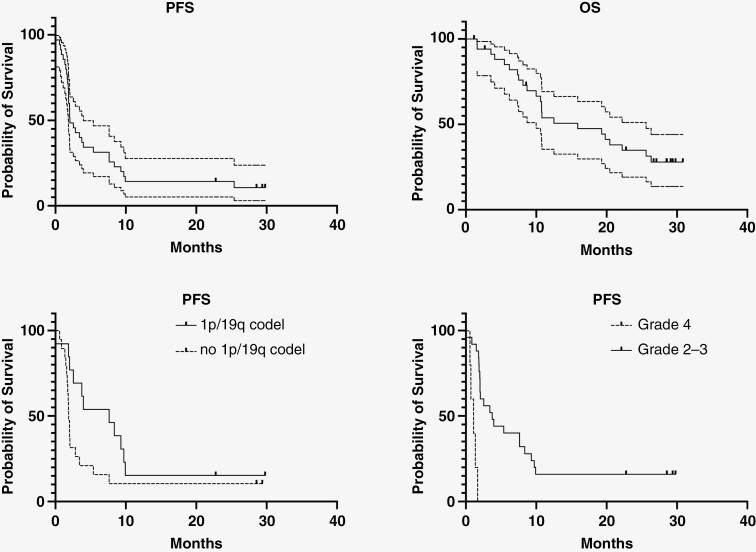
Thirty-five patients with recurrent IDHm HGGs were enrolled, 77% at ≥ 2nd recurrence. Median time since diagnosis and radiotherapy were 7.5 years and 33 months, respectively. PFS-6 was 31.4% (95% CI [16.9; 49.3%]). Two patients (6%) had an objective response and 14 patients (40%) had a stable disease as their best response. Median PFS and median overall survival were 2.05 and 15.9 months, respectively. Oligodendrogliomas (1p/19q codeleted) had a higher PFS-6 (53.4% vs. 15.7%, = .05) than astrocytomas while an initial diagnosis of grade 4 astrocytoma tended to be associated with a lower PFS-6 compared to grade 2/3 gliomas (0% vs 31.4%, = .16). A grade 2 or 3 treatment-related adverse event was observed in 15 patients (43%) and 5 patients (14%), respectively. No patient definitively discontinued treatment due to side effects.
Although it did not meet its primary endpoint, the present study shows that in this heavily pretreated population, olaparib monotherapy was well tolerated and resulted in some activity, supporting further PARP inhibitors evaluation in IDHm HGGs, especially in oligodendrogliomas.
基于临床前研究显示异柠檬酸脱氢酶突变(IDHm)的胶质瘤可能对聚(ADP-核糖)聚合酶(PARP)抑制敏感,我们开展了一项多中心2期研究,以测试奥拉帕利单药治疗在该人群中的疗效。
纳入放疗后复发的IDHm高级别胶质瘤(HGG)且至少接受过一线烷化剂化疗的成年患者。主要终点是根据神经肿瘤学标准的反应评估得出的6个月无进展生存率(PFS-6)。研究成功的预定义阈值是PFS-6至少为50%。
纳入35例复发的IDHm HGG患者,77%为≥第二次复发。自诊断和放疗以来的中位时间分别为7.5年和33个月。PFS-6为31.4%(95%置信区间[16.9;49.3%])。2例患者(6%)有客观反应,14例患者(40%)最佳反应为病情稳定。中位PFS和中位总生存期分别为2.05个月和15.9个月。少突胶质细胞瘤(1p/19q共缺失)的PFS-6(53.4%对15.7%,P = 0.05)高于星形细胞瘤,而与2/3级胶质瘤相比,初始诊断为4级星形细胞瘤往往与较低的PFS-6相关(0%对31.4%,P = 0.16)。分别有15例患者(43%)和5例患者(14%)观察到2级或3级治疗相关不良事件。没有患者因副作用而明确停止治疗。
尽管未达到主要终点,但本研究表明,在这个经过大量预处理的人群中,奥拉帕利单药治疗耐受性良好且有一定活性,支持在IDHm HGG中进一步评估PARP抑制剂,尤其是在少突胶质细胞瘤中。