Children's Hospital Affiliated to Zhengzhou University, Henan Children's Hospital, Zhengzhou Children's Hospital, Zhengzhou, Henan, China.
Front Public Health. 2024 May 23;12:1270698. doi: 10.3389/fpubh.2024.1270698. eCollection 2024.
The association between birth weight and childhood body mass index (BMI) and frailty has been extensively studied, but it is currently unclear whether this relationship is causal.
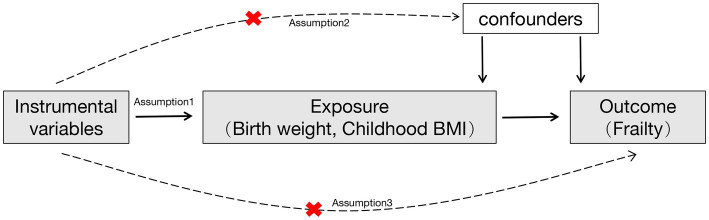
We utilized a two-sample Mendelian randomization (MR) methodology to investigate the causal effects of birth weight and childhood BMI on the risk of frailty. Instrumental variables ( < 5E-08) strongly associated with own birth weight ( = 298,142 infants), offspring birth weight ( = 210,267 mothers), and childhood BMI ( = 39,620) were identified from large-scale genomic data from genome-wide association studies (GWAS). The frailty status was assessed using the frailty index, which was derived from comprehensive geriatric assessments of older adults within the UK Biobank and the TwinGene database ( = 175,226).
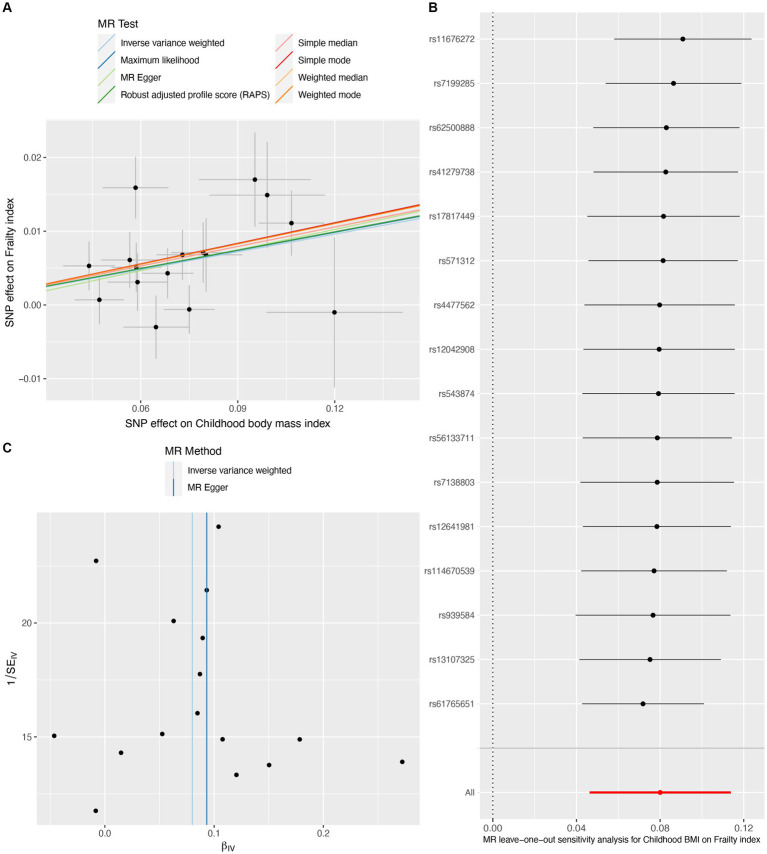
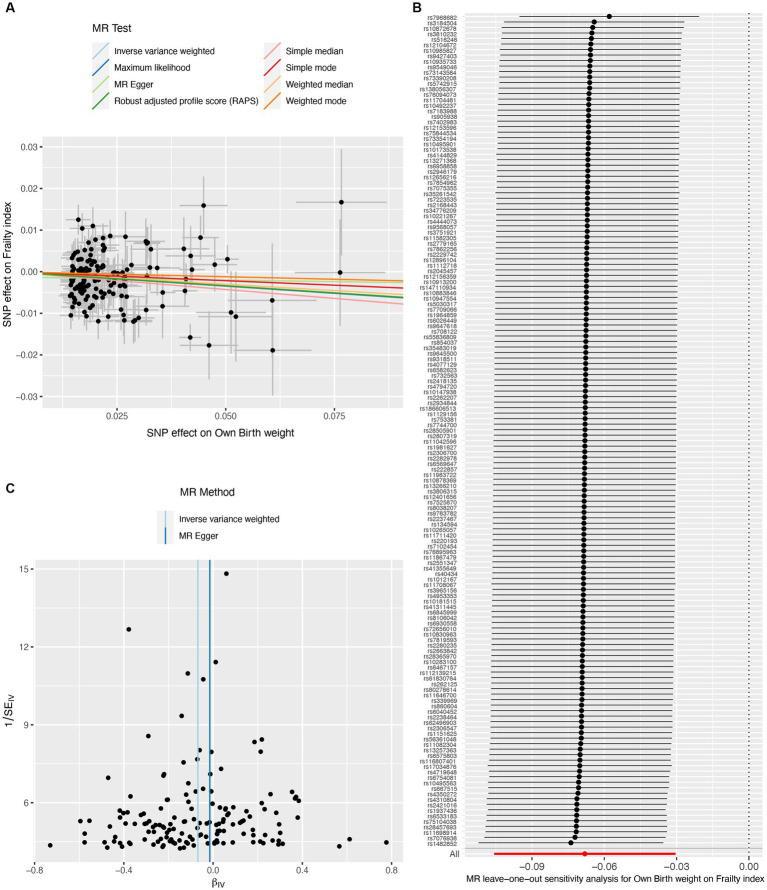
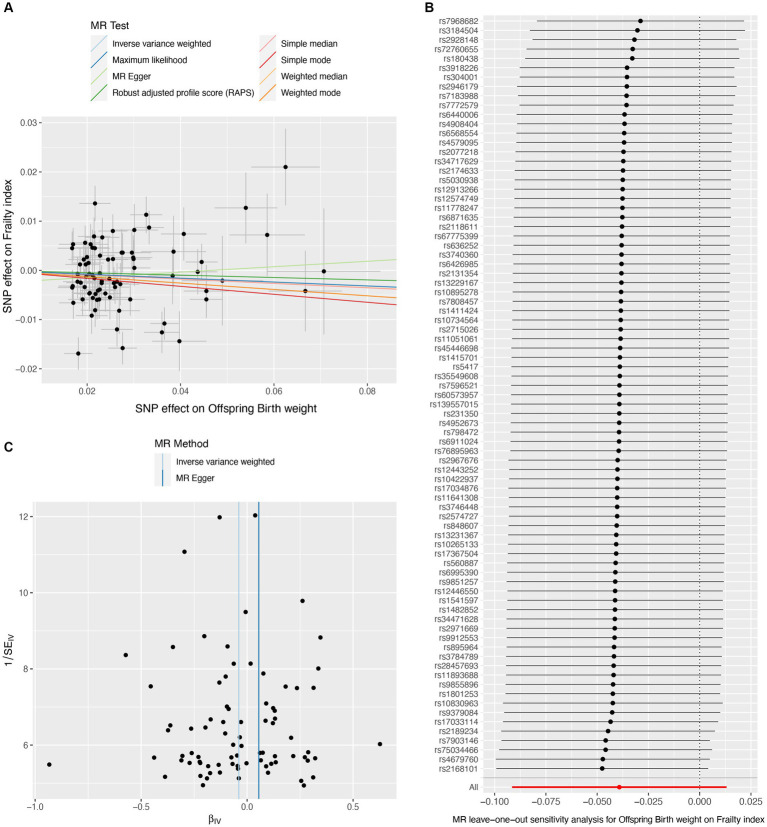
Genetically predicted one standard deviation (SD) increase in own birth weight, but not offspring birth weight (maternal-specific), was linked to a decreased frailty index (β per SD increase = -0.068, 95%CI = -0.106 to -0.030, = 3.92E-04). Conversely, genetically predicted one SD increase in childhood BMI was associated with an elevated frailty index (β per SD increase = 0.080, 95%CI = 0.046 to 0.114, = 3.43E-06) with good statistical power (99.8%). The findings remained consistent across sensitivity analyses and showed no horizontal pleiotropy ( > 0.05).
This MR study provides evidence supporting a causal relationship between lower birth weight, higher childhood BMI, and an increased risk of frailty.
出生体重与儿童时期的体重指数(BMI)和虚弱之间的关系已得到广泛研究,但目前尚不清楚这种关系是否具有因果关系。
我们使用两样本孟德尔随机化(MR)方法来研究出生体重和儿童时期 BMI 对虚弱风险的因果影响。从全基因组关联研究(GWAS)的大规模基因组数据中,确定了与自身出生体重( = 298142 名婴儿)、子女出生体重( = 210267 名母亲)和儿童时期 BMI( = 39620)强烈相关的工具变量( < 5E-08)。使用来自英国生物银行和 TwinGene 数据库的老年成年人综合老年评估得出的虚弱指数来评估虚弱状态( = 175226)。
遗传预测自身出生体重增加一个标准差(SD)与虚弱指数降低有关(每增加一个 SD 的 β 值 = -0.068,95%CI = -0.106 至 -0.030, = 3.92E-04),但与子女出生体重(母亲特异性)无关。相反,遗传预测儿童时期 BMI 增加一个 SD 与虚弱指数升高有关(每增加一个 SD 的 β 值 = 0.080,95%CI = 0.046 至 0.114, = 3.43E-06),且具有良好的统计功效(99.8%)。敏感性分析结果一致,且不存在水平多效性( > 0.05)。
这项 MR 研究提供了证据,支持较低的出生体重、较高的儿童 BMI 与虚弱风险增加之间存在因果关系。