Zerlotin Roberta, Oranger Angela, Pignataro Patrizia, Dicarlo Manuela, Sanesi Lorenzo, Suriano Clelia, Storlino Giuseppina, Rizzi Rita, Mestice Anna, Di Gioia Sante, Mori Giorgio, Grano Maria, Colaianni Graziana, Colucci Silvia
Department of Precision and Regenerative Medicine and Ionian Area, University of Bari, 70124 Bari, Italy.
Department of Translational Biomedicine and Neuroscience, University of Bari, 70124 Bari, Italy.
JBMR Plus. 2024 May 23;8(7):ziae066. doi: 10.1093/jbmrpl/ziae066. eCollection 2024 Jul.
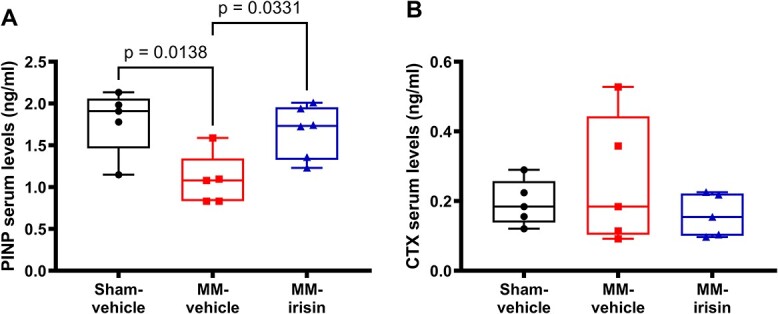
Bone disease associated with multiple myeloma (MM) is characterized by osteolytic lesions and pathological fractures, which remain a therapeutic priority despite new drugs improving MM patient survival. Antiresorptive molecules represent the main option for the treatment of MM-associated bone disease (MMBD), whereas osteoanabolic molecules are under investigation. Among these latter, we here focused on the myokine irisin, which is able to enhance bone mass in healthy mice, prevent bone loss in osteoporotic mouse models, and accelerate fracture healing in mice. Therefore, we investigated irisin effect on MMBD in a mouse model of MM induced by intratibial injection of myeloma cells followed by weekly administration of 100 μg/kg of recombinant irisin for 5 wk. By micro-Ct analysis, we demonstrated that irisin improves MM-induced trabecular bone damage by partially preventing the reduction of femur Trabecular Bone Volume/Total Volume ( = .0028), Trabecular Number ( = .0076), Trabecular Fractal Dimension ( = .0044), and increasing Trabecular Separation ( = .0003) in MM mice. In cortical bone, irisin downregulates the expression of Sclerostin, a bone formation inhibitor, and RankL, a pro-osteoclastogenic molecule, while in BM it upregulates Opg, an anti-osteoclastogenic cytokine. We found that in the BM tibia of irisin-treated MM mice, the percentage of MM cells displays a reduction trend, while in the femur it decreases significantly. This is in line with the in vitro reduction of myeloma cell viability after 48 h of irisin stimulation at both 200 and 500 ng/mL and, after 72 h already at 100 ng/mL rec-irisin. These results could be due to irisin ability to downregulate the expression of Notch 3, which is important for cell-to-cell communication in the tumor niche, and Cyclin D1, supporting an inhibitory effect of irisin on MM cell proliferation. Overall, our findings suggest that irisin could be a new promising strategy to counteract MMBD and tumor burden in one shot.
与多发性骨髓瘤(MM)相关的骨病以溶骨性病变和病理性骨折为特征,尽管新药提高了MM患者的生存率,但这些问题仍然是治疗的重点。抗吸收分子是治疗MM相关骨病(MMBD)的主要选择,而成骨分子正在研究中。在后者中,我们在此关注肌动蛋白鸢尾素,它能够增加健康小鼠的骨量,预防骨质疏松小鼠模型中的骨质流失,并加速小鼠骨折愈合。因此,我们在通过胫骨内注射骨髓瘤细胞诱导的MM小鼠模型中研究了鸢尾素对MMBD的影响,随后每周给予100μg/kg重组鸢尾素,持续5周。通过显微CT分析,我们证明鸢尾素通过部分防止MM小鼠股骨小梁骨体积/总体积(=0.0028)、小梁数量(=0.0076)、小梁分形维数(=0.0044)的减少以及增加小梁间距(=0.0003)来改善MM诱导的小梁骨损伤。在皮质骨中,鸢尾素下调骨形成抑制剂硬化蛋白和促破骨细胞生成分子核因子κB受体活化因子配体(RankL)的表达,而在骨髓中,它上调抗破骨细胞生成细胞因子骨保护素(Opg)。我们发现,在接受鸢尾素治疗的MM小鼠的胫骨骨髓中,MM细胞的百分比呈现下降趋势,而在股骨中则显著下降。这与在200和500 ng/mL鸢尾素刺激48小时后以及在100 ng/mL重组鸢尾素刺激72小时后骨髓瘤细胞活力的体外降低一致。这些结果可能归因于鸢尾素下调Notch 3表达的能力,Notch 3对肿瘤微环境中的细胞间通讯很重要,以及细胞周期蛋白D1,这支持了鸢尾素对MM细胞增殖的抑制作用。总体而言,我们的研究结果表明,鸢尾素可能是一种一举抵消MMBD和肿瘤负担的新的有前景的策略。