Park Ko Un, Padamsee Tasleem J, Birken Sarah A, Lee Sandy, Niles Kaleigh, Blair Sarah L, Grignol Valerie, Dickson-Witmer Diana, Nowell Kerri, Neuman Heather, King Tari, Mittendorf Elizabeth, Paskett Electra D, Brindle Mary
Division of Breast Surgery, Department of Surgery, Brigham and Women's Hospital, Boston, MA, USA.
Ariadne Labs, Brigham and Women's Hospital, Harvard T.H. Chan School of Public Health, Boston, MA, USA.
Ann Surg Oncol. 2024 Sep;31(9):5888-5895. doi: 10.1245/s10434-024-15515-2. Epub 2024 Jun 11.
The technical aspects of cancer surgery have a significant impact on patient outcomes. To monitor surgical quality, in 2020, the Commission on Cancer (CoC) revised its accreditation standards for cancer surgery and introduced the synoptic operative reports (SORs). The standardization of SORs holds promise, but successful implementation requires strategies to address key implementation barriers. This study aimed to identify the barriers and facilitators to implementing breast SOR within diverse CoC-accredited programs.
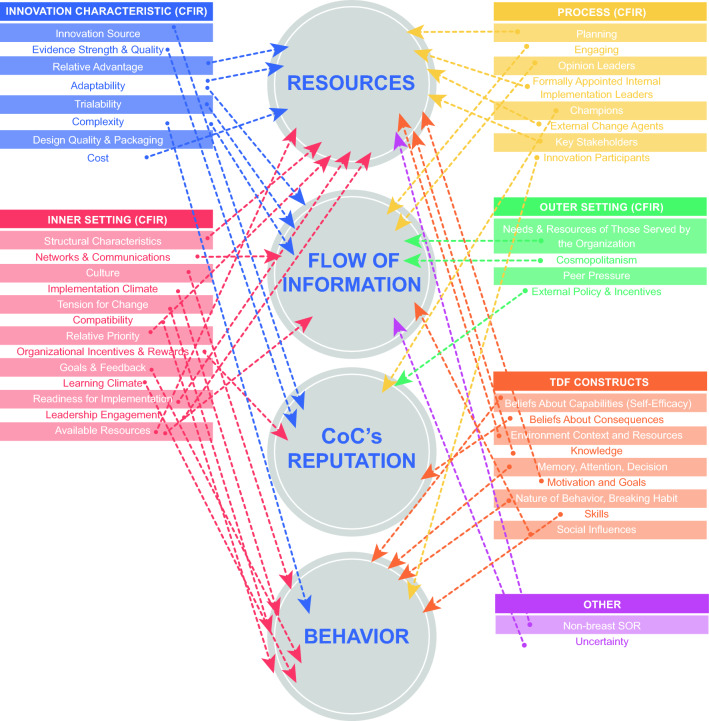
In-depth semi-structured interviews were conducted with 31 health care professionals across diverse CoC-accredited sites. The study used two comprehensive implementation frameworks to guide data collection and analysis.
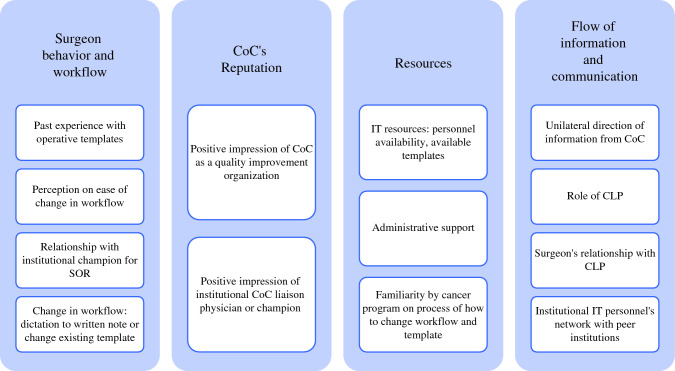
Successful SOR implementation was impeded by disrupted workflows, surgeon resistance to change, low prioritization of resources, and poor flow of information despite CoC's positive reputation. Participants often lacked understanding of the requirements and timeline for breast SOR and were heavily influenced by prior experiences with templates and SOR champion relationships. The perceived lack of monetary benefits (to obtaining CoC accreditation) together with the significant information technology (IT) resource requirements tempered some of the enthusiasm. Additionally, resource constraints and the redirection of personnel during the COVID-19 pandemic were noted as hurdles.
Surgeon behavior and workflow change, IT and personnel resources, and communication and networking strategies influenced SOR implementation. During early implementation and the implementation planning phase, the primary focus was on achieving buy-in and initiating successful roll-out rather than effective use or sustainment. These findings have implications for enhancing standardization of surgical cancer care and guidance of future strategies to optimize implementation of CoC accreditation standards.
癌症手术的技术层面会对患者的治疗结果产生重大影响。为监测手术质量,癌症委员会(CoC)于2020年修订了癌症手术的认证标准,并引入了概要手术报告(SOR)。SOR的标准化前景广阔,但要成功实施需要应对关键实施障碍的策略。本研究旨在确定在不同的CoC认证项目中实施乳腺SOR的障碍和促进因素。
对不同CoC认证机构的31名医疗保健专业人员进行了深入的半结构化访谈。该研究使用了两个全面的实施框架来指导数据收集和分析。
尽管CoC声誉良好,但工作流程中断、外科医生对变革的抵触、资源优先级低以及信息流通不畅阻碍了SOR的成功实施。参与者通常对乳腺SOR的要求和时间线缺乏了解,并且深受模板和SOR倡导者关系的既往经验影响。对(获得CoC认证)金钱利益的认知缺乏,再加上对信息技术(IT)资源的巨大需求,削弱了一些积极性。此外,资源限制以及新冠疫情期间人员的重新调配也被视为障碍。
外科医生的行为和工作流程变化、IT和人员资源以及沟通与网络策略影响了SOR的实施。在早期实施和实施规划阶段,主要重点是获得支持并启动成功推广,而非有效使用或维持。这些发现对提高癌症手术护理的标准化以及指导未来优化CoC认证标准实施的策略具有启示意义。