Institute for Molecular Medicine Finland, University of Helsinki, Helsinki, Finland.
Institute for Molecular Medicine Finland, University of Helsinki, Helsinki, Finland
BMJ Open. 2024 Jun 12;14(6):e081947. doi: 10.1136/bmjopen-2023-081947.
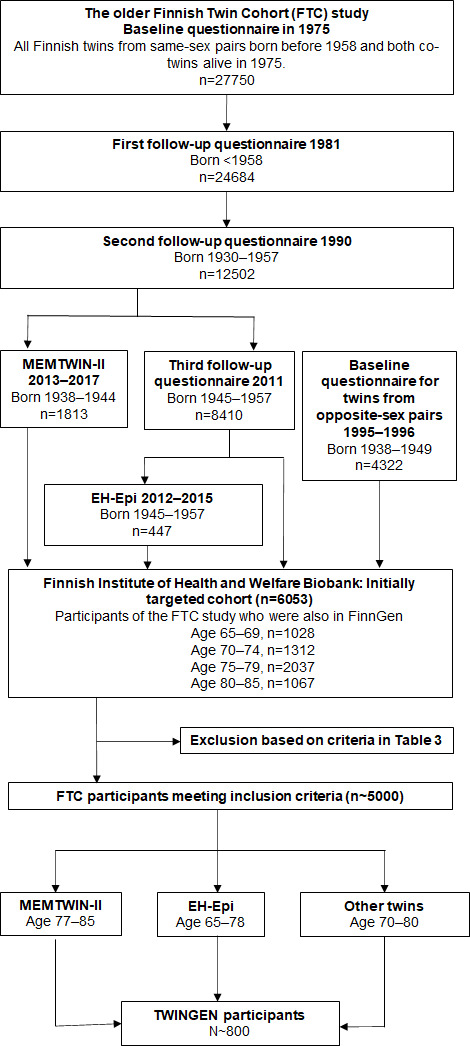
A better understanding of the earliest stages of Alzheimer's disease (AD) could expedite the development or administration of treatments. Large population biobanks hold the promise to identify individuals at an elevated risk of AD and related dementias based on health registry information. Here, we establish the protocol for an observational clinical recall and biomarker study called TWINGEN with the aim to identify individuals at high risk of AD by assessing cognition, health and AD-related biomarkers. Suitable candidates were identified and invited to participate in the new study among THL Biobank donors according to TWINGEN study criteria.
A multi-centre study (n=800) to obtain blood-based biomarkers, telephone-administered and web-based memory and cognitive parameters, questionnaire information on lifestyle, health and psychological factors, and accelerometer data for measures of physical activity, sedentary behaviour and sleep. A subcohort is being asked to participate in an in-person neuropsychological assessment (n=200) and wear an Oura ring (n=50). All participants in the TWINGEN study have genome-wide genotyping data and up to 48 years of follow-up data from the population-based older Finnish Twin Cohort (FTC) study of the University of Helsinki. The data collected in TWINGEN will be returned to THL Biobank from where it can later be requested for other biobank studies such as FinnGen that supported TWINGEN.
This recall study consists of FTC/THL Biobank/FinnGen participants whose data were acquired in accordance with the Finnish Biobank Act. The recruitment protocols followed the biobank protocols approved by Finnish Medicines Agency. The TWINGEN study plan was approved by the Ethics Committee of Hospital District of Helsinki and Uusimaa (number 16831/2022). THL Biobank approved the research plan with the permission no: THLBB2022_83.
更好地了解阿尔茨海默病(AD)的早期阶段可能会加速治疗的开发或实施。大型人群生物库有望根据健康登记信息,识别出 AD 及相关痴呆症风险较高的个体。在这里,我们建立了一项名为 TWINGEN 的观察性临床回忆和生物标志物研究的方案,旨在通过评估认知、健康和与 AD 相关的生物标志物来识别 AD 风险较高的个体。根据 TWINGEN 研究标准,从 THL 生物库供体中确定并邀请合适的候选人参加新的研究。
一项多中心研究(n=800)旨在获得基于血液的生物标志物、电话管理和基于网络的记忆和认知参数、生活方式、健康和心理因素的问卷调查信息以及加速度计数据,用于衡量身体活动、久坐行为和睡眠。一个亚组被要求参加现场神经心理评估(n=200)并佩戴 Oura 戒指(n=50)。TWINGEN 研究的所有参与者都有全基因组基因分型数据和来自赫尔辛基大学基于人群的芬兰双胞胎队列(FTC)研究的长达 48 年的随访数据。TWINGEN 收集的数据将从 THL 生物库返回,以后可以从那里请求用于支持 TWINGEN 的其他生物库研究,如 FinnGen。
这项召回研究包括 FTC/THL 生物库/FinnGen 参与者,其数据是根据芬兰生物库法获得的。招募方案遵循了芬兰药品管理局批准的生物库方案。TWINGEN 研究计划获得了赫尔辛基和乌西马地区医院区伦理委员会的批准(编号 16831/2022)。THL 生物库批准了研究计划,许可号为 THLBB2022_83。