Gong Yi, Liu Mian, Zhang Qianqian, Li Jinjing, Cai Hong, Ran Jing, Ma Linna, Ma Yanlin, Quan Song
Center for Reproductive Medicine, Department of Obstetrics and Gynecology, Nanfang Hospital, Southern Medical University, 1838 Guangzhou Avenue North, Guangzhou, Guangdong, 510515, China.
Hainan Provincial Key Laboratory for Human Reproductive Medicine and Genetic Research, Hainan Provincial Clinical Research Center for Thalassemia, Key Laboratory of Reproductive Health Diseases Research and Translation, Ministry of Education, Department of Reproductive Medicine, Hainan Medical University, The First Affiliated Hospital of Hainan Medical University, Hainan Medical University, 54-1 LongHua road, Haikou, Hainan, 570100, China.
J Transl Med. 2024 Jun 12;22(1):561. doi: 10.1186/s12967-024-05243-2.
Fibrogenesis within ovarian endometrioma (endometrioma), mainly induced by transforming growth factor-β (TGF-β), is characterized by myofibroblast over-activation and excessive extracellular matrix (ECM) deposition, contributing to endometrioma-associated symptoms such as infertility by impairing ovarian reserve and oocyte quality. However, the precise molecular mechanisms that underpin the endometrioma- associated fibrosis progression induced by TGF-β remain poorly understood.
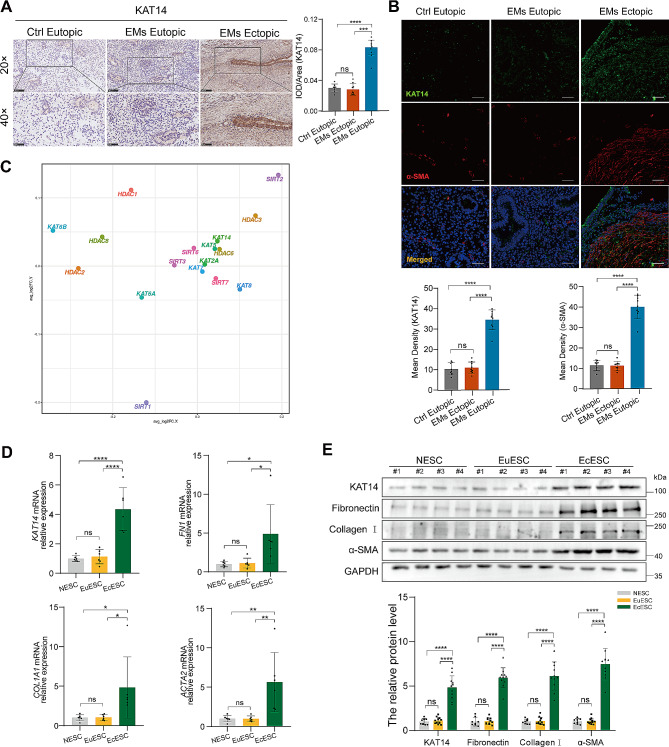
The expression level of lysine acetyltransferase 14 (KAT14) was validated in endometrium biopsies from patients with endometrioma and healthy controls, and the transcription level of KAT14 was further confirmed by analyzing a published single-cell transcriptome (scRNA-seq) dataset of endometriosis. We used overexpression, knockout, and knockdown approaches in immortalized human endometrial stromal cells (HESCs) or human primary ectopic endometrial stromal cells (EcESCs) to determine the role of KAT14 in TGF-β-induced fibrosis. Furthermore, an adeno-associated virus (AAV) carrying KAT14-shRNA was used in an endometriosis mice model to assess the role of KAT14 in vivo.
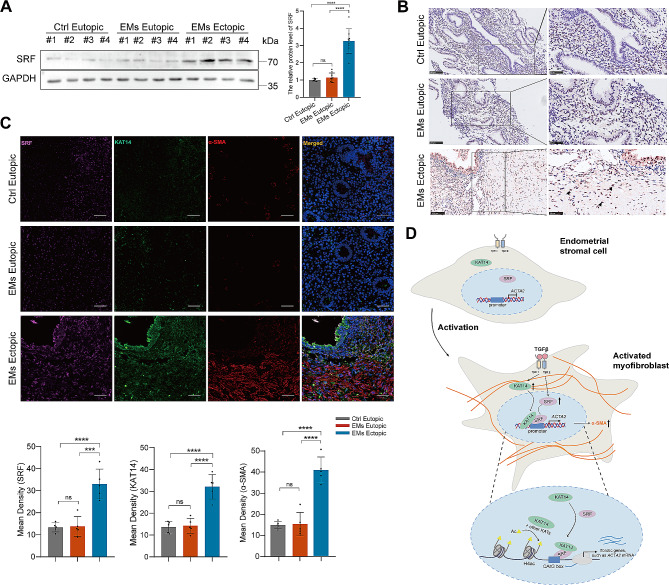
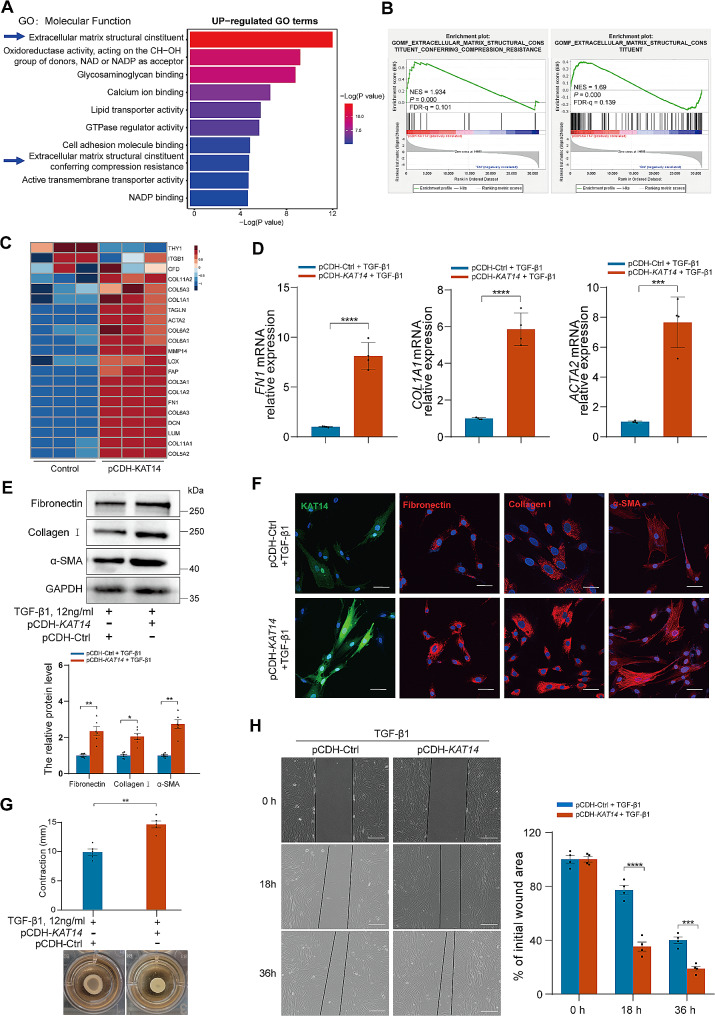
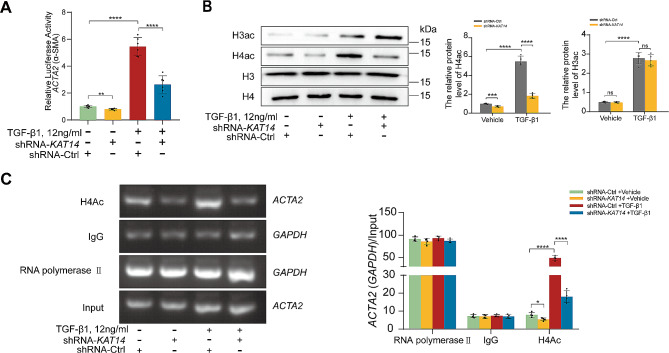
KAT14 was upregulated in ectopic lesions from endometrioma patients and predominantly expressed in activated fibroblasts. In vitro studies showed that KAT14 overexpression significantly promoted a TGF-β-induced profibrotic response in endometrial stromal cells, while KAT14 silencing showed adverse effects that could be rescued by KAT14 re-enhancement. In vivo, Kat14 knockdown ameliorated fibrosis in the ectopic lesions of the endometriosis mouse model. Mechanistically, we showed that KAT14 directly interacted with serum response factor (SRF) to promote the expression of α-smooth muscle actin (α-SMA) by increasing histone H4 acetylation at promoter regions; this is necessary for TGF-β-induced ECM production and myofibroblast differentiation. In addition, the knockdown or pharmacological inhibition of SRF significantly attenuated KAT14-mediating profibrotic effects under TGF-β treatment. Notably, the KAT14/SRF complex was abundant in endometrioma samples and positively correlated with α-SMA expression, further supporting the key role of KAT14/SRF complex in the progression of endometrioma-associated fibrogenesis.
Our results shed light on KAT14 as a key effector of TGF-β-induced ECM production and myofibroblast differentiation in EcESCs by promoting histone H4 acetylation via co-operating with SRF, representing a potential therapeutic target for endometrioma-associated fibrosis.
卵巢子宫内膜异位囊肿(子宫内膜异位囊肿)内的纤维生成主要由转化生长因子-β(TGF-β)诱导,其特征为肌成纤维细胞过度活化和细胞外基质(ECM)过度沉积,并通过损害卵巢储备和卵母细胞质量导致诸如不孕等与子宫内膜异位囊肿相关的症状。然而,TGF-β诱导的与子宫内膜异位囊肿相关的纤维化进展的精确分子机制仍知之甚少。
在子宫内膜异位囊肿患者和健康对照者的子宫内膜活检组织中验证赖氨酸乙酰转移酶14(KAT14)的表达水平,并通过分析已发表的子宫内膜异位症单细胞转录组(scRNA-seq)数据集进一步确认KAT14的转录水平。我们在永生化人子宫内膜基质细胞(HESC)或人原代异位子宫内膜基质细胞(EcESC)中采用过表达、敲除和敲低方法来确定KAT14在TGF-β诱导的纤维化中的作用。此外,将携带KAT14-shRNA的腺相关病毒(AAV)用于子宫内膜异位症小鼠模型以评估KAT14在体内的作用。
KAT14在子宫内膜异位囊肿患者的异位病灶中上调,且主要在活化的成纤维细胞中表达。体外研究表明,KAT14过表达显著促进TGF-β诱导的子宫内膜基质细胞中的促纤维化反应,而KAT14沉默则显示出不利影响,且可通过KAT14的重新增强得以挽救。在体内,敲低Kat14可改善子宫内膜异位症小鼠模型异位病灶中的纤维化。机制上,我们表明KAT14直接与血清反应因子(SRF)相互作用,通过增加启动子区域组蛋白H4的乙酰化来促进α-平滑肌肌动蛋白(α-SMA)的表达;这对于TGF-β诱导的ECM产生和肌成纤维细胞分化是必需的。此外,敲低或药理学抑制SRF可显著减弱TGF-β处理下KAT14介导的促纤维化作用。值得注意的是,KAT14/SRF复合物在子宫内膜异位囊肿样本中丰富,且与α-SMA表达呈正相关,进一步支持了KAT14/SRF复合物在子宫内膜异位囊肿相关纤维生成进展中的关键作用。
我们的结果揭示KAT14作为TGF-β诱导的EcESC中ECM产生和肌成纤维细胞分化的关键效应因子,通过与SRF协同促进组蛋白H4乙酰化,代表了子宫内膜异位囊肿相关纤维化的潜在治疗靶点。