Hashimoto Kazuhiko, Nishimura Shunji, Ito Tomohiko, Kakinoki Ryosuke, Goto Koji
Department of Orthopedic Surgery, Kindai University Hospital, Osakasayama, Osaka 589-8511, Japan.
Mol Clin Oncol. 2024 Jun 4;21(1):51. doi: 10.3892/mco.2024.2749. eCollection 2024 Jul.
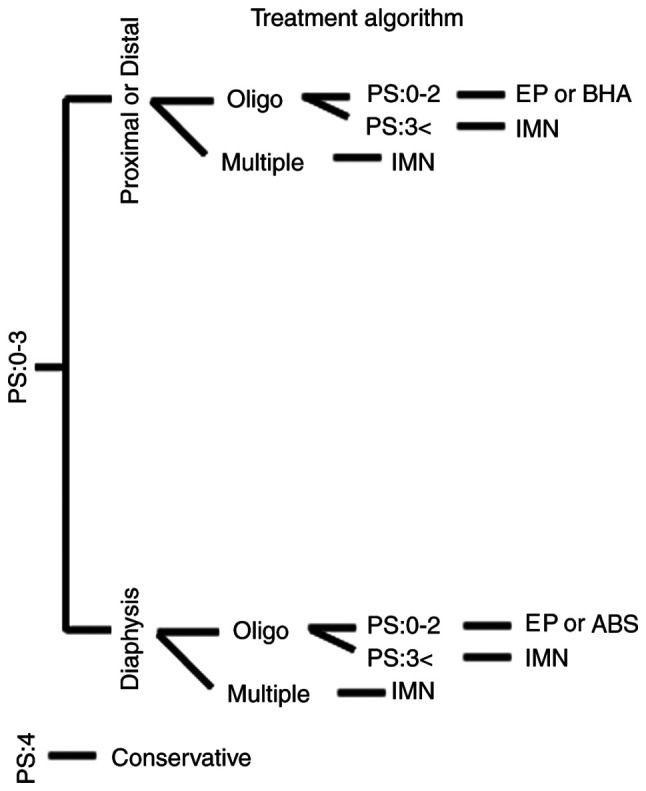
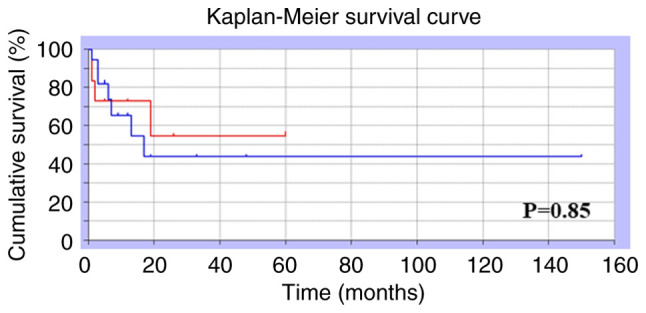
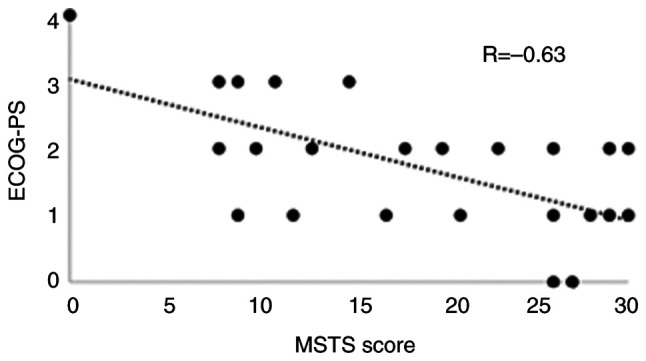
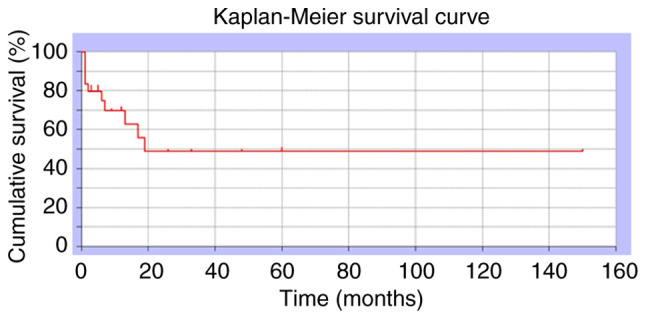
A high prevalence of proximal femoral metastases persists in patients with cancer, particularly regarding lower extremity fractures. This study offers a detailed analysis of clinical characteristics of patients undergoing surgical treatment for pathological or impending fractures, enhancing treatment strategies for metastatic malignancies. A total of thirty patients who underwent treatment of impending and pathological fractures at Kindai University Hospital (Osakasayama, Japan) were included. The retrospective study comprised parameters including age, sex, fracture site, type of primary malignancy, number of metastases, pre-fracture Eastern Cooperative Oncology Group performance status (ECOG-PS) score, adjuvant therapy, treatment modality, operative time, blood loss, postoperative complications, Musculoskeletal Tumor Society (MSTS) score, outcome and follow-up period. Post-treatment MSTS scores were compared in cases of impending and pathological fractures, and between intramedullary nailing and other surgical procedures. In addition, one-year postoperative survival rates were calculated. Furthermore, operative time, blood loss and survival rates were compared between impending and pathological fractures. The participants' median age was 70.5 years, with disease sites primarily in the subtrochanteric femur, trochanteric femur, femoral diaphysis, femoral neck and other locations. Pathologies included multiple myeloma and unknown primary, lung, breast, kidney, liver, gastric, esophageal and uterine cancers. The median ECOG-PS score pre-fracture was 2. Treatment approaches involved radiotherapy, chemotherapy and a combination of both. Surgical interventions included intramedullary nailing (16 cases), endoprosthesis (1 case), bipolar head replacement (3 cases) and compression hip screw (3 cases), among others. A negative correlation (R=-0.63) existed between MSTS and pre-fracture ECOG-PS scores. The operative time was significantly shorter in impending than in pathological fractures, with impending fractures showing significantly lower blood loss. The treatment algorithm for malignant bone tumors of the lower extremity provided in the present study was efficient, potentially optimizing treatment strategies for such cases, and contributing to improved patient care and outcomes in oncology and orthopedic surgery.
癌症患者中股骨近端转移的高患病率持续存在,尤其是在下肢骨折方面。本研究对接受手术治疗病理性骨折或即将发生骨折的患者的临床特征进行了详细分析,完善了转移性恶性肿瘤的治疗策略。纳入了在近畿大学医院(日本大阪狭山市)接受即将发生骨折和病理性骨折治疗的30例患者。这项回顾性研究的参数包括年龄、性别、骨折部位、原发性恶性肿瘤类型、转移灶数量、骨折前东部肿瘤协作组体能状态(ECOG-PS)评分、辅助治疗、治疗方式、手术时间、失血量、术后并发症、肌肉骨骼肿瘤学会(MSTS)评分、结局和随访期。比较了即将发生骨折和病理性骨折病例以及髓内钉固定和其他手术方法之间治疗后的MSTS评分。此外,计算了术后一年生存率。此外,还比较了即将发生骨折和病理性骨折之间的手术时间、失血量和生存率。参与者的中位年龄为70.5岁,病变部位主要在股骨转子下、股骨转子、股骨干、股骨颈及其他部位。病理类型包括多发性骨髓瘤、原发灶不明、肺癌、乳腺癌、肾癌、肝癌、胃癌、食管癌和子宫癌。骨折前ECOG-PS评分中位数为2。治疗方法包括放疗、化疗以及两者联合。手术干预包括髓内钉固定(16例)、人工关节置换(1例)、双极股骨头置换(3例)和加压髋螺钉(3例)等。MSTS评分与骨折前ECOG-PS评分之间存在负相关(R=-0.63)。即将发生骨折时的手术时间明显短于病理性骨折,且即将发生骨折时的失血量明显更低。本研究中提供的下肢恶性骨肿瘤治疗方案是有效的,可能会优化此类病例的治疗策略,并有助于改善肿瘤学和骨科手术中的患者护理及治疗效果。