Rodríguez-Cruz Ulises E, Castelán-Sánchez Hugo G, Madrigal-Trejo David, Eguiarte Luis E, Souza Valeria
Departamento de Ecología Evolutiva, Instituto de Ecología, Universidad Nacional Autónoma de México, Ciudad de México, Mexico.
Doctorado en Ciencias Biomédicas, Universidad Nacional Autónoma de México, Ciudad de México, Mexico.
Front Microbiol. 2024 May 30;15:1369263. doi: 10.3389/fmicb.2024.1369263. eCollection 2024.
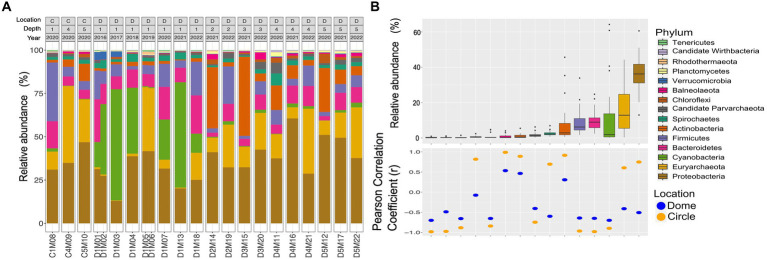
A comprehensive study was conducted in the Cuatro Ciénegas Basin (CCB) in Coahuila, Mexico, which is known for its diversity of microorganisms and unique physicochemical properties. The study focused on the "Archaean Domes" (AD) site in the CCB, which is characterized by an abundance of hypersaline, non-lithifying microbial mats. In AD, we analyzed the small domes and circular structures using metagenome assembly genomes (MAGs) with the aim of expanding our understanding of the prokaryotic tree of life by uncovering previously unreported lineages, as well as analyzing the diversity of bacteria and archaea in the CCB. A total of 325 MAGs were identified, including 48 Archaea and 277 Bacteria. Remarkably, 22 archaea and 104 bacteria could not be classified even at the genus level, highlighting the remarkable novel diversity of the CCB. Besides, AD site exhibited significant diversity at the phylum level, with Proteobacteria being the most abundant, followed by Desulfobacteria, Spirochaetes, Bacteroidetes, Nanoarchaeota, Halobacteriota, Cyanobacteria, Planctomycetota, Verrucomicrobiota, Actinomycetes and Chloroflexi. In Archaea, the monophyletic groups of MAGs belonged to the Archaeoglobi, Aenigmarchaeota, Candidate Nanoarchaeota, and Halobacteriota. Among Bacteria, monophyletic groups were also identified, including Spirochaetes, Proteobacteria, Planctomycetes, Actinobacteria, Verrucomicrobia, Bacteroidetes, Candidate Bipolaricaulota, Desulfobacteria, and Cyanobacteria. These monophyletic groups were possibly influenced by geographic isolation, as well as the extreme and fluctuating environmental conditions in the pond AD, such as stoichiometric imbalance of C:N:P of 122:42:1, fluctuating pH (5-9.8) and high salinity (5.28% to saturation).
在墨西哥科阿韦拉州的夸特罗谢内加斯盆地(CCB)进行了一项全面研究,该盆地以其微生物多样性和独特的物理化学性质而闻名。该研究聚焦于CCB中的“太古宙穹顶”(AD)地点,其特点是有大量高盐、非石化的微生物垫。在AD中,我们使用宏基因组组装基因组(MAGs)分析了小穹顶和圆形结构,目的是通过发现以前未报告的谱系来扩展我们对原核生物生命树的理解,同时分析CCB中细菌和古菌的多样性。总共鉴定出325个MAGs,包括48个古菌和277个细菌。值得注意的是,即使在属水平上,仍有22个古菌和104个细菌无法分类,这突出了CCB显著的新多样性。此外,AD地点在门水平上表现出显著的多样性,变形菌门最为丰富,其次是脱硫杆菌门、螺旋体门、拟杆菌门、纳古菌门、盐杆菌门、蓝细菌门、浮霉菌门、疣微菌门、放线菌门和绿弯菌门。在古菌中,MAGs的单系类群属于古球状菌纲、谜古菌门、候选纳古菌门和盐杆菌门。在细菌中,也鉴定出了单系类群,包括螺旋体门、变形菌门、浮霉菌门、放线菌门、疣微菌门、拟杆菌门、候选双极茎菌门、脱硫杆菌门和蓝细菌门。这些单系类群可能受到地理隔离以及AD池塘中极端和波动的环境条件的影响,例如碳:氮:磷的化学计量不平衡为122:42:1、pH值波动(5 - 9.8)和高盐度(5.28%至饱和)。