
每日一次口服乌帕替尼对比安慰剂治疗泛发性非节段型白癜风成人患者:一项2期、多中心、随机、双盲、安慰剂对照、剂量范围研究。
Once-daily upadacitinib versus placebo in adults with extensive non-segmental vitiligo: a phase 2, multicentre, randomised, double-blind, placebo-controlled, dose-ranging study.
作者信息
Passeron Thierry, Ezzedine Khaled, Hamzavi Iltefat, van Geel Nanja, Schlosser Bethanee J, Wu Xiaoqiang, Huang Xiaohong, Soliman Ahmed M, Rosmarin David, Harris John E, Camp Heidi S, Pandya Amit G
机构信息
INSERM U1065, Centre Méditerranéen de Médecine Moléculaire (C3M), Côte d'Azur University, Nice, France.
Department of Dermatology, Centre Hospitalier Universitaire de Nice, Côte d'Azur University, Nice, France.
出版信息
EClinicalMedicine. 2024 May 31;73:102655. doi: 10.1016/j.eclinm.2024.102655. eCollection 2024 Jul.
BACKGROUND
Janus kinase (JAK) inhibition is a promising approach for treating vitiligo. We aimed to assess the efficacy and safety of upadacitinib, an oral selective JAK inhibitor, in adults with non-segmental vitiligo.
METHODS
This was a phase 2, multicentre, randomised, double-blind, placebo-controlled, dose-ranging study completed at 33 clinical centres in the United States, Canada, France, and Japan. Eligible patients were aged 18-65 years with non-segmental vitiligo and had a Facial Vitiligo Area Scoring Index (F-VASI) ≥0.5 and a Total Vitiligo Area Scoring Index (T-VASI) ≥5. Patients were randomly assigned (2:2:2:1:1) using an interactive response technology to receive upadacitinib 6 mg (UPA6), upadacitinib 11 mg (UPA11), upadacitinib 22 mg (UPA22), or placebo (PBO; preassigned to switch to either UPA11 or UPA22 in period 2) once daily for 24 weeks (period 1). For weeks 24-52 (period 2), patients randomly assigned to upadacitinib continued their treatment, and patients receiving PBO switched to their preassigned upadacitinib dose in a blinded fashion. The primary endpoint was the percent change from baseline in F-VASI at week 24. Efficacy was analysed in the intention-to-treat population, and safety was examined in all randomly assigned patients who received at least one dose of study drug. This study is registered with ClinicalTrials.gov, number NCT04927975.
FINDINGS
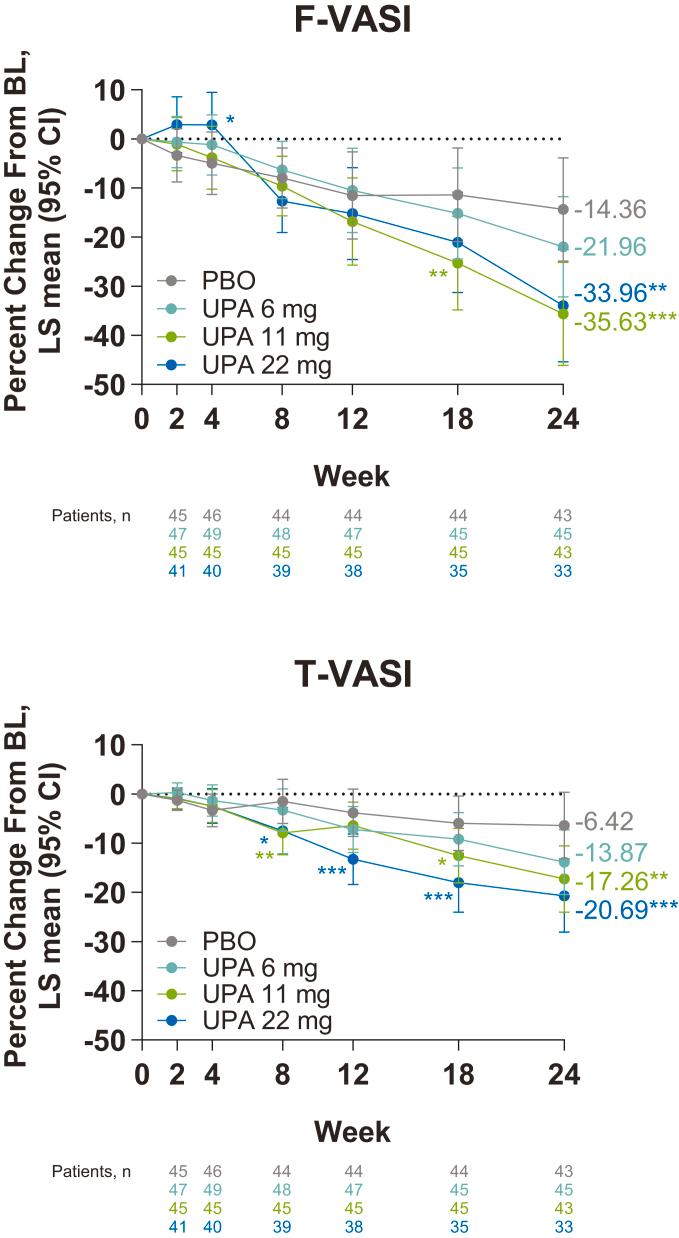
Between June 16, 2021, and June 27, 2022, 185 patients (including 115 [62%] who were female and 70 [38%] who were male) were randomly assigned to UPA6 (n = 49), UPA11 (n = 47), UPA22 (n = 43), or PBO (n = 46). At week 24, the LS mean difference versus PBO in the percent change from baseline in F-VASI was -7.60 (95% CI -22.18 to 6.97; p = 0.3037) for UPA6, -21.27 (95% CI -36.02 to -6.52; p = 0.0051) for UPA11, and -19.60 (95% CI -35.04 to -4.16; p = 0.0132) for UPA22. The LS mean difference versus PBO in the percent change from baseline in T-VASI was -7.45 (95% CI -16.86 to 1.96; p = 0.1198) for UPA6, -10.84 (95% CI -20.37 to -1.32; p = 0.0259) for UPA11 and -14.27 (95% CI -24.24 to -4.30; p = 0.0053) for UPA22. Ongoing treatment with upadacitinib induced continuous skin repigmentation over time without reaching a plateau through week 52. The rates for study drug discontinuation and serious treatment-emergent adverse events (TEAEs) were higher in the UPA22 group than in the UPA11 and UPA6 groups. Eight serious TEAEs, including one death of unknown cause and one case of infiltrating lobular breast carcinoma, were reported through 52 weeks; only two serious TEAEs (coronary artery arteriosclerosis [UPA6 (n = 1)] and non-fatal ischemic stroke [UPA11 (n = 1)]) were deemed by the investigator to have a reasonable possibility of being related to study drug. The one case of breast cancer in the UPA11 group was deemed unrelated to study drug, and the one death of unknown cause in the UPA22 group was reviewed and adjudicated and was deemed to be unrelated to study drug. The most common TEAEs were COVID-19, headache, acne, and fatigue. No new safety signals were observed.
INTERPRETATION
Upadacitinib monotherapy led to substantial repigmentation of both facial and total body vitiligo lesions and may offer an effective treatment option for adults with extensive non-segmental vitiligo. Based on these findings, upadacitinib 15 mg is being investigated in adults and adolescents with non-segmental vitiligo in an ongoing phase 3 randomised controlled trial.
FUNDING
AbbVie Inc.
背景
抑制 Janus 激酶(JAK)是治疗白癜风的一种有前景的方法。我们旨在评估口服选择性 JAK 抑制剂乌帕替尼治疗非节段性白癜风成人患者的疗效和安全性。
方法
这是一项 2 期、多中心、随机、双盲、安慰剂对照、剂量范围研究,在美国、加拿大、法国和日本的 33 个临床中心完成。符合条件的患者年龄为 18 - 65 岁,患有非节段性白癜风,面部白癜风面积评分指数(F-VASI)≥0.5 且全身白癜风面积评分指数(T-VASI)≥5。患者使用交互式应答技术随机分配(2:2:2:1:1),接受乌帕替尼 6 mg(UPA6)、乌帕替尼 11 mg(UPA11)、乌帕替尼 2 mg(UPA22)或安慰剂(PBO;在第 2 阶段预先分配切换至 UPA11 或 UPA22),每日一次,共 24 周(第 1 阶段)。在第 24 - 52 周(第 2 阶段),随机分配至乌帕替尼的患者继续治疗,接受 PBO 的患者以盲法切换至预先分配的乌帕替尼剂量。主要终点是第 24 周时 F-VASI 相对于基线的变化百分比。在意向性治疗人群中分析疗效,在所有接受至少一剂研究药物的随机分配患者中检查安全性。本研究已在 ClinicalTrials.gov 注册,编号为 NCT04927975。
结果
在 2021 年 6 月 16 日至 2022 年 6 月 27 日期间共纳入 185 例患者(其中女性 115 例[62%],男性 70 例[38%]),随机分配至 UPA6(n = 49)、UPA11(n = 47)、UPA22(n = 43)或 PBO(n = 46)组。在第 24 周时,UPA6 组相对于 PBO 组 F-VASI 从基线变化百分比的最小二乘均值差为 -7.60(95%CI -22.18 至 6.97;p = 0.3037),UPA11 组为 -21.27(95%CI -36.02 至 -6.52;p = 0.0051),UPA22 组为 -19.60(95%CI -35.04 至 -4.16;p = 0.0132)。UPA6 组相对于 PBO 组 T-VASI 从基线变化百分比的最小二乘均值差为 -7.45(95%CI -16.86 至 1.96;p = 0.1198),UPA11 组为 -10.84(95%CI -20.37 至 -1.32;p = 0.0259),UPA22 组为 -14.27(95%CI -24.24 至 -4.30;p = 0.0053)。持续使用乌帕替尼治疗可随时间诱导皮肤持续复色,至第 52 周仍未达到平台期。UPA22 组的研究药物停药率和严重治疗中出现的不良事件(TEAE)发生率高于 UPA11 和 UPA6 组。在 52 周内共报告了 8 例严重 TEAE,包括 1 例不明原因死亡和 1 例浸润性小叶乳腺癌;研究者认为只有 2 例严重 TEAE(冠状动脉动脉硬化[UPA6 组(n = 1)]和非致命性缺血性中风[UPA11 组(n = 1)])有可能与研究药物相关。UPA11 组的 1 例乳腺癌病例被认为与研究药物无关,UPA22 组的 1 例不明原因死亡经审查和判定后也被认为与研究药物无关。最常见的 TEAE 是 COVID-19、头痛、痤疮和疲劳。未观察到新的安全信号。
解读
乌帕替尼单药治疗可使面部和全身白癜风皮损显著复色,可能为广泛非节段性白癜风成人患者提供一种有效的治疗选择。基于这些发现,正在进行的 3 期随机对照试验中对 15 mg 乌帕替尼治疗非节段性白癜风成人和青少年患者进行研究。
资助
艾伯维公司


 Zotero 插件