Nursing Department, Peking University Third Hospital, Beijing, China.
Renal Department, Peking University International Hospital, Beijing, China.
Ren Fail. 2024 Dec;46(2):2363589. doi: 10.1080/0886022X.2024.2363589. Epub 2024 Jun 14.
To investigate the dietary nutrient intake of Maintenance hemodialysis (MHD) patients, identify influencing factors, and explore the correlation between dietary nutrient intake and nutritional and disease control indicators.
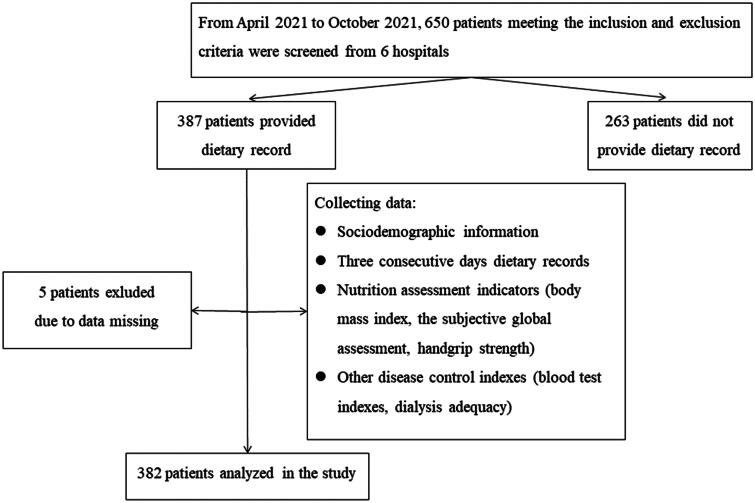
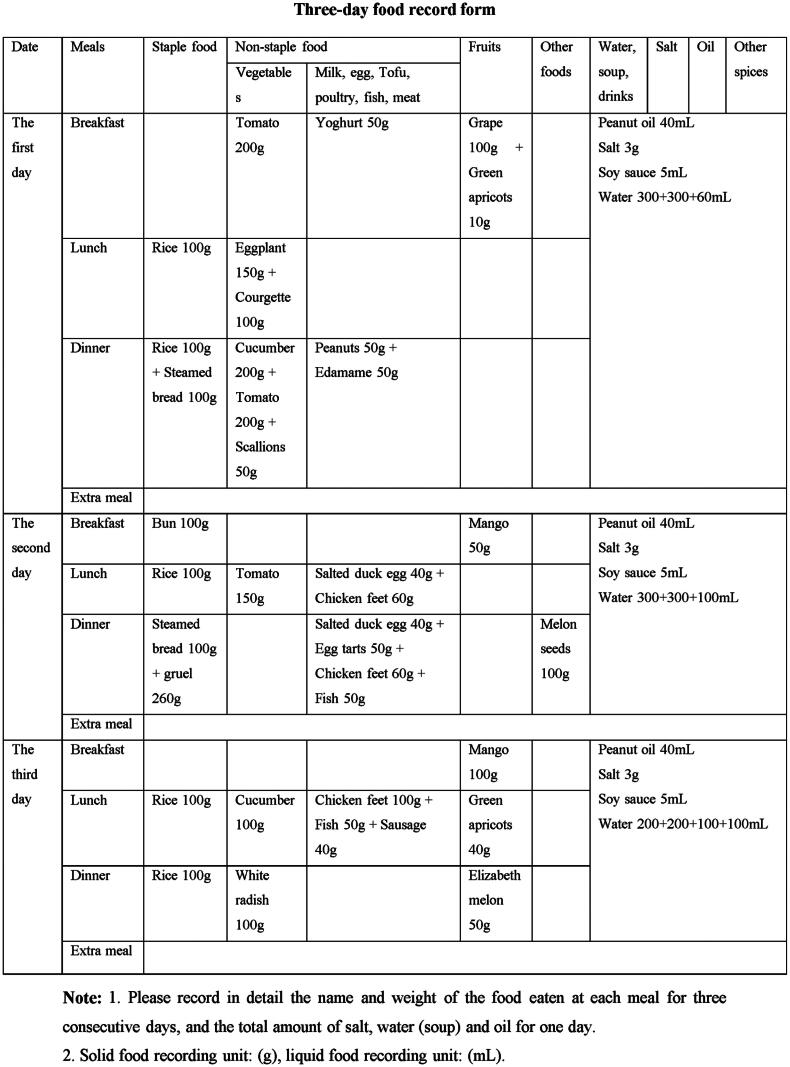
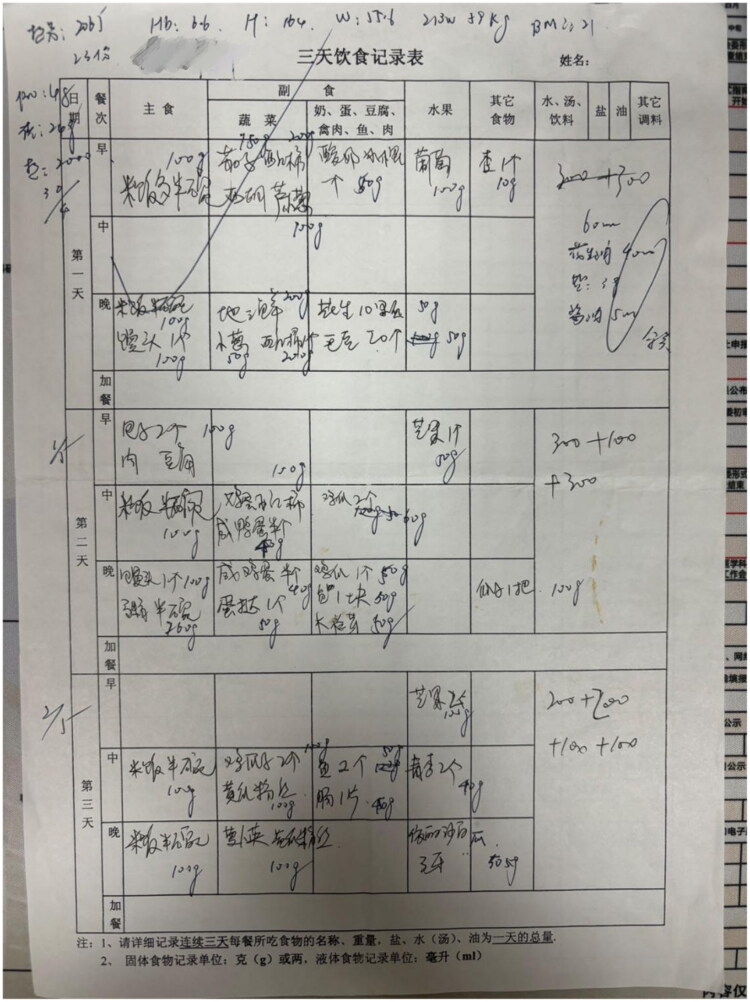
This was a multicenter cross-sectional study. A dietary survey was conducted using a three-day dietary record method, and a self-designed diet management software was utilized to calculate the daily intake of dietary nutrients. The nutritional status and disease control indicators were assessed using subjective global assessment, handgrip strength, blood test indexes, and dialysis adequacy.
A total of 382 MHD patients were included in this study. Among them, 225 (58.9%) and 233 (61.0%) patients' protein and energy intake did not meet the recommendations outlined in the National Kidney Foundation's Kidney Disease Outcomes Quality Initiative Clinical Practice Guideline for Nutrition in Chronic Kidney Disease (2020 update). The average protein and energy intake for these patients were 0.99 ± 0.32 g/kg/d and 29.06 ± 7.79 kcal/kg/d, respectively. Multiple linear regression analysis showed that comorbidity-diabetes had a negative influence on normalized daily energy intake (nDEI = DEI / ideal body weight) (B = -2.880, = 0.001) and normalized daily protein intake (nDPI = DPI / ideal body weight) (B = -0.109, = 0.001). Pearson correlation analysis revealed that dietary DPI ( = -0.109, < 0.05), DEI ( = -0.226, < 0.05) and phosphorus ( = -0.195, < 0.001) intake were statistically correlated to Kt/V; dietary nDPI ( = 0.101, < 0.05) and sodium ( = -0.144, < 0.001) intake were statistically correlated to serum urea nitrogen; dietary DPI ( = 0.200, < 0.001), DEI ( = 0.241, < 0.001), potassium ( = 0.129, < 0.05), phosphorus ( = 0.199, < 0.001), and fiber ( = 0.157, < 0.001) intake were statistically correlated to serum creatinine; dietary phosphorus ( = 0.117, < 0.05) and fiber ( = 0.142, < 0.001) intake were statistically correlated to serum phosphorus; dietary nDPI ( = 0.125, < 0.05), DPI ( = 0.135, < 0.05), nDEI ( = 0.116, < 0.05), DEI ( = 0.125, < 0.05), potassium ( = 0.148, < 0.001), and phosphorus ( = 0.156, < 0.001) intake were statistically correlated to subjective global assessment scores; dietary nDPI ( = 0.215, < 0.001), DPI ( = 0.341, < 0.001), nDEI ( = 0.142, < 0.05), DEI ( = 0.241, < 0.001), potassium ( = 0.166, < 0.05), phosphorus ( = 0.258, < 0.001), and fiber ( = 0.252, < 0.001) intake were statistically correlated to handgrip strength in males; dietary fiber ( = 0.190, < 0.05) intake was statistically correlated to handgrip strength in females.
The dietary nutrient intake of MHD patients need improvement. Inadequate dietary nutrient intake among MHD patients could have a detrimental effect on their blood test indexes and overall nutritional status. It is crucial to address and optimize the dietary intake of nutrients in this patient population to enhance their health outcomes and well-being.
调查维持性血液透析(MHD)患者的膳食营养素摄入情况,分析影响因素,并探讨膳食营养素摄入与营养和疾病控制指标的相关性。
这是一项多中心横断面研究。采用三天膳食记录法进行膳食调查,使用自行设计的饮食管理软件计算每日膳食营养素摄入量。采用主观全面评估、握力、血液检测指标和透析充分性评估营养状况和疾病控制指标。
共纳入 382 例 MHD 患者。其中,225(58.9%)和 233(61.0%)例患者的蛋白质和能量摄入未达到美国肾脏病基金会肾脏病结局质量倡议慢性肾脏病营养临床实践指南(2020 年更新版)的推荐量。这些患者的平均蛋白质和能量摄入量分别为 0.99±0.32g/kg/d和 29.06±7.79kcal/kg/d。多线性回归分析显示,合并症-糖尿病对标准化每日能量摄入(nDEI=DEI/理想体重)(B=-2.880,=0.001)和标准化每日蛋白质摄入(nDPI=DPI/理想体重)(B=-0.109,=0.001)有负面影响。Pearson 相关分析显示,膳食 DPI(=−0.109,<0.05)、DEI(=−0.226,<0.05)和磷(=−0.195,<0.001)摄入与 Kt/V 呈统计学相关;膳食 nDPI(=0.101,<0.05)和钠(=−0.144,<0.001)摄入与血清尿素氮呈统计学相关;膳食 DPI(=0.200,<0.001)、DEI(=0.241,<0.001)、钾(=0.129,<0.05)、磷(=0.199,<0.001)和纤维(=0.157,<0.001)摄入与血清肌酐呈统计学相关;膳食磷(=0.117,<0.05)和纤维(=0.142,<0.001)摄入与血清磷呈统计学相关;膳食 nDPI(=0.125,<0.05)、DPI(=0.135,<0.05)、nDEI(=0.116,<0.05)、DEI(=0.125,<0.05)、钾(=0.148,<0.001)和磷(=0.156,<0.001)摄入与主观全面评估评分呈统计学相关;膳食 nDPI(=0.215,<0.001)、DPI(=0.341,<0.001)、nDEI(=0.142,<0.05)、DEI(=0.241,<0.001)、钾(=0.166,<0.05)、磷(=0.258,<0.001)和纤维(=0.252,<0.001)摄入与男性握力呈统计学相关;膳食纤维(=0.190,<0.05)摄入与女性握力呈统计学相关。
MHD 患者的膳食营养素摄入需要改善。MHD 患者膳食营养素摄入不足可能对血液检测指标和整体营养状况产生不利影响。解决和优化这一患者群体的营养素摄入对于提高他们的健康结局和幸福感至关重要。