
青年双相情感障碍患者循环游离线粒体DNA与脑结构关系的初步研究。
Pilot study of circulating cell-free mitochondrial DNA in relation to brain structure in youth bipolar disorder.
作者信息
Shao Suyi, Zou Yi, Kennedy Kody G, Dimick Mikaela K, Andreazza Ana C, Young L Trevor, Goncalves Vanessa F, MacIntosh Bradley J, Goldstein Benjamin I
机构信息
Centre for Youth Bipolar Disorder, Centre for Addiction and Mental Health, Toronto, ON, Canada.
Department of Pharmacology & Toxicology, Temerty Faculty of Medicine, University of Toronto, Toronto, ON, Canada.
出版信息
Int J Bipolar Disord. 2024 Jun 14;12(1):21. doi: 10.1186/s40345-024-00334-x.
BACKGROUND
Mitochondrial dysfunction is implicated in the neuropathology of bipolar disorder (BD). Higher circulating cell-free mitochondrial DNA (ccf-mtDNA), generally reflecting poorer mitochondrial health, has been associated with greater symptoms severity in BD. The current study examines the association of serum ccf-mtDNA and brain structure in relation to youth BD. We hypothesized that higher ccf-mtDNA will be associated with measures of lower brain structure, particularly in the BD group.
METHODS
Participants included 40 youth (BD, n = 19; Control group [CG], n = 21; aged 13-20 years). Serum ccf-mtDNA levels were assayed. T1-weighted brain images were acquired using 3T-MRI. Region of interest (ROI) analyses examined prefrontal cortex (PFC) and whole brain gray matter, alongside exploratory vertex-wise analyses. Analyses examined ccf-mtDNA main-effects and ccf-mtDNA-by-diagnosis interaction effects controlling for age, sex, and intracranial volume.
RESULTS
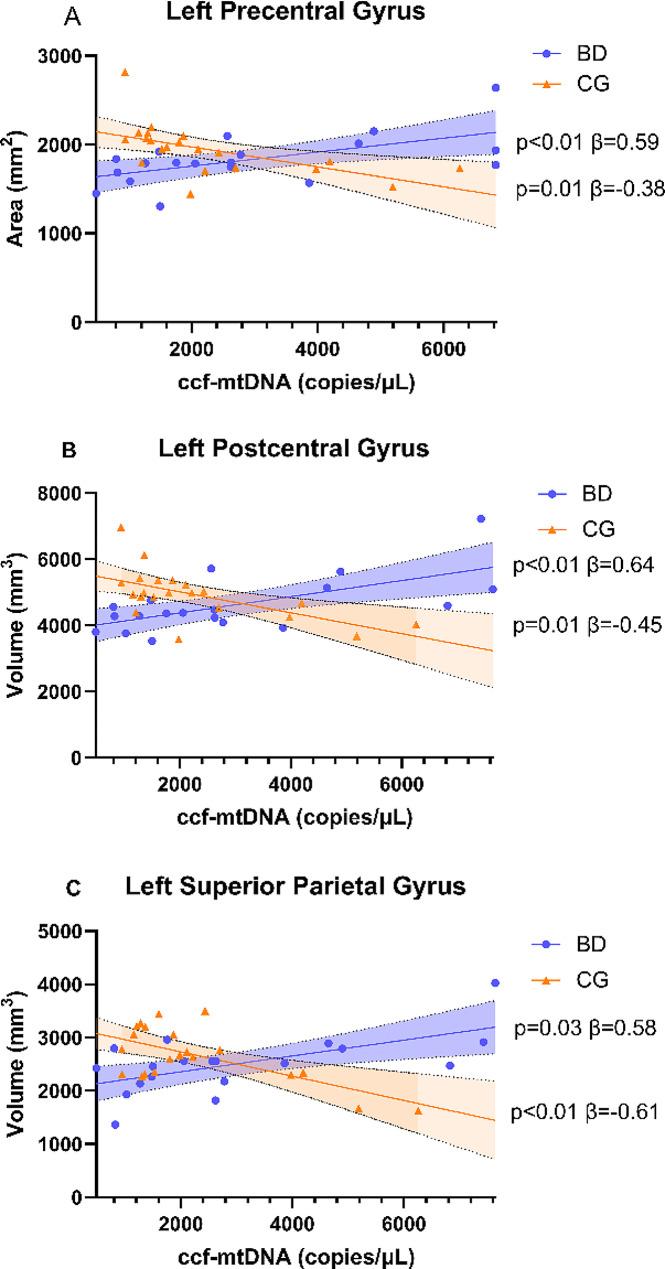
There was no significant difference in ccf-mtDNA levels between BD and CG. In ROI analyses, higher ccf-mtDNA was associated with higher PFC surface area (SA) (β = 0.32 p < 0.001) and PFC volume (β = 0.32 p = 0.002) in the overall sample. In stratified analyses, higher ccf-mtDNA was associated with higher PFC SA within both subgroups (BD: β = 0.39 p = 0.02; CG: β = 0.24 p = 0.045). Higher ccf-mtDNA was associated with higher PFC volume within the BD group (β = 0.39 p = 0.046). In vertex-wise analyses, higher ccf-mtDNA was associated with higher SA and volume in frontal clusters within the overall sample and within the BD group. There were significant ccf-mtDNA-by-diagnosis interactions in three frontal and parietal clusters, whereby higher ccf-mtDNA was associated with higher neurostructural metrics in the BD group but lower neurostructural metrics in CG.
CONCLUSIONS
Contrasting our hypothesis, higher ccf-mtDNA was consistently associated with higher, rather than lower, regional neuralstructural metrics among youth with BD. While this finding may reflect a compensatory mechanism, future repeated-measures prospective studies evaluating the inter-relationship among ccf-mtDNA, mood, and brain structure across developmental epochs and illness stages are warranted.
背景
线粒体功能障碍与双相情感障碍(BD)的神经病理学有关。循环中游离线粒体DNA(ccf-mtDNA)水平升高通常反映线粒体健康状况较差,与BD症状严重程度增加有关。本研究探讨血清ccf-mtDNA与青少年BD脑结构的关系。我们假设,较高的ccf-mtDNA水平将与较低的脑结构指标相关,尤其是在BD组中。
方法
参与者包括40名青少年(BD组,n = 19;对照组[CG],n = 21;年龄13 - 20岁)。检测血清ccf-mtDNA水平。使用3T-MRI获取T1加权脑图像。感兴趣区域(ROI)分析检查前额叶皮质(PFC)和全脑灰质,同时进行探索性的逐顶点分析。分析控制年龄、性别和颅内体积后,检测ccf-mtDNA的主效应和ccf-mtDNA与诊断的交互效应。
结果
BD组和CG组的ccf-mtDNA水平无显著差异。在ROI分析中,在总体样本中,较高的ccf-mtDNA与较高的PFC表面积(SA)(β = 0.32,p < 0.001)和PFC体积(β = 0.32,p = 0.002)相关。在分层分析中,两个亚组中较高的ccf-mtDNA均与较高的PFC SA相关(BD组:β = 0.39,p = 0.02;CG组:β = 0.24,p = 0.045)。在BD组中,较高的ccf-mtDNA与较高的PFC体积相关(β = 0.39,p = 0.046)。在逐顶点分析中,在总体样本和BD组中,较高的ccf-mtDNA与额叶簇中较高的SA和体积相关。在三个额叶和顶叶簇中存在显著的ccf-mtDNA与诊断的交互作用,即较高的ccf-mtDNA在BD组中与较高的神经结构指标相关,但在CG组中与较低的神经结构指标相关。
结论
与我们的假设相反,在患有BD的青少年中,较高的ccf-mtDNA始终与较高而非较低的区域神经结构指标相关。虽然这一发现可能反映了一种代偿机制,但未来有必要进行重复测量的前瞻性研究,以评估ccf-mtDNA、情绪和脑结构在发育阶段和疾病阶段之间的相互关系。

 Zotero 插件