Department of Life Sciences, University of Modena and Reggio Emilia, 41125 Modena, Italy.
National Institute for Cardiovascular Research-INRC, 40126 Bologna, Italy.
Cells. 2021 Oct 26;10(11):2898. doi: 10.3390/cells10112898.
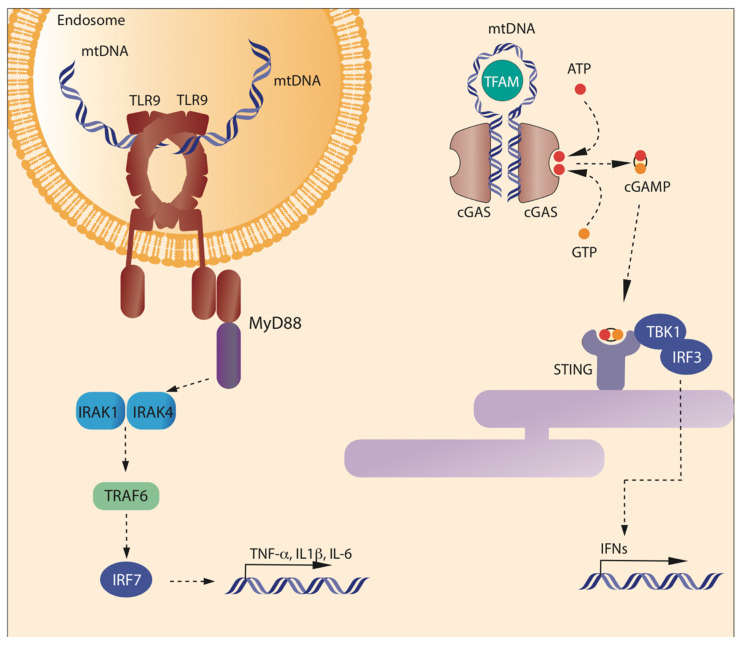
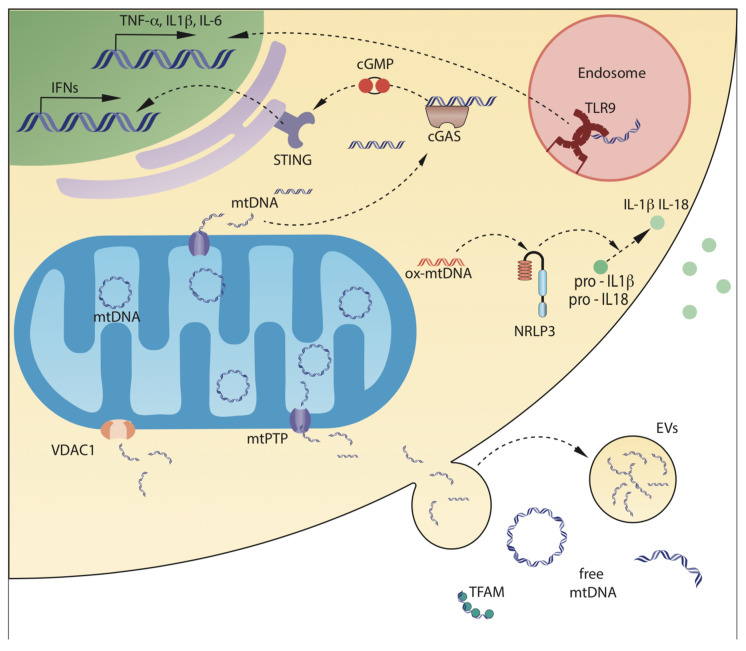
Besides their role in cell metabolism, mitochondria display many other functions. Mitochondrial DNA (mtDNA), the own genome of the organelle, plays an important role in modulating the inflammatory immune response. When released from the mitochondrion to the cytosol, mtDNA is recognized by cGAS, a cGAMP which activates a pathway leading to enhanced expression of type I interferons, and by NLRP3 inflammasome, which promotes the activation of pro-inflammatory cytokines Interleukin-1beta and Interleukin-18. Furthermore, mtDNA can be bound by Toll-like receptor 9 in the endosome and activate a pathway that ultimately leads to the expression of pro-inflammatory cytokines. mtDNA is released in the extracellular space in different forms (free DNA, protein-bound DNA fragments) either as free circulating molecules or encapsulated in extracellular vesicles. In this review, we discussed the latest findings concerning the molecular mechanisms that regulate the release of mtDNA from mitochondria, and the mechanisms that connect mtDNA misplacement to the activation of inflammation in different pathophysiological conditions.
除了在细胞代谢中的作用外,线粒体还具有许多其他功能。线粒体 DNA(mtDNA)是细胞器自身的基因组,在调节炎症免疫反应中起着重要作用。当 mtDNA 从线粒体释放到细胞质中时,被 cGAS 识别,cGAS 激活一种途径,导致 I 型干扰素的表达增强,同时被 NLRP3 炎性小体识别,促进促炎细胞因子白细胞介素-1β和白细胞介素-18 的激活。此外,mtDNA 可以在内体中的 Toll 样受体 9 结合,并激活最终导致促炎细胞因子表达的途径。mtDNA 以不同的形式(游离 DNA、蛋白结合的 DNA 片段)释放到细胞外空间,要么作为游离循环分子,要么封装在细胞外囊泡中。在这篇综述中,我们讨论了关于调节 mtDNA 从线粒体释放的分子机制的最新发现,以及 mtDNA 错位与不同病理生理条件下炎症激活之间的联系的机制。