Department of Biochemistry and Molecular Biology, Michael Smith Laboratories, University of British Columbia, Vancouver, BC V6T1Z4, Canada.
Department of Applied Ecology, North Carolina State University, Raleigh, NC 27695, USA.
J Econ Entomol. 2024 Aug 12;117(4):1324-1335. doi: 10.1093/jee/toae119.
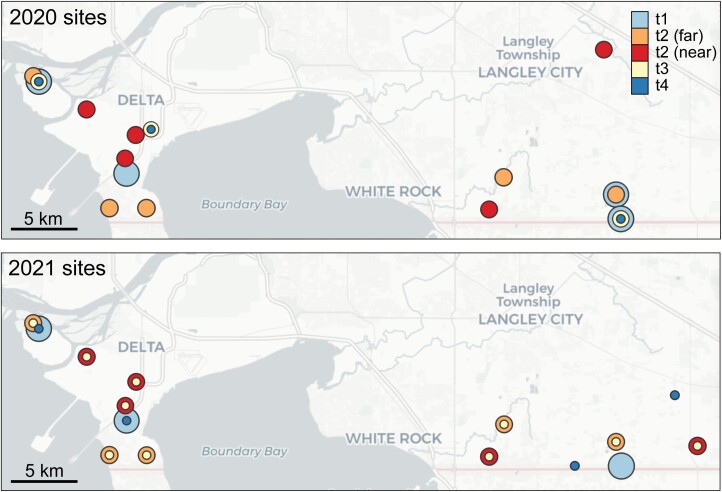
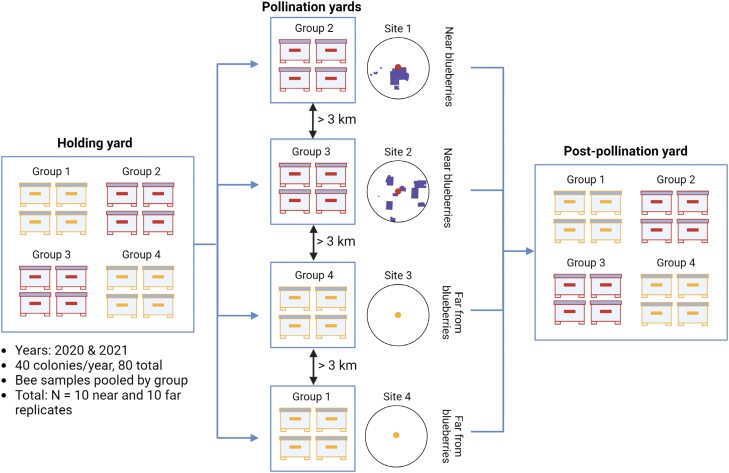
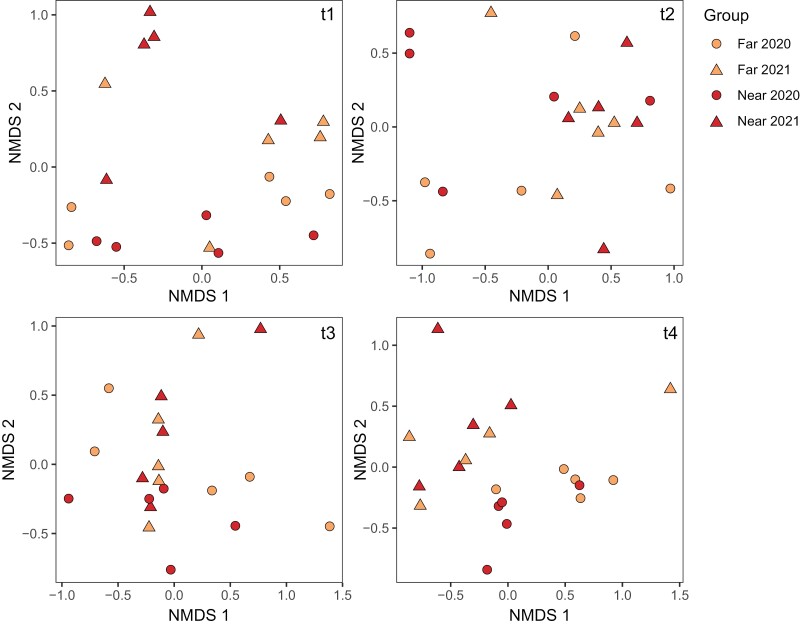
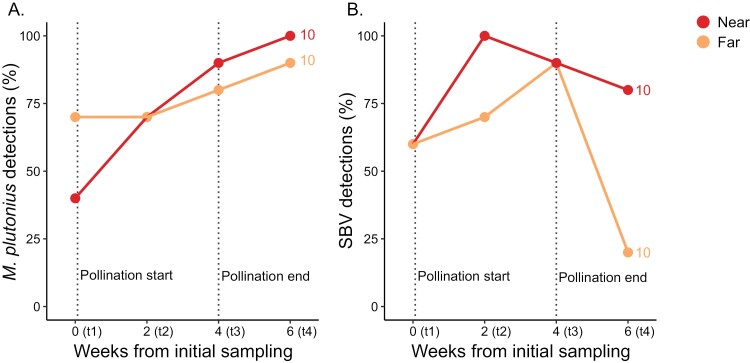
Highbush blueberry pollination depends on managed honey bees (Apis mellifera) L. for adequate fruit sets; however, beekeepers have raised concerns about the poor health of colonies after pollinating this crop. Postulated causes include agrochemical exposure, nutritional deficits, and interactions with parasites and pathogens, particularly Melisococcus plutonius [(ex. White) Bailey and Collins, Lactobacillales: Enterococcaceae], the causal agent of European foulbrood disease, but other pathogens could be involved. To broadly investigate common honey bee pathogens in relation to blueberry pollination, we sampled adult honey bees from colonies at time points corresponding to before (t1), during (t2), at the end (t3), and after (t4) highbush blueberry pollination in British Columbia, Canada, across 2 years (2020 and 2021). Nine viruses, as well as M. plutonius, Vairimorpha ceranae, and V. apis [Tokarev et al., Microsporidia: Nosematidae; formerly Nosema ceranae (Fries et al.) and N. apis (Zander)], were detected by PCR and compared among colonies located near and far from blueberry fields. We found a significant interactive effect of time and blueberry proximity on the multivariate pathogen community, mainly due to differences at t4 (corresponding to ~6 wk after the beginning of the pollination period). Post hoc comparisons of pathogens in near and far groups at t4 showed that detections of sacbrood virus (SBV), which was significantly higher in the near group, not M. plutonius, was the primary driver. Further research is needed to determine if the association of SBV with highbush blueberry pollination is contributing to the health decline that beekeepers observe after pollinating this crop.
高丛蓝莓的授粉依赖于经过管理的意蜂(Apis mellifera)来确保果实的充分形成;然而,养蜂人对授粉后蜂群健康状况不佳表示担忧。推测的原因包括接触农用化学品、营养不足以及与寄生虫和病原体的相互作用,特别是欧洲幼虫腐臭病的病原体梅利斯科斯菌(Melisococcus plutonius)[(ex. White) Bailey and Collins, Lactobacillales: Enterococcaceae],但也可能涉及其他病原体。为了广泛调查与蓝莓授粉有关的常见蜜蜂病原体,我们在加拿大不列颠哥伦比亚省的两个年份(2020 年和 2021 年)中,在高丛蓝莓授粉前后的时间点(t1、t2、t3 和 t4),从蜂群中采集成年蜜蜂样本。通过 PCR 检测到了 9 种病毒,以及梅利斯科斯菌、Vairimorpha ceranae 和 V. apis [Tokarev 等人,微孢子虫目:Nosematidae;原 Nosema ceranae (Fries et al.) 和 N. apis (Zander)],并将它们在靠近蓝莓田和远离蓝莓田的蜂群之间进行了比较。我们发现时间和蓝莓田的接近程度对多病原体群落有显著的交互影响,主要是由于 t4 时的差异(对应于授粉期开始后约 6 周)。在 t4 时对近组和远组的病原体进行事后比较发现,Sacbrood 病毒(SBV)的检测显著更高,而不是梅利斯科斯菌,这是主要驱动因素。需要进一步研究以确定 SBV 与高丛蓝莓授粉的关联是否是导致养蜂人在授粉后观察到蜂群健康状况下降的原因。