Department of Psychiatry and Behavioral Services, Boston Children's Hospital, Harvard Medical School, Boston, MA, USA.
Department of Psychiatry and Behavioral Services, Boston Children's Hospital, 300 Longwood Avenue, Boston, MA, 02115, USA.
J Neurodev Disord. 2024 Jun 15;16(1):32. doi: 10.1186/s11689-024-09548-7.
Angelman syndrome (AS) is a neurodevelopmental disorder associated with severe global developmental delay. However, the ages at which different developmental skills are achieved in these individuals remain unclear. We seek to determine the probability and the age of acquisition of specific developmental milestones and daily living skills in individuals with AS across the different molecular subtypes, viz. class I deletion, class II deletion, uniparental disomy, imprinting defect, and UBE3A variants.
Caregivers participating in a longitudinal multicenter Angelman Syndrome Natural History Study completed a questionnaire regarding the age at which their children achieved specific developmental milestones and daily living skills. The Cox Proportional Hazard model was applied to analyze differences in the probability of achievement of skills at various ages among five molecular subtypes of AS.
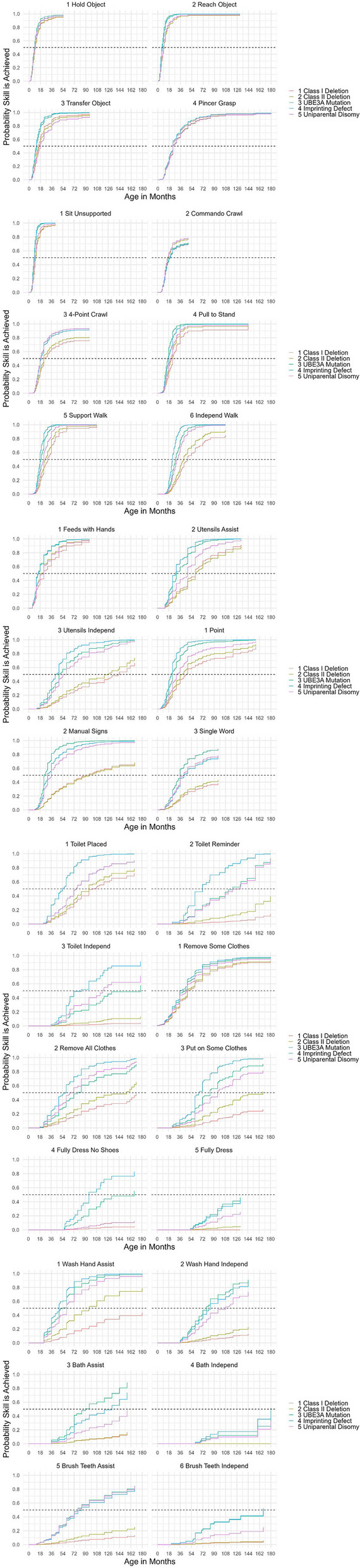
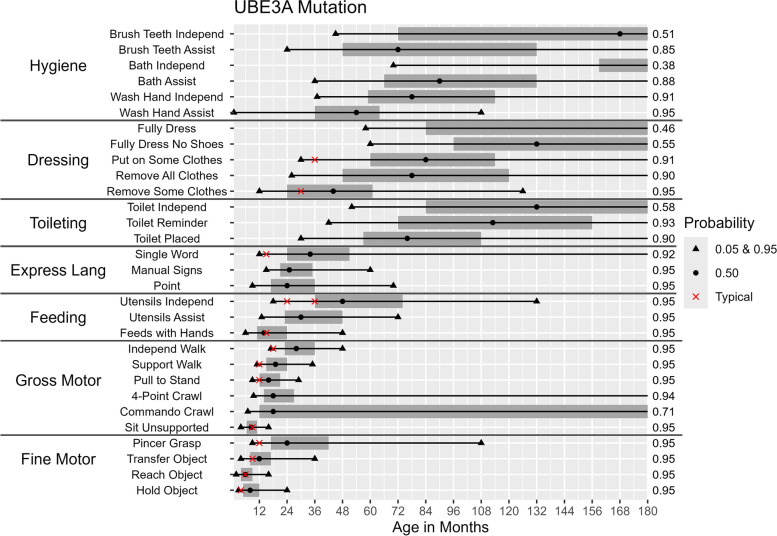
Almost all individuals, regardless of molecular subtype, were able to walk with support by five years of age. By age 15, those with a deletion had at least a 50% probability of acquiring 17 out of 30 skills compared to 25 out of 30 skills among those without a deletion. Overall, fine and gross motor skills such as holding and reaching for small objects, sitting, and walking with support were achieved within a fairly narrow range of ages, while toileting, feeding, and hygiene skills tend to have greater variability in the ages at which these skills were achieved. Those without a deletion had a higher probability (25-92%) of achieving daily living skills such as independently toileting and dressing compared to those with a deletion (0-13%). Across all molecular subtypes, there was a low probability of achieving independence in bathing and brushing teeth.
Individuals with AS without a deletion are more likely to achieve developmental milestones and daily living skills at an earlier age than those with a deletion. Many individuals with AS are unable to achieve daily living skills necessary for independent self-care.
天使综合征(AS)是一种与严重全面发育迟缓相关的神经发育障碍。然而,这些个体达到不同发育技能的年龄仍不清楚。我们旨在确定不同分子亚型(即 I 类缺失、II 类缺失、单亲二倍体、印记缺陷和 UBE3A 变体)的 AS 个体获得特定发育里程碑和日常生活技能的概率和年龄。
参与纵向多中心天使综合征自然史研究的照顾者完成了一份问卷,内容是关于他们的孩子达到特定发育里程碑和日常生活技能的年龄。应用 Cox 比例风险模型分析了 AS 五种分子亚型在不同年龄获得技能的概率差异。
几乎所有个体,无论分子亚型如何,都能够在五岁时在支持下行走。到 15 岁时,与缺失相比,删除组至少有 50%的概率获得 30 项技能中的 17 项,而非缺失组则有 25 项。总体而言,精细和粗大运动技能,如握持和够取小物体、坐立和在支持下行走,达到这些技能的年龄范围相当狭窄,而如厕、进食和个人卫生技能在达到这些技能的年龄上则存在更大的差异。与缺失相比,没有缺失的个体更有可能(25%-92%)获得独立如厕和穿衣等日常生活技能。在所有分子亚型中,独立洗澡和刷牙的可能性较低。
与缺失相比,没有缺失的 AS 个体更有可能在更早的年龄达到发育里程碑和日常生活技能。许多 AS 个体无法获得独立自理所需的日常生活技能。