Hatef Elham, Wilson Renee F, Zhang Allen, Hannum Susan M, Kharrazi Hadi, Davis Stacey A, Foroughmand Iman, Weiner Jonathan P, Robinson Karen A
Division of General Internal Medicine, Department of Medicine, Johns Hopkins School of Medicine, Baltimore, MD, USA.
Center for Population Health Information Technology, Department of Health Policy and Management, Johns Hopkins Bloomberg School of Public Health, Baltimore, MD, USA.
NPJ Digit Med. 2024 Jun 15;7(1):157. doi: 10.1038/s41746-024-01152-2.
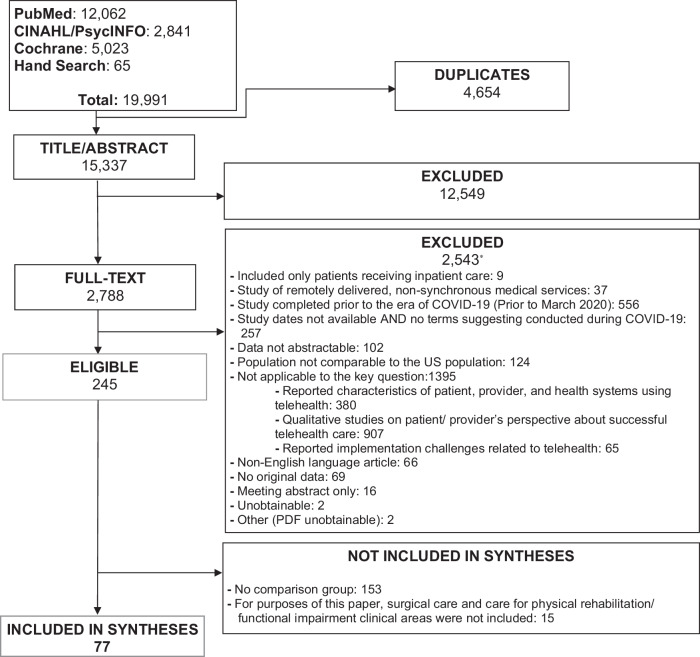
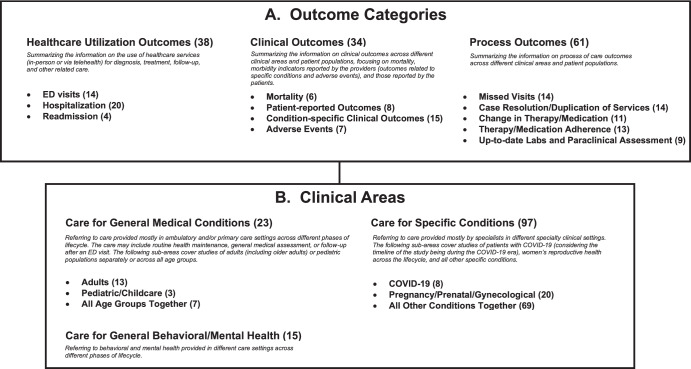
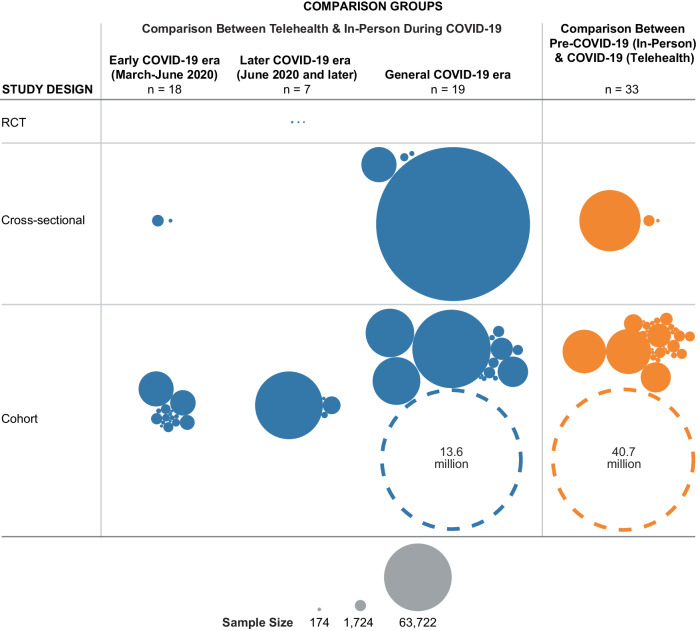
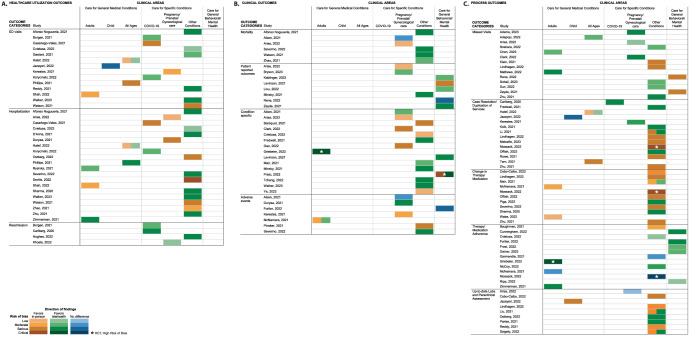
In this systematic review, we compared the effectiveness of telehealth with in-person care during the pandemic using PubMed, CINAHL, PsycINFO, and the Cochrane Central Register of Controlled Trials from March 2020 to April 2023. We included English-language, U.S.-healthcare relevant studies comparing telehealth with in-person care conducted after the onset of the pandemic. Two reviewers independently screened search results, serially extracted data, and independently assessed the risk of bias and strength of evidence. We identified 77 studies, the majority of which (47, 61%) were judged to have a serious or high risk of bias. Differences, if any, in healthcare utilization and clinical outcomes between in-person and telehealth care were generally small and/or not clinically meaningful and varied across the type of outcome and clinical area. For process outcomes, there was a mostly lower rate of missed visits and changes in therapy/medication and higher rates of therapy/medication adherence among patients receiving an initial telehealth visit compared with those receiving in-person care. However, the rates of up-to-date labs/paraclinical assessment were also lower among patients receiving an initial telehealth visit compared with those receiving in-person care. Most studies lacked a standardized approach to assessing outcomes. While we refrain from making an overall conclusion about the performance of telehealth versus in-person visits the use of telehealth is comparable to in-person care across a variety of outcomes and clinical areas. As we transition through the COVID-19 era, models for integrating telehealth with traditional care become increasingly important, and ongoing evaluations of telehealth will be particularly valuable.
在这项系统评价中,我们利用PubMed、CINAHL、PsycINFO以及Cochrane对照试验中央注册库,对2020年3月至2023年4月大流行期间远程医疗与面对面护理的有效性进行了比较。我们纳入了大流行开始后进行的、将远程医疗与面对面护理相比较的、与美国医疗保健相关的英文研究。两名评审员独立筛选检索结果、依次提取数据,并独立评估偏倚风险和证据强度。我们识别出77项研究,其中大多数(47项,61%)被判定存在严重或高偏倚风险。面对面护理和远程医疗护理在医疗保健利用和临床结局方面的差异(如有)通常较小和/或在临床上无意义,且因结局类型和临床领域而异。对于过程结局,与接受面对面护理的患者相比,接受首次远程医疗就诊的患者错过就诊和治疗/药物变更的发生率大多较低,治疗/药物依从率较高。然而,与接受面对面护理的患者相比,接受首次远程医疗就诊的患者最新实验室检查/辅助临床评估的比率也较低。大多数研究缺乏评估结局的标准化方法。虽然我们不就远程医疗与面对面就诊的表现得出总体结论,但在各种结局和临床领域中,远程医疗的使用与面对面护理相当。随着我们度过新冠疫情时代,将远程医疗与传统护理相结合的模式变得越来越重要,对远程医疗的持续评估将特别有价值。