Department of Interdisciplinary Oncology, Louisiana State University Health Sciences Center, New Orleans, LA 70112, USA.
Department of Genetics, Louisiana State University Health Sciences Center, New Orleans, LA 70112, USA.
Int J Mol Sci. 2024 May 23;25(11):5661. doi: 10.3390/ijms25115661.
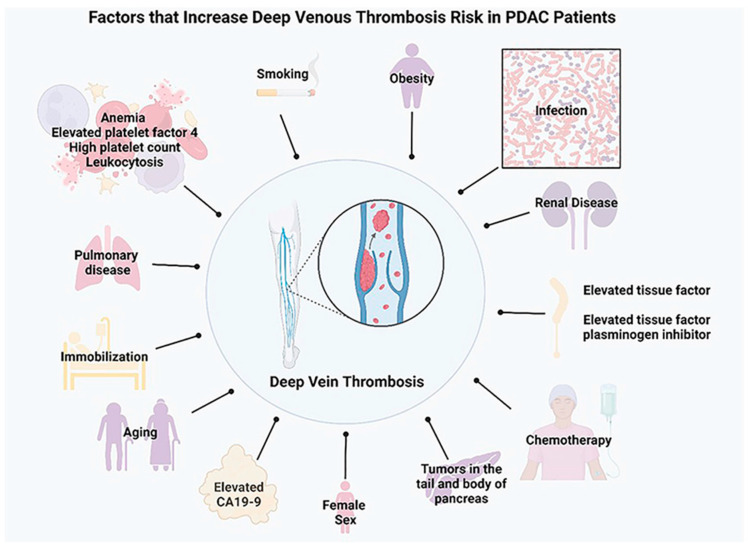
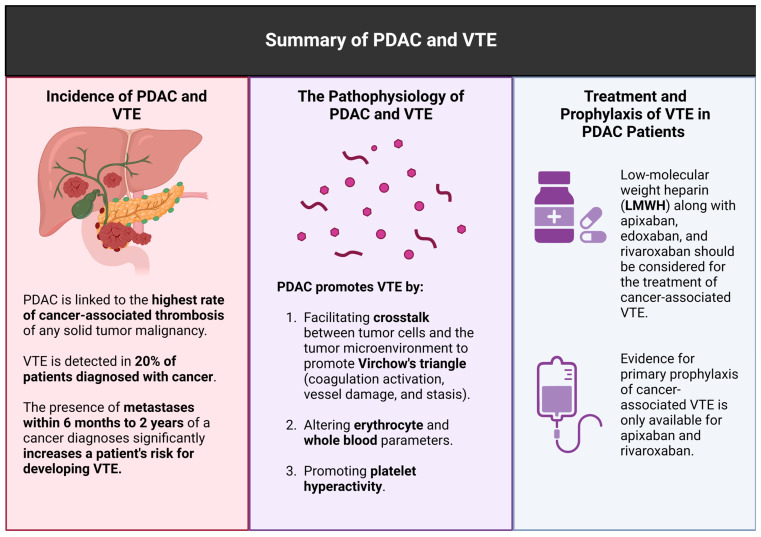
Pancreatic ductal adenocarcinoma (PDAC) accounts for more than 90% of all pancreatic cancers and is the most fatal of all cancers. The treatment response from combination chemotherapies is far from satisfactory and surgery remains the mainstay of curative strategies. These challenges warrant identifying effective treatments for combating this deadly cancer. PDAC tumor progression is associated with the robust activation of the coagulation system. Notably, cancer-associated thrombosis (CAT) is a significant risk factor in PDAC. CAT is a concept whereby cancer cells promote thromboembolism, primarily venous thromboembolism (VTE). Of all cancer types, PDAC is associated with the highest risk of developing VTE. Hypoxia in a PDAC tumor microenvironment also elevates thrombotic risk. Direct oral anticoagulants (DOACs) or low-molecular-weight heparin (LMWH) are used only as thromboprophylaxis in PDAC. However, a precision medicine approach is recommended to determine the precise dose and duration of thromboprophylaxis in clinical setting.
胰腺导管腺癌 (PDAC) 占所有胰腺癌的 90%以上,是所有癌症中最致命的一种。联合化疗的治疗反应远不能令人满意,手术仍然是主要的治疗策略。这些挑战需要确定有效的治疗方法来对抗这种致命的癌症。PDAC 肿瘤的进展与凝血系统的强烈激活有关。值得注意的是,癌症相关的血栓形成 (CAT) 是 PDAC 的一个重要危险因素。CAT 是指癌细胞促进血栓栓塞,主要是静脉血栓栓塞 (VTE)。在所有癌症类型中,PDAC 发生 VTE 的风险最高。PDAC 肿瘤微环境中的缺氧也会增加血栓形成的风险。直接口服抗凝剂 (DOAC) 或低分子量肝素 (LMWH) 仅在 PDAC 中用作血栓预防。然而,建议采用精准医疗方法来确定临床环境中血栓预防的精确剂量和持续时间。