Domínguez-Casas Lucía C, Lasa-Teja Carmen, Ferraz-Amaro Iván, Castañeda Santos, Blanco Ricardo
Rheumatology, Hospital Universitario Marqués de Valdecilla, 39008 Santander, Spain.
Rheumatology, Hospital Universitario de Canarias, 38320 Tenerife, Spain.
J Clin Med. 2024 May 26;13(11):3121. doi: 10.3390/jcm13113121.
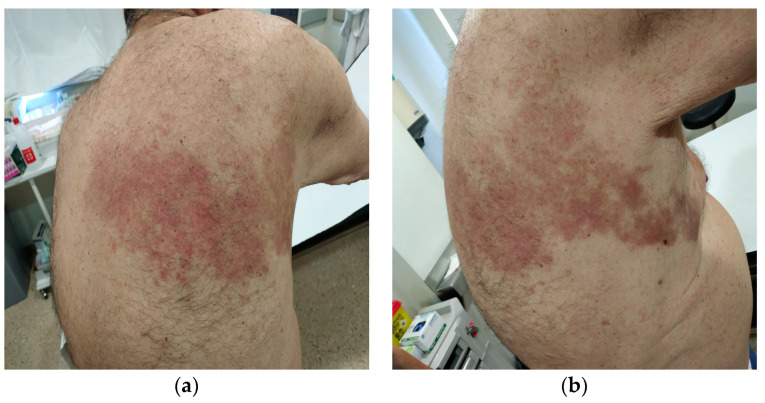
: Patients with rheumatoid arthritis (RA) have an increased risk of infection. Their risk of presenting herpes zoster (HZ) is 1.5-2 times higher than immunocompetent individuals and disseminated presentation is more frequent. Our aim was to analyze the prevalence and general features of HZ in RA patients. : This was a prospective study of 392 RA patients included in the vaccination program of our hospital between 2011 and 2016, and follow-up continued until December 2020. A diagnosis of HZ was made according to clinical manifestations: skin rash, blisters, paresthesia, and local pain in one or more dermatomes. : We studied 392 participants (309 women/83 men), mean age 59 ± 13 years. Every patient was followed-up over a mean period of 137 ± 110 months (range: 42 months-42 years). HZ infection was observed in 30 of 392 (25 women/5 men) patients, age (mean ± SD) 64.7 ± 11.8 years. Prevalence was 7.65% in this period and the incidence rate was 13.22/1000 patients/year. Three patients had facial involvement, one had optic involvement, and one patient presented disseminated HZ. Seven patients presented post herpetic neuralgia treated with gabapentinoids. The main features of RA of these 30 patients were: positive RF (n = 17; 56.6%), positive anti-CCP (n = 13; 43.3%), and erosive disease (n = 10; 33.3%). At HZ infection, the treatments were glucocorticoids (n = 19; 63.3%), conventional DMARDs (n = 15; 50%), biological DMARDs (n = 15; 50%), tofacitinib (n = 2; 6.6%), and upadacitinib (n = 1; 3.3%). : HZ is a relatively frequent viral complication in RA patients. In our series, one patient presented disseminated HZ and nearly 25% of patients had post-herpetic neuralgia. Including a HZ vaccine in our vaccination program for RA patients may be beneficial.
类风湿关节炎(RA)患者感染风险增加。他们患带状疱疹(HZ)的风险比免疫功能正常者高1.5至2倍,且播散性表现更为常见。我们的目的是分析RA患者中HZ的患病率和一般特征。
这是一项对2011年至2016年间纳入我院疫苗接种计划的392例RA患者进行的前瞻性研究,随访持续至2020年12月。根据临床表现做出HZ诊断:皮疹、水疱、感觉异常以及一个或多个皮节的局部疼痛。
我们研究了392名参与者(309名女性/83名男性),平均年龄59±13岁。每位患者平均随访137±110个月(范围:42个月至42年)。392例患者中有30例(25名女性/5名男性)发生HZ感染,年龄(平均±标准差)64.7±11.8岁。在此期间患病率为7.65%,发病率为13.22/1000患者/年。3例患者有面部受累,1例有眼部受累,1例患者表现为播散性HZ。7例患者出现带状疱疹后神经痛,接受加巴喷丁类药物治疗。这30例患者RA的主要特征为:类风湿因子(RF)阳性(n = 17;56.6%),抗环瓜氨酸肽(anti-CCP)阳性(n = 13;43.3%),以及侵蚀性疾病(n = 10;33.3%)。在HZ感染时,治疗药物有糖皮质激素(n = 19;63.3%)、传统改善病情抗风湿药(DMARDs)(n = 15;50%)、生物DMARDs(n = 15;50%)、托法替布(n = 2;6.6%)和乌帕替尼(n = 1;3.3%)。
HZ是RA患者中一种相对常见的病毒并发症。在我们的系列研究中,1例患者出现播散性HZ,近25%的患者有带状疱疹后神经痛。在我们的RA患者疫苗接种计划中纳入HZ疫苗可能有益。