Avranas Konstantinos, Pitoulias Apostolos G, Taneva Gergana T, Beropoulis Efthymios, Donas Konstantinos P
Rhein Main Vascular Center, Department of Vascular and Endovascular Surgery, Asklepios Clinics Langen, Paulinen Wiesbaden, 63225 Langen, Germany.
J Clin Med. 2024 May 30;13(11):3235. doi: 10.3390/jcm13113235.
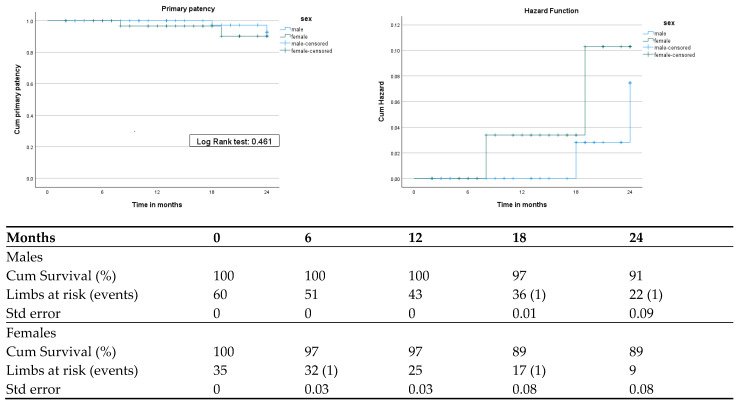
Endovascular treatment of lower-extremity peripheral disease (PAD) is associated with higher complication rates and suboptimal outcomes in women. Atherectomy has shown favourable outcomes in calcified lesions, minimising the incidence of stent placement caused by recoil or flow-limiting dissection. To date, there are no published mid-term outcomes evaluating the performance of atherectomy differentiated by sex. This study aims to evaluate sex-specific outcomes and prognostic factors affecting the results of atherectomy-assisted endovascular treatment in severe PAD. A retrospective analysis was conducted at a single centre in Germany, initiated by physicians and not sponsored by industry, on patients presenting with Rutherford categories ranging from III to V and featuring de novo occlusive or stenotic lesions of the superficial femoral (SFA) and/or popliteal arteries. The intervention involved rotational atherectomy-assisted angioplasty utilising the Jetstream (Boston, US) device. The point of interest of this study was postinterventional clinical improvement as well as mid-term outcomes, including primary patency, over a targeted 2-year follow-up period. Statistical analysis utilised Cox regression (survival analysis) to calculate hazard ratios according to sex category. Comparative survival analysis was performed using the log-rank test and visually represented through Kaplan-Meier curves. Risk factors associated with absence of clinical improvement were examined across both sex groups utilising the chi-square or Fisher exact test, as appropriate. A total of 98 patients (103 limbs) were initially included, with >75% having moderate-to-severe lesion calcification (>50%). A total of 84 patients (97 limbs, 62 male and 35 female) proceeded to a 2-year follow-up (mean 16.4 months for males and 16.1 for females) after a successful index procedure. Age distribution, Rutherford class, diabetes, chronic kidney disease (CKD), target vessel, lesion type, and length were balanced among both groups. Similar primary patency rates, of 89% among female and 91% among male limbs, were observed ( = 0.471). Female patients exhibited a lower rate of clinical improvement based on the Rutherford scale in comparison to males (80.6% vs. 94.5%, = 0.048). CDK was the only significant prognostic factor across pooled data (odds ratio for CKD: 15.15, < 0.001). Rotational atherectomy showed comparably high rates of mid-term primary patency, with low rates of bailout stent placement. These findings highlight the beneficial use of atherectomy in female patients who are per se at risk for higher rates of complications during and after endovascular interventions.
下肢外周动脉疾病(PAD)的血管内治疗在女性患者中并发症发生率较高且预后欠佳。斑块旋切术在钙化病变中显示出良好的效果,可将因弹性回缩或限流性夹层导致的支架置入发生率降至最低。迄今为止,尚无已发表的中期结果评估按性别区分的斑块旋切术效果。本研究旨在评估严重PAD患者中斑块旋切术辅助血管内治疗的性别特异性结果及影响其结果的预后因素。在德国的一个单一中心进行了一项回顾性分析,该分析由医生发起且无行业赞助,研究对象为卢瑟福分级在III至V级、存在股浅动脉(SFA)和/或腘动脉新发闭塞或狭窄病变的患者。干预措施包括使用Jetstream(美国波士顿)设备进行斑块旋切术辅助血管成形术。本研究的关注点是介入治疗后的临床改善情况以及中期结果,包括在目标2年随访期内的原发性通畅率。统计分析采用Cox回归(生存分析)根据性别类别计算风险比。使用对数秩检验进行比较生存分析,并通过Kaplan-Meier曲线直观呈现。根据情况,使用卡方检验或Fisher精确检验在两个性别组中检查与无临床改善相关的危险因素。最初共纳入98例患者(103条肢体),超过75%的患者有中度至重度病变钙化(>50%)。在成功进行首次手术后,共有84例患者(97条肢体,62例男性和35例女性)进入2年随访(男性平均16.4个月,女性平均16.1个月)。两组在年龄分布、卢瑟福分级、糖尿病、慢性肾脏病(CKD)、靶血管、病变类型和长度方面均衡。观察到女性肢体和男性肢体原发性通畅率相似,分别为89%和91%(P = 0.471)。与男性相比,女性患者基于卢瑟福量表的临床改善率较低(80.6%对94.5%,P = 0.048)。CKD是汇总数据中唯一显著的预后因素(CKD的优势比:15.15,P < 0.001)。斑块旋切术显示出相当高的中期原发性通畅率,补救性支架置入率较低。这些发现突出了斑块旋切术在血管内介入治疗期间及之后本身有较高并发症风险的女性患者中的有益应用。