Papadopoulou-Marketou Nektaria, Tsoli Marina, Chatzellis Eleftherios, Alexandraki Krystallenia I, Kaltsas Gregory
Neuroendocrine Tumor Unit, EURACAN 4 and ENETS Centre of Excellence, 1st Department of Propaedeutic Internal Medicine, Laiko General Hospital, National and Kapodistrian University of Athens, 11527 Athens, Greece.
251 Air Force General Hospital, 11525 Athens, Greece.
Cancers (Basel). 2024 May 30;16(11):2075. doi: 10.3390/cancers16112075.
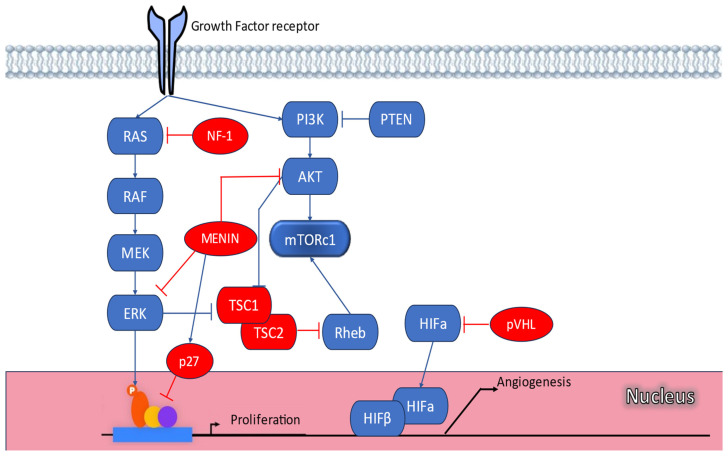
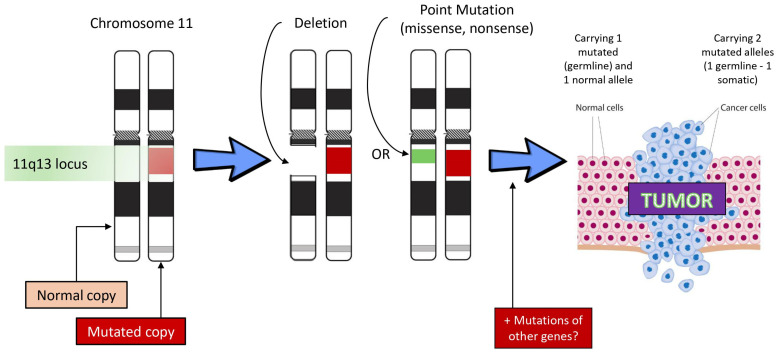
Pancreatic neuroendocrine tumors (PanNETs) and lung NETs (LNETs) represent a rare but clinically significant subgroup of neoplasms. While the majority is sporadic, approximately 17% of PanNETs and a subset of LNETs develop in the context of monogenic familial tumor syndromes, especially multiple endocrine neoplasia type 1 (MEN1) syndrome. Other inherited syndromes associated with PanNETs include MEN4, von Hippel-Lindau (VHL) syndrome, neurofibromatosis type 1 (NF1), and tuberous sclerosis complex (TSC). These syndromes are highly penetrant and their clinical manifestations may vary even among members of the same family. They are attributed to genetic mutations involving key molecular pathways regulating cell growth, differentiation, and angiogenesis. Pancreatic NETs in hereditary syndromes are often multiple, develop at a younger age compared to sporadic tumors, and are associated with endocrine and nonendocrine tumors derived from multiple organs. Lung NETs are not as common as PanNETs and are mostly encountered in MEN1 syndrome and include typical and atypical lung carcinoids. Early detection of PanNETs and LNETs related to inherited syndromes is crucial, and specific follow-up protocols need to be employed to optimize diagnosis and management. Genetic screening is recommended in childhood, and diagnostic screening starts often in adolescence, even in asymptomatic mutation carriers. Optimal management and therapeutic decisions should be made in the context of a multidisciplinary team in specialized centers, whereas specific biomarkers aiming to identify patients denoted to follow a more aggressive course need to be developed.
胰腺神经内分泌肿瘤(PanNETs)和肺神经内分泌肿瘤(LNETs)是一类罕见但具有临床重要性的肿瘤亚组。虽然大多数为散发性,但约17%的PanNETs和一部分LNETs是在单基因家族性肿瘤综合征背景下发生的,尤其是多发性内分泌腺瘤1型(MEN1)综合征。与PanNETs相关的其他遗传性综合征包括MEN4、冯·希佩尔-林道(VHL)综合征、1型神经纤维瘤病(NF1)和结节性硬化症复合体(TSC)。这些综合征具有高度的外显率,其临床表现即使在同一家族成员中也可能有所不同。它们归因于涉及调节细胞生长、分化和血管生成的关键分子途径的基因突变。遗传性综合征中的胰腺神经内分泌肿瘤通常为多发,与散发性肿瘤相比发病年龄较轻,且与源自多个器官的内分泌和非内分泌肿瘤相关。肺神经内分泌肿瘤不如胰腺神经内分泌肿瘤常见,主要见于MEN1综合征,包括典型和非典型肺类癌。早期发现与遗传性综合征相关的PanNETs和LNETs至关重要,需要采用特定的随访方案以优化诊断和管理。建议在儿童期进行基因筛查,诊断性筛查通常从青少年期开始,即使是无症状的突变携带者。应在专业中心的多学科团队背景下做出最佳管理和治疗决策,同时需要开发旨在识别可能需要更积极治疗方案的患者的特定生物标志物。