Joo Dong-Hyun, Park Hyo Chan, Kim Joon Han, Yang Seo Hee, Kim Tae Hun, Kim Hyung-Jun, Song Myung Jin, Lim Sung Yoon, Kim Sung A, Bae Hee Won, Ahn Yoon Hae, Yoon Si Mong, Park Jimyung, Lee Hong Yeul, Lee Jinwoo, Lee Sang-Min, Lee Jung Chan, Cho Young-Jae
Division of Pulmonary and Critical Care Medicine, Department of Internal Medicine, Seoul National University College of Medicine, Seoul National University Bundang Hospital, Seongnam 13620, Republic of Korea.
Department of Medical Device Development, Seoul National University College of Medicine, Seoul 03080, Republic of Korea.
Diagnostics (Basel). 2024 May 21;14(11):1068. doi: 10.3390/diagnostics14111068.
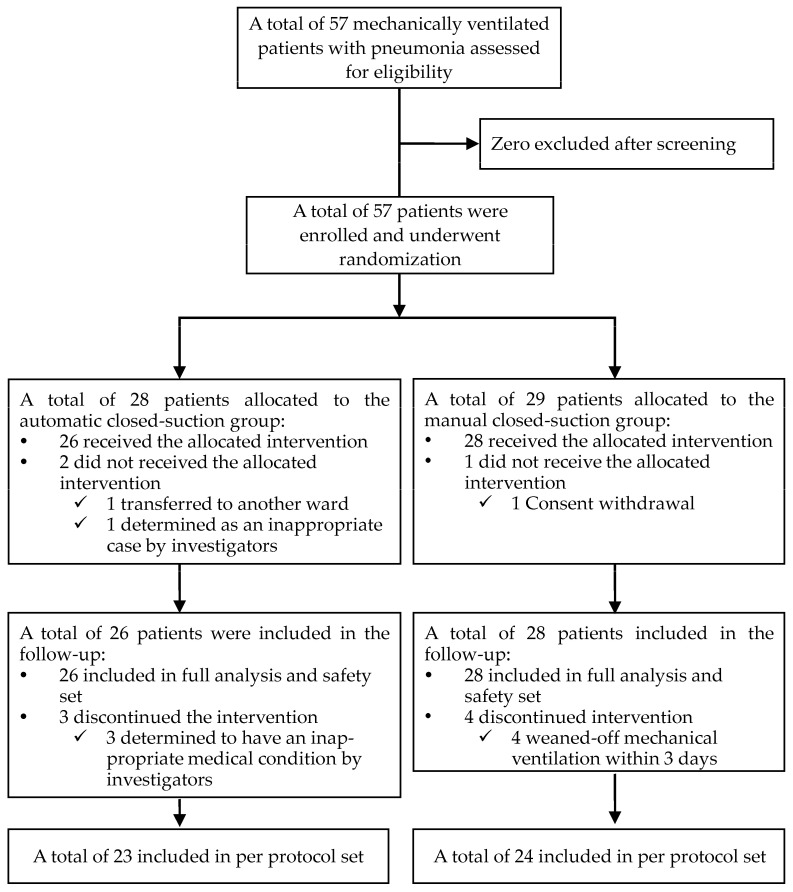
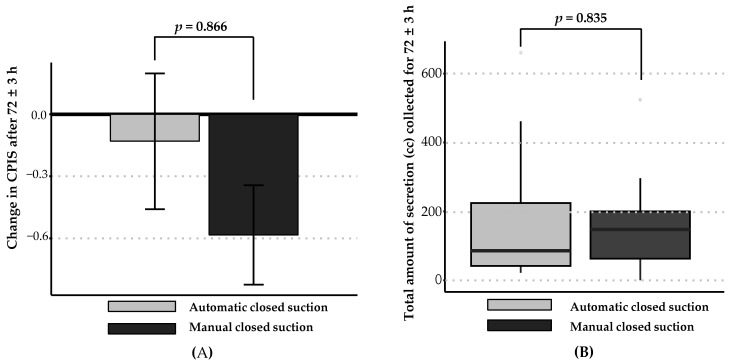
Endotracheal suctioning is an essential but labor-intensive procedure, with the risk of serious complications. A brand new automatic closed-suction device was developed to alleviate the workload of healthcare providers and minimize those complications. We evaluated the clinical efficacy and safety of the automatic suction system in mechanically ventilated patients with pneumonia. In this multicenter, randomized, non-inferiority, investigator-initiated trial, mechanically ventilated patients with pneumonia were randomized to the automatic device (intervention) or conventional manual suctioning (control). The primary efficacy outcome was the change in the modified clinical pulmonary infection score (CPIS) in 3 days. Secondary outcomes were the frequency of additional suctioning and the amount of secretion. Safety outcomes included adverse events or complications. A total of 54 participants, less than the pre-determined number of 102, were enrolled. There was no significant difference in the change in the CPIS over 72 h (-0.13 ± 1.58 in the intervention group, -0.58 ± 1.18 in the control group, = 0.866), but the non-inferiority margin was not satisfied. There were no significant differences in the secondary outcomes and safety outcomes, with a tendency for more patients with improved tracheal mucosal injury in the intervention group. The novel automatic closed-suction system showed comparable efficacy and safety compared with conventional manual suctioning in mechanically ventilated patients with pneumonia.
气管内吸痰是一项必不可少但劳动强度大的操作,存在严重并发症的风险。一种全新的自动封闭式吸痰装置被研发出来,以减轻医护人员的工作量并将这些并发症降至最低。我们评估了该自动吸痰系统在机械通气肺炎患者中的临床疗效和安全性。在这项多中心、随机、非劣效性、研究者发起的试验中,机械通气肺炎患者被随机分为自动装置组(干预组)或传统手动吸痰组(对照组)。主要疗效指标是3天内改良临床肺部感染评分(CPIS)的变化。次要指标是额外吸痰的频率和分泌物量。安全性指标包括不良事件或并发症。共招募了54名参与者,少于预先确定的102名。72小时内CPIS的变化无显著差异(干预组为-0.13±1.58,对照组为-0.58±1.18,P=0.866),但未达到非劣效性界值。次要指标和安全性指标无显著差异,干预组气管黏膜损伤改善的患者有增多趋势。新型自动封闭式吸痰系统在机械通气肺炎患者中与传统手动吸痰相比,疗效和安全性相当。