Plubell Deanna L, Remes Philip M, Wu Christine C, Jacob Cristina C, Merrihew Gennifer E, Hsu Chris, Shulman Nick, MacLean Brendan X, Heil Lilian, Poston Kathleen, Montine Tom, MacCoss Michael J
Department of Genome Sciences, University of Washington, Seattle WA.
Thermo Fisher Scientific, San Jose, CA.
bioRxiv. 2024 Jun 11:2024.06.04.597431. doi: 10.1101/2024.06.04.597431.
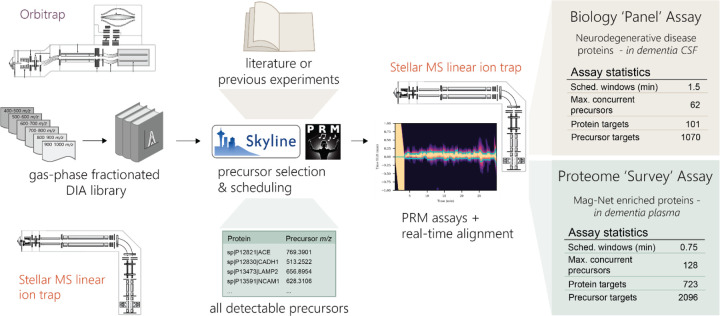
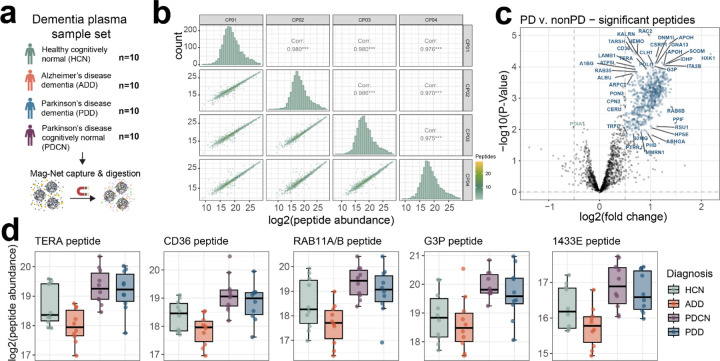
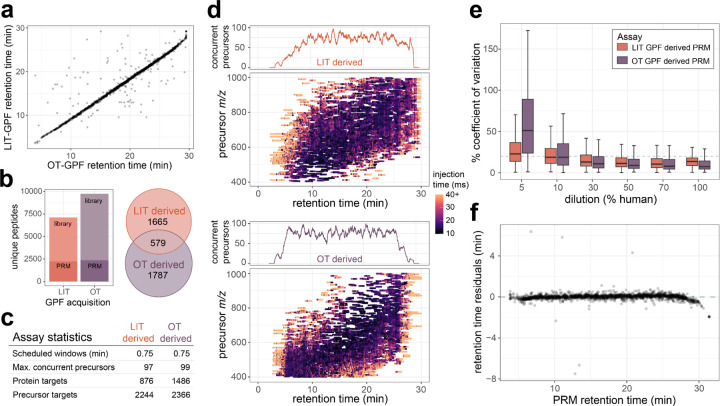
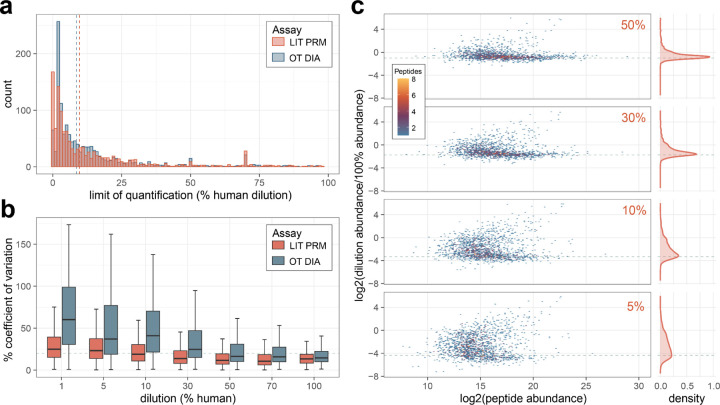
The development of targeted assays that monitor biomedically relevant proteins is an important step in bridging discovery experiments to large scale clinical studies. Targeted assays are currently unable to scale to hundreds or thousands of targets. We demonstrate the generation of large-scale assays using a novel hybrid nominal mass instrument. The scale of these assays is achievable with the Stellar mass spectrometer through the accommodation of shifting retention times by real-time alignment, while being sensitive and fast enough to handle many concurrent targets. Assays were constructed using precursor information from gas-phase fractionated (GPF) data-independent acquisition (DIA). We demonstrate the ability to schedule methods from an orbitrap and linear ion trap acquired GPF DIA library and compare the quantification of a matrix-matched calibration curve from orbitrap DIA and linear ion trap parallel reaction monitoring (PRM). Two applications of these proposed workflows are shown with a cerebrospinal fluid (CSF) neurodegenerative disease protein PRM assay and with a Mag-Net enriched plasma extracellular vesicle (EV) protein survey PRM assay.
监测生物医学相关蛋白质的靶向分析方法的发展是将发现实验与大规模临床研究联系起来的重要一步。目前,靶向分析方法还无法扩展到数百或数千个靶点。我们展示了使用新型混合标称质量仪器生成大规模分析方法的过程。通过实时校准来适应保留时间的变化,使用恒星质谱仪可以实现这些分析方法的规模扩展,同时其灵敏度和速度足以处理多个并发靶点。分析方法是利用气相分级(GPF)数据非依赖采集(DIA)的前体信息构建的。我们展示了从轨道阱和线性离子阱获取的GPF DIA库中安排方法的能力,并比较了轨道阱DIA和线性离子阱平行反应监测(PRM)对基质匹配校准曲线的定量分析。这些提议的工作流程的两个应用展示在脑脊液(CSF)神经退行性疾病蛋白质PRM分析以及磁珠富集血浆细胞外囊泡(EV)蛋白质检测PRM分析中。