Fendler Nikole L, Ly Jimmy, Welp Luisa, Urlaub Henning, Vos Seychelle M
Department of Biology, Massachusetts Institute of Technology, Building 68, 31 Ames St., Cambridge, MA 02139.
Whitehead Institute for Biomedical Research, Cambridge, MA 02139.
bioRxiv. 2024 Jun 6:2024.06.05.597643. doi: 10.1101/2024.06.05.597643.
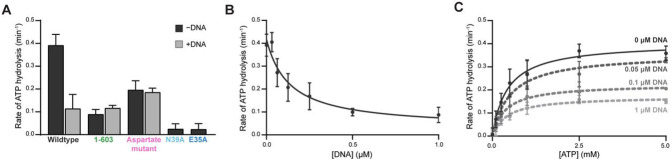
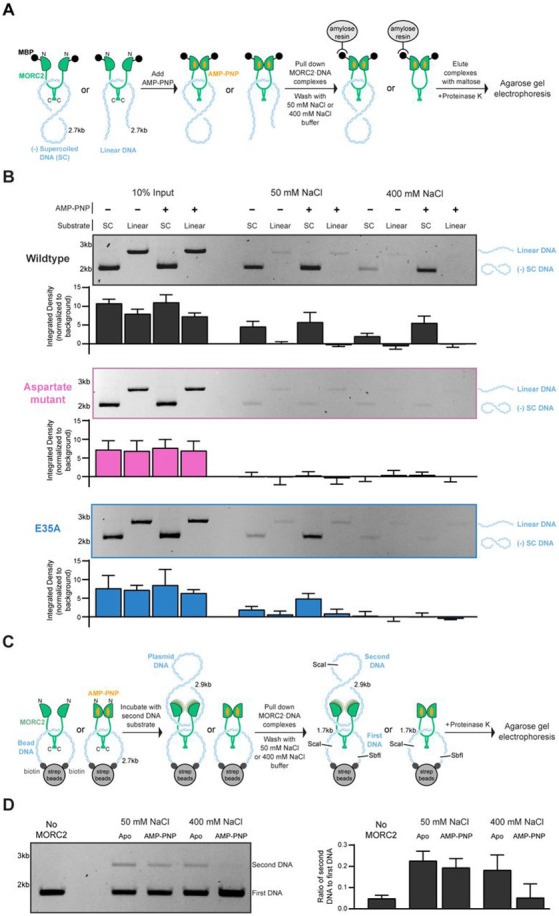
The eukaryotic microrchidia (MORC) protein family are DNA gyrase, Hsp90, histidine kinase, MutL (GHKL)-type ATPases involved in gene expression regulation and chromatin compaction. The molecular mechanisms underlying these activities are incompletely understood. Here we studied the full-length human MORC2 protein biochemically. We identified a DNA binding site in the C-terminus of the protein, and we observe that this region is heavily phosphorylated in cells. Phosphorylation of MORC2 reduces its affinity for DNA and appears to exclude the protein from the nucleus. We observe that DNA binding by MORC2 reduces its ATPase activity and that MORC2 can topologically entrap multiple DNA substrates between its N-terminal GHKL and C-terminal coiled coil 3 dimerization domains. Finally, we observe that the MORC2 C-terminal DNA binding region is required for gene silencing in cells. Together, our data provide a model to understand how MORC2 engages with DNA substrates to mediate gene silencing.
真核微小orchidia(MORC)蛋白家族是参与基因表达调控和染色质压缩的DNA解旋酶、热休克蛋白90、组氨酸激酶、MutL(GHKL)型ATP酶。这些活性背后的分子机制尚未完全了解。在这里,我们对全长人类MORC2蛋白进行了生化研究。我们在该蛋白的C末端鉴定出一个DNA结合位点,并且我们观察到该区域在细胞中高度磷酸化。MORC2的磷酸化降低了其对DNA的亲和力,并似乎将该蛋白排除在细胞核外。我们观察到MORC2与DNA的结合降低了其ATP酶活性,并且MORC2可以在其N末端GHKL和C末端卷曲螺旋3二聚化结构域之间拓扑捕获多个DNA底物。最后,我们观察到MORC2的C末端DNA结合区域是细胞中基因沉默所必需的。总之,我们的数据提供了一个模型,以了解MORC2如何与DNA底物结合以介导基因沉默。