
优化跨部门真实世界健康数据的提供:一个用于改善临床研究和患者护理的服务平台。
Streamlining intersectoral provision of real-world health data: a service platform for improved clinical research and patient care.
作者信息
Hoffmann Katja, Nesterow Igor, Peng Yuan, Henke Elisa, Barnett Daniela, Klengel Cigdem, Gruhl Mirko, Bartos Martin, Nüßler Frank, Gebler Richard, Grummt Sophia, Seim Anne, Bathelt Franziska, Reinecke Ines, Wolfien Markus, Weidner Jens, Sedlmayr Martin
机构信息
Faculty of Medicine Carl Gustav Carus, Institute for Medical Informatics and Biometry, Technische Universität Dresden, Dresden, Germany.
Data Integration Center, Center for Medical Informatics, University Hospital Carl Gustav Carus, Dresden, Germany.
出版信息
Front Med (Lausanne). 2024 Jun 5;11:1377209. doi: 10.3389/fmed.2024.1377209. eCollection 2024.
INTRODUCTION
Obtaining real-world data from routine clinical care is of growing interest for scientific research and personalized medicine. Despite the abundance of medical data across various facilities - including hospitals, outpatient clinics, and physician practices - the intersectoral exchange of information remains largely hindered due to differences in data structure, content, and adherence to data protection regulations. In response to this challenge, the Medical Informatics Initiative (MII) was launched in Germany, focusing initially on university hospitals to foster the exchange and utilization of real-world data through the development of standardized methods and tools, including the creation of a common core dataset. Our aim, as part of the Medical Informatics Research Hub in Saxony (MiHUBx), is to extend the MII concepts to non-university healthcare providers in a more seamless manner to enable the exchange of real-world data among intersectoral medical sites.
METHODS
We investigated what services are needed to facilitate the provision of harmonized real-world data for cross-site research. On this basis, we designed a Service Platform Prototype that hosts services for data harmonization, adhering to the globally recognized Health Level 7 (HL7) Fast Healthcare Interoperability Resources (FHIR) international standard communication format and the Observational Medical Outcomes Partnership (OMOP) common data model (CDM). Leveraging these standards, we implemented additional services facilitating data utilization, exchange and analysis. Throughout the development phase, we collaborated with an interdisciplinary team of experts from the fields of system administration, software engineering and technology acceptance to ensure that the solution is sustainable and reusable in the long term.
RESULTS
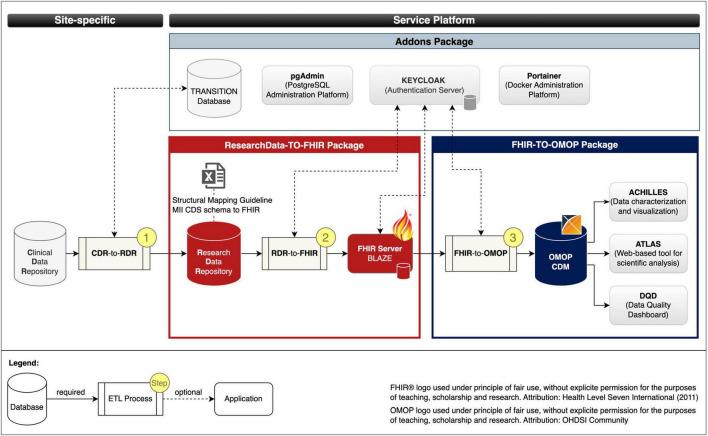
We have developed the pre-built packages "ResearchData-to-FHIR," "FHIR-to-OMOP," and "Addons," which provide the services for data harmonization and provision of project-related real-world data in both the FHIR MII Core dataset format (CDS) and the OMOP CDM format as well as utilization and a Service Platform Prototype to streamline data management and use.
CONCLUSION
Our development shows a possible approach to extend the MII concepts to non-university healthcare providers to enable cross-site research on real-world data. Our Service Platform Prototype can thus pave the way for intersectoral data sharing, federated analysis, and provision of SMART-on-FHIR applications to support clinical decision making.
引言
从常规临床护理中获取真实世界数据对于科学研究和个性化医疗越来越重要。尽管各类医疗机构(包括医院、门诊诊所和医生执业机构)存在大量医疗数据,但由于数据结构、内容以及对数据保护法规的遵循情况存在差异,部门间的信息交换在很大程度上仍然受到阻碍。为应对这一挑战,德国启动了医学信息学倡议(MII),最初聚焦于大学医院,通过开发标准化方法和工具,包括创建一个通用核心数据集,来促进真实世界数据的交换和利用。作为萨克森医学信息学研究中心(MiHUBx)的一部分,我们的目标是以更无缝的方式将MII概念扩展到非大学医疗服务提供者,以实现跨部门医疗站点之间真实世界数据的交换。
方法
我们调查了为跨站点研究提供统一的真实世界数据需要哪些服务。在此基础上,我们设计了一个服务平台原型,该平台承载数据协调服务,遵循全球公认的健康水平7(HL7)快速医疗保健互操作性资源(FHIR)国际标准通信格式和观察性医疗结果合作组织(OMOP)通用数据模型(CDM)。利用这些标准,我们实施了额外的服务,以促进数据利用、交换和分析。在整个开发阶段,我们与系统管理、软件工程和技术接受领域的跨学科专家团队合作,以确保该解决方案具有长期可持续性和可重用性。
结果
我们开发了预构建包“ResearchData-to-FHIR”、“FHIR-to-OMOP”和“插件”,它们以FHIR MII核心数据集格式(CDS)和OMOP CDM格式提供数据协调服务以及与项目相关的真实世界数据,并提供数据利用功能,以及一个服务平台原型,以简化数据管理和使用。
结论
我们的开发展示了一种将MII概念扩展到非大学医疗服务提供者以实现真实世界数据跨站点研究的可行方法。我们的服务平台原型因此可以为部门间数据共享、联合分析以及提供基于FHIR的智能应用以支持临床决策铺平道路。


 Zotero 插件