Findeis Hannelore, Strauß Maria, Kröber Hans-Ludwig
Klinik für Psychiatrie und Psychotherapie, Universitätsklinikum Leipzig, Leipzig, Germany.
Institut für Forensische Psychiatrie, Charité Berlin, Berlin, Germany.
Front Psychiatry. 2024 Jun 11;15:1404263. doi: 10.3389/fpsyt.2024.1404263. eCollection 2024.
There is evidence that there is a small group of people with schizophrenia spectrum disorders who are more likely to commit homicide than those in the general population. However, there is limited knowledge about the psychopathology that leads to homicide in this group. The aim of this study was to examine two commonly used definitions of the concept, which aims to identify a certain risk of serious violence in patients with schizophrenia spectrum disorders.
This is a sub analysis of a file-based, retrospective and exploratory cross-sectional study. All forensic homicide offenders with schizophrenia spectrum disorders who were detained at the Forensic Hospital Berlin as of 31 December 2014 were examined for the occurrence of according to two commonly used definitions.
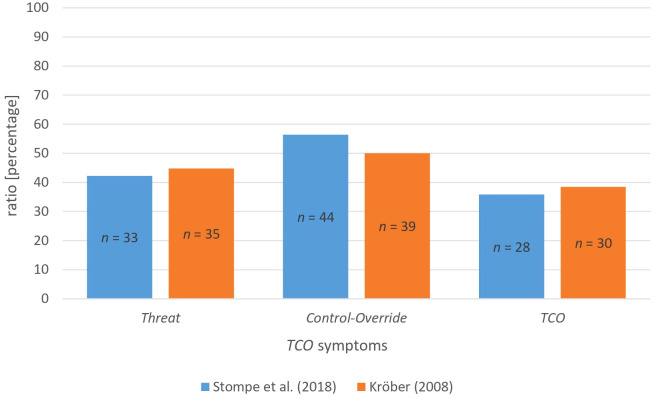
Of a total of 419 forensic patients with schizophrenia spectrum disorders, 78 committed homicide (18.6%). The forensic homicide offenders with schizophrenia spectrum disorders were characterised by being male, unemployed, single and having committed (attempted) manslaughter. Irrespective of the definition used, the entire complex was present in less than a third of the sample. In both definitions, symptoms were slightly less frequent than symptoms. While symptoms occurred less frequently in Stompe et al.'s definition, symptoms were the most common. With regard to Kröber's definition of and , the situation is exactly the opposite.
Regarding the entire complex, Kröber's definition seems a little more open and Stompe et al.'s more strict (38.5% . 35.9%). Since only occurs in about one third of the subjects in both definitions, neither definition appears to be conclusive. A combination with proportions from both definitions could be a contribution to a future definition of . The present study provides scarcely published primary data on psychopathology in homicide offenders with schizophrenia spectrum disorders, especially on the much discussed concept in two definitions. In order to determine the most useful definition of , to avoid false positives and to identify clear psychopathological risk symptoms, larger samples and comparative studies with offenders and non-offenders should be conducted in the future.
有证据表明,一小部分精神分裂症谱系障碍患者比普通人群更有可能实施杀人行为。然而,对于导致该群体杀人行为的精神病理学知识却很有限。本研究的目的是检验该概念的两种常用定义,旨在识别精神分裂症谱系障碍患者中严重暴力行为的特定风险。
这是一项基于档案的回顾性探索性横断面研究的子分析。对截至2014年12月31日被关押在柏林法医医院的所有患有精神分裂症谱系障碍的法医杀人罪犯,根据两种常用定义检查其发生情况。
在总共419名患有精神分裂症谱系障碍的法医患者中,78人实施了杀人行为(18.6%)。患有精神分裂症谱系障碍的法医杀人罪犯的特征是男性、失业、单身且实施过(未遂) manslaughter(此处“manslaughter”未翻译完整,可能是“过失杀人”之类的专业术语)。无论使用何种定义,整个 复合体(此处“复合体”指代不明)在不到三分之一的样本中出现。在两种定义中, 症状的出现频率略低于 症状。在Stompe等人的定义中, 症状出现频率较低,而 症状最为常见。关于Kröber对 和 的定义,情况正好相反。
关于整个 复合体,Kröber的定义似乎更宽松一些,而Stompe等人的定义更严格(38.5% 对35.9%)。由于在两种定义中 仅在约三分之一的受试者中出现,两种定义似乎都不具有决定性。将两种定义的比例结合起来可能有助于未来对 的定义。本研究提供了关于患有精神分裂症谱系障碍的杀人罪犯精神病理学的几乎未发表的原始数据,特别是关于两种定义中备受讨论的 概念。为了确定最有用的 定义,避免假阳性并识别明确的精神病理学风险症状,未来应进行更大规模的样本研究以及罪犯与非罪犯的比较研究。