Xie Shijing, Lei Min, Sun Jiawei, Yang Chongdou, Liu Wenbo, Yun Di, Zhao Xiqiang, Qiu Jie
School of Nuclear Science and Technology, Xi'an Jiaotong University, Xi'an 710049, China.
State Key Laboratory of Multiphase Flow, Xi'an Jiaotong University, Xi'an 710049, China.
Nanomaterials (Basel). 2024 Jun 13;14(12):1026. doi: 10.3390/nano14121026.
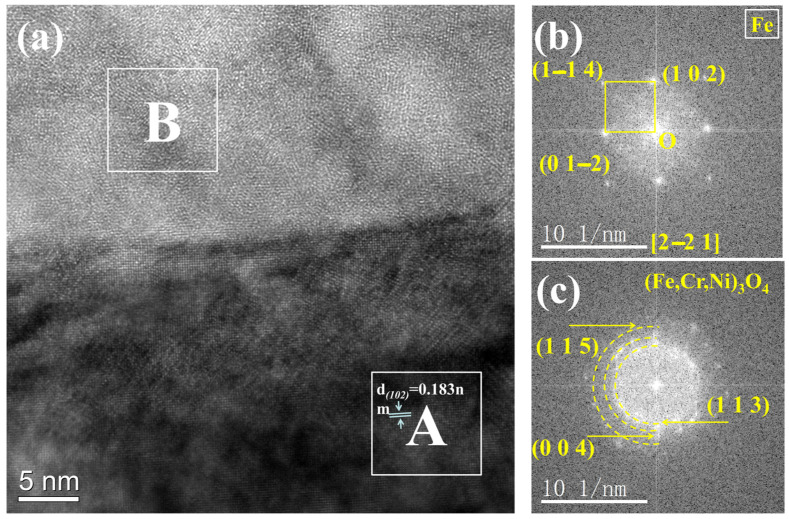
The corrosion behavior of 20G and TP347H materials was investigated in molten LiCl-NaCl-KCl salt. The corrosion rates of these materials in molten chloride salt are high and are strongly affected by the alloying surface oxide formation. The 20G shows uniform surface corrosion with almost no protective oxide formation on the surface. In contrast, the austenitic steel TP347H exhibits better corrosion resistance in molten chloride salts due to its high Cr content. Owing to the highly corrosive nature of molten chloride salts, the Cl in molten salt could react with oxides and alloy, inducing intergranular corrosion of austenitic steel in molten chloride salt environments.
研究了20G和TP347H材料在LiCl-NaCl-KCl熔盐中的腐蚀行为。这些材料在氯化物熔盐中的腐蚀速率很高,并且受到合金表面氧化物形成的强烈影响。20G表现出均匀的表面腐蚀,表面几乎没有形成保护性氧化物。相比之下,奥氏体不锈钢TP347H由于其高铬含量,在氯化物熔盐中表现出更好的耐腐蚀性。由于氯化物熔盐的高腐蚀性,熔盐中的Cl会与氧化物和合金发生反应,在氯化物熔盐环境中引发奥氏体不锈钢的晶间腐蚀。