Liu Chang, Wu Hailong, Guo Anfu, Kong Dekun, Zhao Zhengyu, Wang Lu, Yin Lvfa, Xia Guojun, Su Xiaofei, Hu Yingbin
School of Mechanical and Automotive Engineering, Liaocheng University, Liaocheng 252000, China.
Department of Mechanical and Manufacturing Engineering, Miami University, Oxford, OH 45056, USA.
Materials (Basel). 2024 Jun 18;17(12):2973. doi: 10.3390/ma17122973.
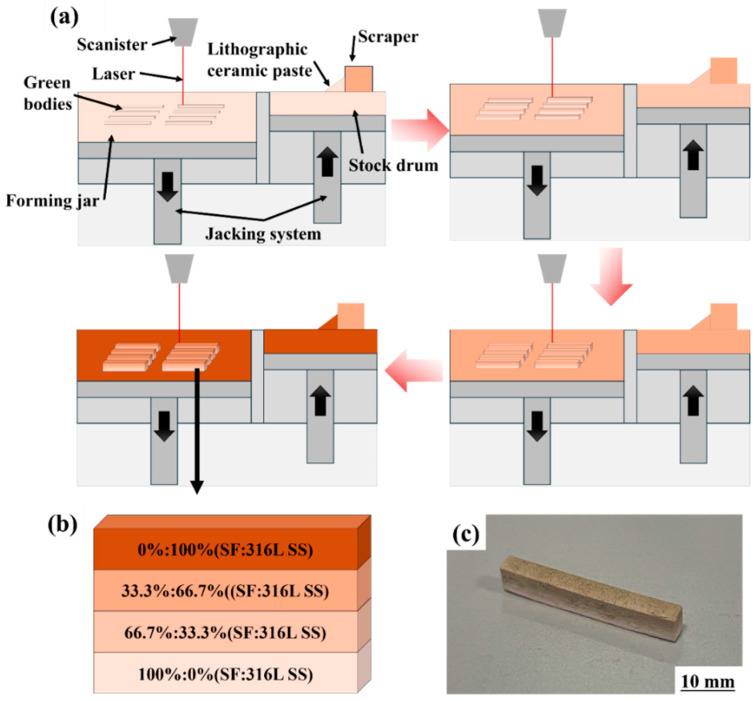
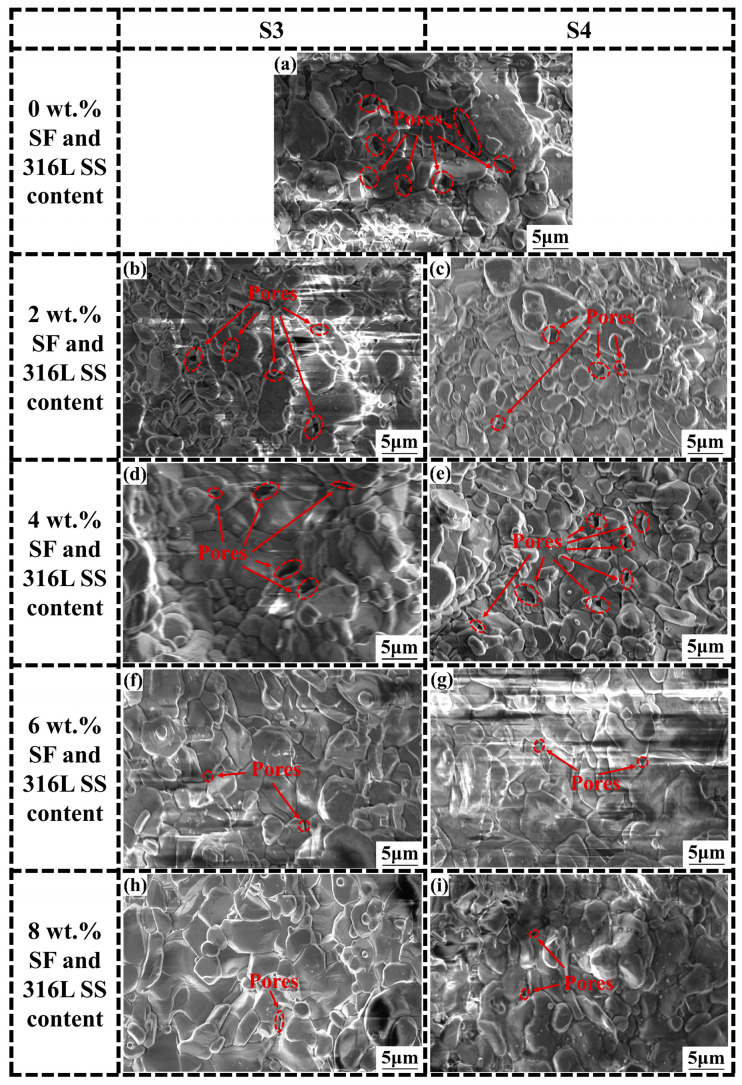
Alumina (AlO) ceramics are widely used in electronics, machinery, healthcare, and other fields due to their excellent hardness and high temperature stability. However, their high brittleness limits further applications, such as artificial ceramic implants and highly flexible protective gear. To address the limitations of single-phase toughening in AlO ceramics, some researchers have introduced a second phase to enhance these ceramics. However, introducing a single phase still limits the range of performance improvement. Therefore, this study explores the printing of AlO ceramics by adding two different phases. Additionally, a new gradient printing technique is proposed to overcome the limitations of single material homogeneity, such as uniform performance and the presence of large residual stresses. Unlike traditional vat photopolymerization printing technology, this study stands out by generating green bodies with varying second-phase particle ratios across different layers. This study investigated the effects of different contents of sepiolite fiber (SF) and 316L stainless steel (SS) on various aspects of microstructure, phase composition, physical properties, and mechanical properties of gradient-printed AlO. The experimental results demonstrate that compared to AlO parts without added SF and 316L SS, the inclusion of these materials can significantly reduce porosity and water absorption, resulting in a denser structure. In addition, the substantial improvements, with an increase of 394.4% in flexural strength and an increase of 316.7% in toughness, of the AlO components enhanced by incorporating SF and 316L SS have been obtained.
氧化铝(Al₂O₃)陶瓷因其优异的硬度和高温稳定性而广泛应用于电子、机械、医疗保健等领域。然而,其高脆性限制了进一步的应用,如人造陶瓷植入物和高柔韧性防护装备。为了解决Al₂O₃陶瓷单相增韧的局限性,一些研究人员引入了第二相来增强这些陶瓷。然而,引入单相仍然限制了性能提升的范围。因此,本研究探索通过添加两种不同的相来打印Al₂O₃陶瓷。此外,还提出了一种新的梯度打印技术,以克服单一材料均匀性的局限性,如性能均匀性和存在较大残余应力等问题。与传统的光固化3D打印技术不同,本研究的突出之处在于生成的坯体在不同层具有不同的第二相颗粒比例。本研究调查了海泡石纤维(SF)和316L不锈钢(SS)的不同含量对梯度打印Al₂O₃陶瓷的微观结构、相组成、物理性能和力学性能等各个方面的影响。实验结果表明,与未添加SF和316L SS的Al₂O₃部件相比,加入这些材料可显著降低孔隙率和吸水率,从而得到更致密的结构。此外,通过加入SF和316L SS增强的Al₂O₃部件在抗弯强度上提高了394.4%,韧性提高了316.7%,取得了显著的改进。