
头颈部神经源性肿瘤的治疗结果
Outcomes of Head and Neck Neurogenic Tumors.
作者信息
Ali Mohamed A, Attia Amr, Farahat Iman G
机构信息
Head and Neck Surgery, National Cancer Institute, Cairo, EGY.
Pathology, National Cancer Institute, Cairo, EGY.
出版信息
Cureus. 2024 May 27;16(5):e61156. doi: 10.7759/cureus.61156. eCollection 2024 May.
BACKGROUND
Lateral neck mass management frequently challenges surgeons. Nerve tissue neoplasms are an uncommon cause of such nodules. Neurogenic tumors form a tiny percentage of the head and neck neoplastic lesions. Considering the number of nerves in this area, it is surprising that such neoplasms are not more frequently seen.
METHODS
A retrospective study was conducted on all patients who presented to the National Cancer Institute of Cairo, Egypt, with head and neck neurogenic neoplasms.
RESULTS
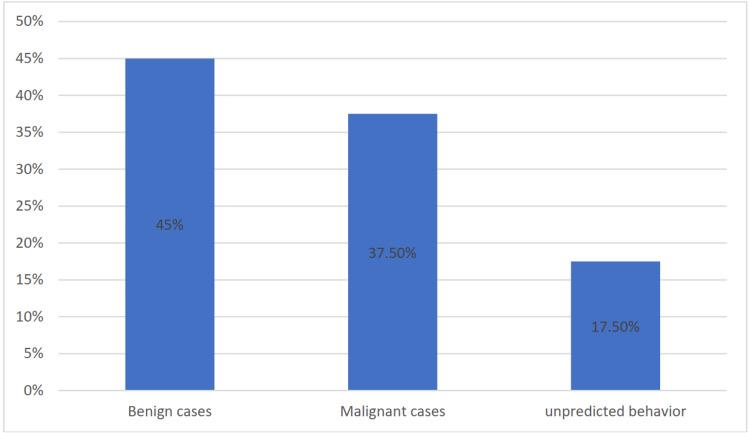
During the last 10 years at the National Cancer Institute of Egypt (2006-2015), 40 cases of neurogenic tumors of the head and neck were treated at the head and neck unit. Patients' ages ranged from two to 78 years with a mean age of 34.7 years. Childhood neurogenic tumors accounted for nine cases (22.5%) only in this study. Male patients diagnosed with these tumors comprised 16 cases, while female patients comprised 24 cases, with a female-to-male ratio of 1.5:1. Patient presentation depends on the biological behavior of the tumor; for instance, some of them present by slowly growing painless well-circumscribed mobile swelling, and others present by rapidly growing swelling with neurological deficit. Clinical picture and imaging studies such as CT and MRI raise suspicion and may help delineate such tumors, but a definitive diagnosis is obtained by tissue biopsy. Surgery is the mainstay of treatment in most head and neck neurogenic tumors, whereas adjuvant therapy is of limited benefit in some types of neurogenic tumors. The five-year survival rate was 60% for the malignant group, while death was reported in six out of 15 cases (40%). Conclusion: Most neurogenic head and neck tumors are benign. Accurate preoperative assessment and a high degree of suspicion are the initial steps in the management. Proper treatment involves complete surgical excision; however, debulking procedures have an important role. Malignant neurogenic tumors are aggressive and are treated with combined radical surgical resection and radiation. Chemotherapy is tried for locally advanced unresectable or metastatic disease.
背景
颈部肿块的处理常给外科医生带来挑战。神经组织肿瘤是此类结节的罕见病因。神经源性肿瘤在头颈部肿瘤性病变中占比极小。鉴于该区域神经数量众多,此类肿瘤未更频繁出现令人惊讶。
方法
对所有就诊于埃及开罗国家癌症研究所的头颈部神经源性肿瘤患者进行回顾性研究。
结果
在埃及国家癌症研究所过去10年(2006 - 2015年)期间,头颈科共治疗了40例头颈部神经源性肿瘤患者。患者年龄从2岁至78岁不等,平均年龄为34.7岁。本研究中儿童神经源性肿瘤仅9例(22.5%)。诊断为这些肿瘤的男性患者16例,女性患者24例,男女比例为1.5:1。患者的表现取决于肿瘤的生物学行为;例如,一些患者表现为缓慢生长、无痛、边界清晰的可移动肿块,另一些患者则表现为快速生长的肿块并伴有神经功能缺损。临床表现以及CT和MRI等影像学检查会引发怀疑并有助于勾勒此类肿瘤,但最终诊断需通过组织活检获得。手术是大多数头颈部神经源性肿瘤的主要治疗方法,而辅助治疗在某些类型的神经源性肿瘤中益处有限。恶性组的五年生存率为60%,15例中有6例(40%)死亡。结论:大多数头颈部神经源性肿瘤为良性。准确的术前评估和高度怀疑是处理的初始步骤。恰当的治疗包括完整的手术切除;然而,减瘤手术也有重要作用。恶性神经源性肿瘤具有侵袭性,需采用根治性手术切除联合放疗治疗。对于局部晚期不可切除或转移性疾病则尝试化疗。




 Zotero 插件