Cardiovascular R&D Centre - UnIC@RISE, Department of Surgery and Physiology, Faculty of Medicine of the University of Porto, Alameda Prof. Hernâni Monteiro, 4200-319, Porto, Portugal.
Faculdade de Medicina Dentária, Universidade do Porto, 4200-393, Porto, Portugal.
Sci Rep. 2024 Jun 27;14(1):14815. doi: 10.1038/s41598-024-65612-1.
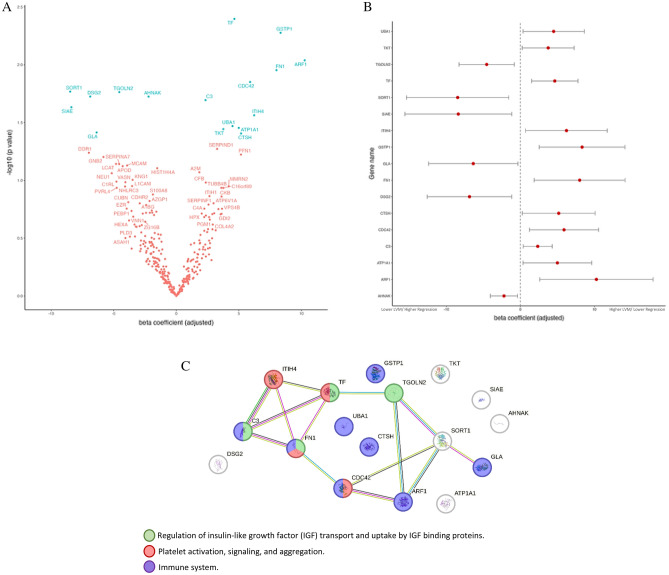
The association of postpartum cardiac reverse remodeling (RR) with urinary proteome, particularly in pregnant women with cardiovascular (CV) risk factors who show long-term increased risk of cardiovascular disease and mortality is unknown. We aim to profile the urinary proteome in pregnant women with/without CV risk factors to identify proteins associated with postpartum RR. Our study included a prospective cohort of 32 healthy and 27 obese and/or hypertensive and/or diabetic pregnant women who underwent transthoracic echocardiography, pulse-wave-velocity, and urine collection at the 3rd trimester and 6 months postpartum. Shotgun HPLC-MS/MS profiled proteins. Generalized linear mixed-effects models were used to identify associations between urinary proteins and left ventricle mass (LVM), a surrogate of RR. An increase in arterial stiffness was documented from 3rd trimester to 6 months after delivery, being significantly elevated in women with CV risk factors. In addition, the presence of at least one CV risk factor was associated with worse LVM RR. We identified 6 and 11 proteins associated with high and low LVM regression, respectively. These proteins were functionally linked with insulin-like growth factor (IGF) transport and uptake regulation by IGF binding-proteins, platelet activation, signaling and aggregation and the immune system's activity. The concentration of IGF-1 in urine samples was associated with low LVM regression after delivery. Urinary proteome showed a predicting potential for identifying pregnant women with incomplete postpartum RR.
产后心脏逆向重构(RR)与尿蛋白质组的关联,特别是在有心血管(CV)危险因素的孕妇中,这些孕妇长期存在心血管疾病和死亡率增加的风险,目前尚不清楚。我们旨在对有/无 CV 危险因素的孕妇进行尿蛋白质组分析,以确定与产后 RR 相关的蛋白质。我们的研究纳入了 32 名健康孕妇和 27 名肥胖和/或高血压和/或糖尿病孕妇,这些孕妇在孕晚期和产后 6 个月时接受了经胸超声心动图、脉搏波速度和尿液采集。使用高效液相色谱-串联质谱法(HPLC-MS/MS)进行蛋白质谱分析。使用广义线性混合效应模型来确定尿液蛋白与左心室质量(LVM)之间的关联,LVM 是 RR 的替代指标。从孕晚期到产后 6 个月,动脉僵硬度增加,有 CV 危险因素的女性显著升高。此外,至少有一种 CV 危险因素的存在与更差的 LVM RR 相关。我们鉴定出 6 种和 11 种与高和低 LVM 回归分别相关的蛋白质。这些蛋白质与胰岛素样生长因子(IGF)的运输和摄取调节、血小板激活、信号转导和聚集以及免疫系统的活性有关。尿液样本中 IGF-1 的浓度与产后 LVM 回归较低有关。尿蛋白质组显示出预测未完全恢复产后 RR 的孕妇的潜力。