Khaleel Ibrahim, Harris Andrew W, Seth Milan, Sukul Devraj, Deeb G Michael, Joseph Megan S, Grossman P Michael, Fukuhara Shinichi, Chetcuti Stanley
Department of Internal Medicine, University of Michigan, Ann Arbor, Michigan, USA.
Division of Cardiovascular Medicine, Department of Medicine, University of Michigan, Ann Arbor, Michigan, USA.
JACC Adv. 2023 Oct 5;2(9):100641. doi: 10.1016/j.jacadv.2023.100641. eCollection 2023 Nov.
Prior studies of aortic valve replacement (AVR) in patients with normal-flow, low-gradient aortic stenosis (NF-LG AS) have demonstrated conflicting results regarding the survival benefit of AVR. Changes in quality of life (QoL) after transcatheter AVR (TAVR) have not been reported in this population.
The purpose of this study was to compare changes in QoL after TAVR for patients with NF-LG AS to patients with high-gradient aortic stenosis (HG-AS).
Patients who underwent TAVR for severe aortic stenosis (AS) were divided into 4 hemodynamic profiles of AS, including NF-LG AS. Changes in Kansas City Cardiomyopathy Questionnaire-12 score from baseline to 1 year were compared between AS groups. The primary composite outcome indicating clinical improvement consisted of survival to 1 year and improved Kansas City Cardiomyopathy Questionnaire overall summary score of ≥5 points while adjusting for relevant baseline factors.
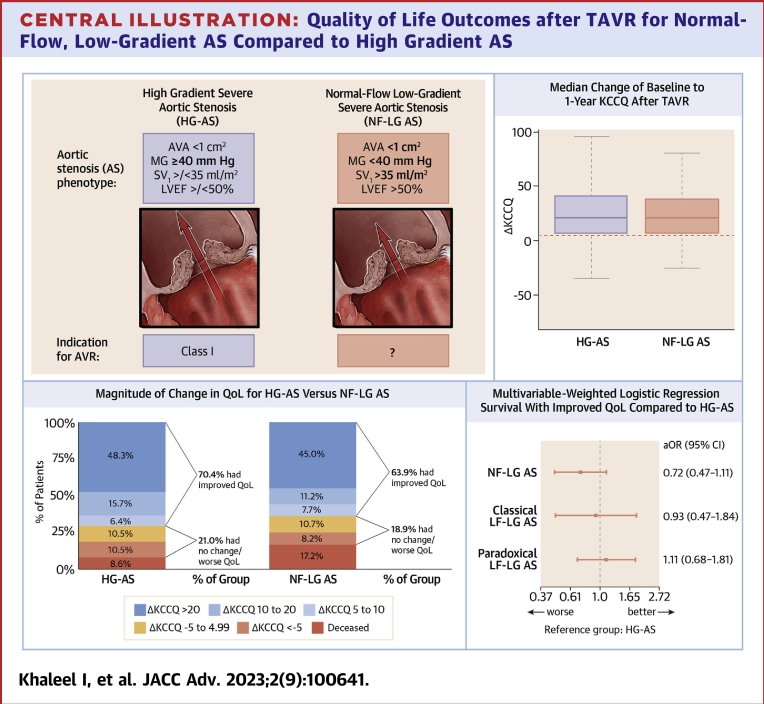
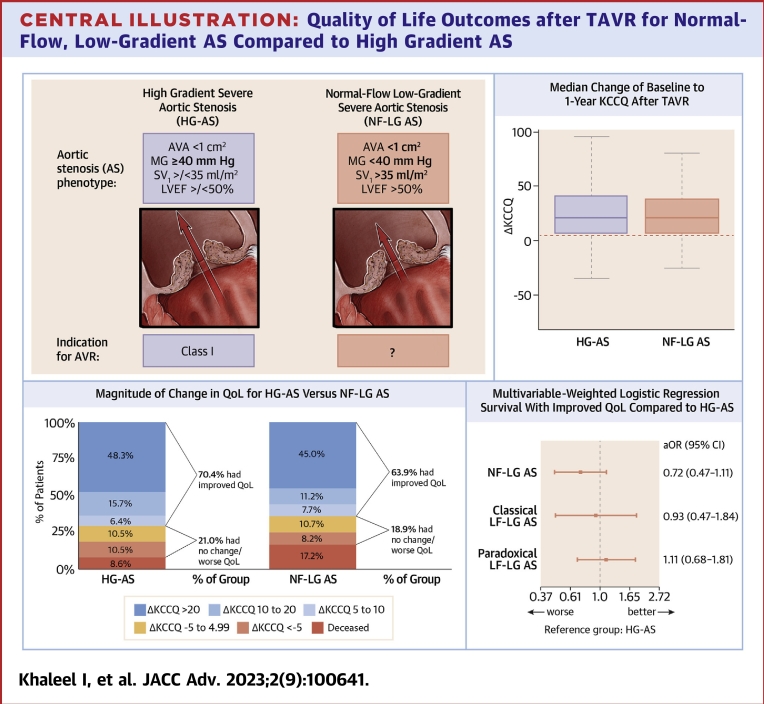
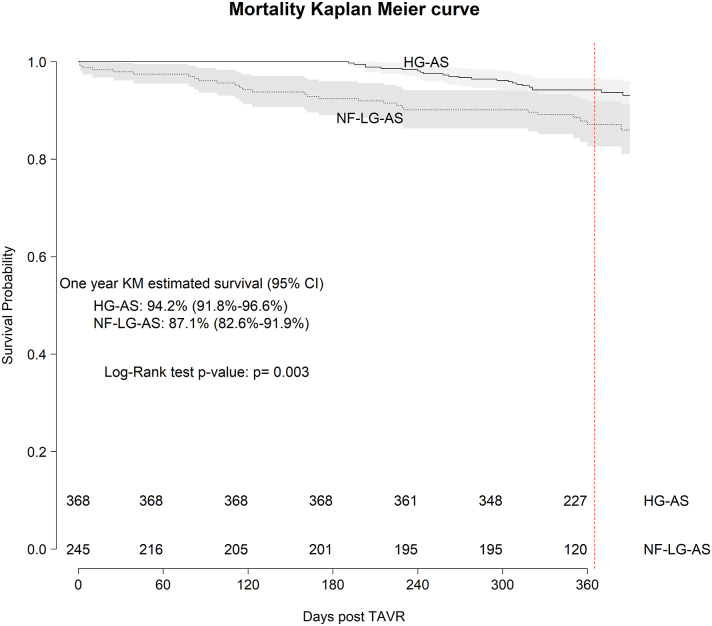
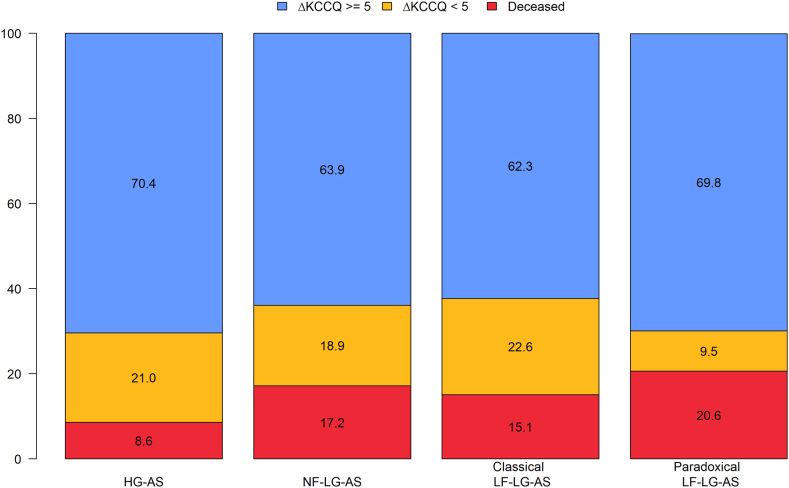
Out of 860 patients who underwent TAVR, high gradient AS was present in 368 (42.8%) patients and NF-LG AS in 245 (28.5%). HG-AS and NF-LG AS groups had a similar proportion of patients who met the primary unadjusted outcome of clinical improvement (70.4% vs 63.9%, respectively; = 0.189). One-year Kaplan-Meier mortality estimates were higher for NF-LG AS patients than HG-AS patients (12.9% vs 5.8%, < 0.001). In the primary adjusted analysis, there was no significant difference in the composite outcome between HG and NF-LG AS groups (adjusted OR: 0.72, 95% CI: 0.47-1.11).
Selected patients with NF-LG AS experienced similar improvement in QoL after TAVR compared with HG-AS. Further investigation of patients with NF-LG AS will help to inform optimal selection for treatment with TAVR.
既往关于正常血流、低跨瓣压差主动脉瓣狭窄(NF-LG AS)患者行主动脉瓣置换术(AVR)的研究,在AVR对生存获益方面显示出相互矛盾的结果。经导管主动脉瓣置换术(TAVR)后该人群生活质量(QoL)的变化尚未见报道。
本研究旨在比较NF-LG AS患者与高跨瓣压差主动脉瓣狭窄(HG-AS)患者TAVR后QoL的变化。
因严重主动脉瓣狭窄(AS)接受TAVR的患者被分为4种AS血流动力学类型,包括NF-LG AS。比较各AS组从基线到1年时堪萨斯心肌病问卷-12评分的变化。表明临床改善的主要复合结局包括存活至1年且堪萨斯心肌病问卷总体总结评分提高≥5分,同时对相关基线因素进行校正。
在860例行TAVR的患者中,368例(42.8%)为高跨瓣压差AS,245例(28.5%)为NF-LG AS。HG-AS组和NF-LG AS组达到临床改善这一未校正主要结局的患者比例相似(分别为70.4%和63.9%;P = 0.189)。NF-LG AS患者1年的Kaplan-Meier死亡率估计高于HG-AS患者(12.9%对5.8%,P < 0.001)。在主要校正分析中HG组和NF-LG AS组之间的复合结局无显著差异(校正OR:0.72,95%CI:0.47-1.11)。
与HG-AS相比,部分NF-LG AS患者TAVR后QoL改善相似。对NF-LG AS患者的进一步研究将有助于为TAVR治疗的最佳选择提供依据。