• 文献检索
  • 文档翻译
  • 深度研究
  • 学术资讯
  • Suppr Zotero 插件Zotero 插件
  • 邀请有礼
  • 套餐&价格
  • 历史记录
应用&插件
Suppr Zotero 插件Zotero 插件浏览器插件Mac 客户端Windows 客户端微信小程序
定价
高级版会员购买积分包购买API积分包
服务
文献检索文档翻译深度研究API 文档MCP 服务
关于我们
关于 Suppr公司介绍联系我们用户协议隐私条款
关注我们

Suppr 超能文献

核心技术专利:CN118964589B侵权必究
粤ICP备2023148730 号-1Suppr @ 2026

文献检索

告别复杂PubMed语法,用中文像聊天一样搜索,搜遍4000万医学文献。AI智能推荐,让科研检索更轻松。

立即免费搜索

文件翻译

保留排版,准确专业,支持PDF/Word/PPT等文件格式,支持 12+语言互译。

免费翻译文档

深度研究

AI帮你快速写综述,25分钟生成高质量综述,智能提取关键信息,辅助科研写作。

立即免费体验

通过生成式人工智能在医学遗传学中近似面部表情对诊断准确性的影响。

Approximating facial expression effects on diagnostic accuracy via generative AI in medical genetics.

机构信息

Medical Genomics Unit, Medical Genetics Branch, National Human Genome Research Institute, Bethesda, MA 20892, United States.

Institute of Computer Science, Augsburg University, Augsburg, Bavaria 86159, Germany.

出版信息

Bioinformatics. 2024 Jun 28;40(Suppl 1):i110-i118. doi: 10.1093/bioinformatics/btae239.

DOI:10.1093/bioinformatics/btae239
PMID:38940144
原文链接:https://pmc.ncbi.nlm.nih.gov/articles/PMC11211818/
Abstract

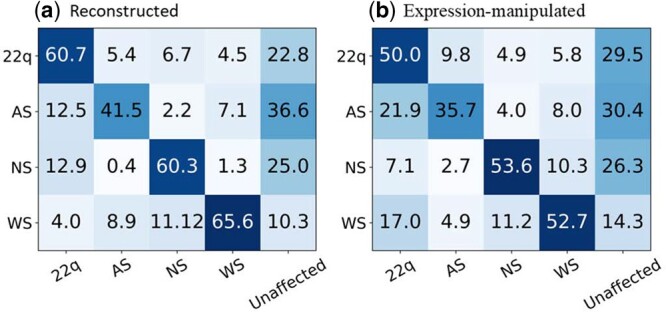
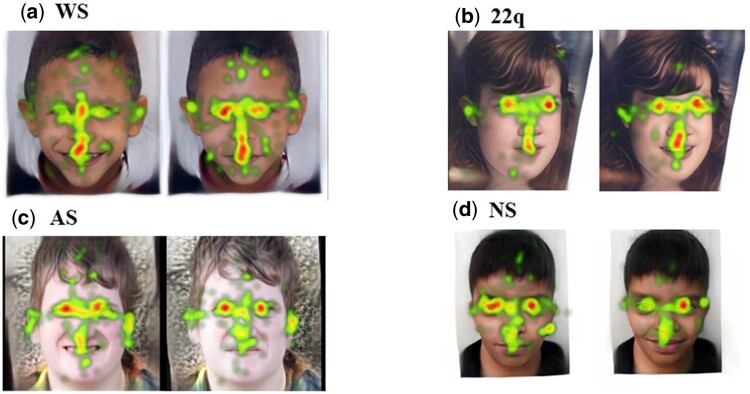
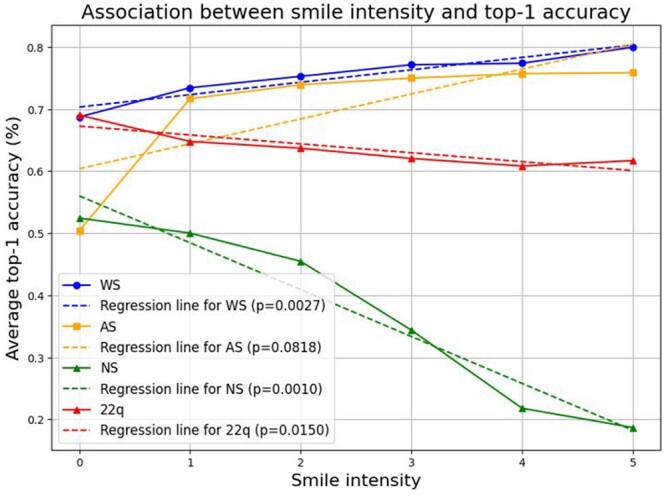
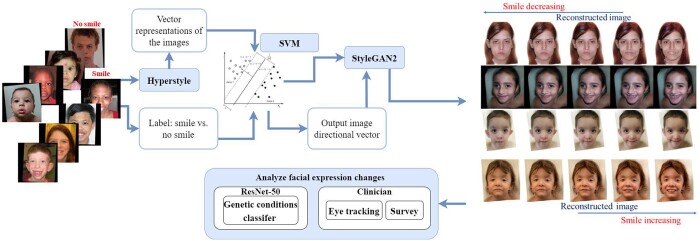
Artificial intelligence (AI) is increasingly used in genomics research and practice, and generative AI has garnered significant recent attention. In clinical applications of generative AI, aspects of the underlying datasets can impact results, and confounders should be studied and mitigated. One example involves the facial expressions of people with genetic conditions. Stereotypically, Williams (WS) and Angelman (AS) syndromes are associated with a "happy" demeanor, including a smiling expression. Clinical geneticists may be more likely to identify these conditions in images of smiling individuals. To study the impact of facial expression, we analyzed publicly available facial images of approximately 3500 individuals with genetic conditions. Using a deep learning (DL) image classifier, we found that WS and AS images with non-smiling expressions had significantly lower prediction probabilities for the correct syndrome labels than those with smiling expressions. This was not seen for 22q11.2 deletion and Noonan syndromes, which are not associated with a smiling expression. To further explore the effect of facial expressions, we computationally altered the facial expressions for these images. We trained HyperStyle, a GAN-inversion technique compatible with StyleGAN2, to determine the vector representations of our images. Then, following the concept of InterfaceGAN, we edited these vectors to recreate the original images in a phenotypically accurate way but with a different facial expression. Through online surveys and an eye-tracking experiment, we examined how altered facial expressions affect the performance of human experts. We overall found that facial expression is associated with diagnostic accuracy variably in different genetic conditions.

摘要

人工智能(AI)在基因组学研究和实践中越来越多地被使用,生成式 AI 最近受到了广泛关注。在生成式 AI 的临床应用中,基础数据集的某些方面会影响结果,应该研究和减轻混杂因素。一个例子涉及到具有遗传条件的人的面部表情。刻板地,威廉姆斯(WS)和安格曼(AS)综合征与“快乐”的外表有关,包括微笑的表情。临床遗传学家可能更有可能在微笑的个体的图像中识别出这些病症。为了研究面部表情的影响,我们分析了大约 3500 名患有遗传疾病的个体的公开面部图像。使用深度学习(DL)图像分类器,我们发现,WS 和 AS 图像的非微笑表情比微笑表情的预测正确综合征标签的概率显著降低。这在 22q11.2 缺失和努南综合征中没有看到,这两种病症与微笑表情无关。为了进一步探索面部表情的影响,我们对这些图像进行了计算性的面部表情改变。我们训练了 HyperStyle,一种与 StyleGAN2 兼容的 GAN 反转技术,以确定我们图像的向量表示。然后,根据 InterfaceGAN 的概念,我们编辑这些向量,以一种表型准确但面部表情不同的方式重新创建原始图像。通过在线调查和眼动实验,我们研究了改变面部表情如何影响人类专家的表现。我们总体发现,面部表情在不同的遗传病症中与诊断准确性有不同程度的关联。
https://cdn.ncbi.nlm.nih.gov/pmc/blobs/1b68/11211818/33164a2a40f0/btae239f4.jpg
https://cdn.ncbi.nlm.nih.gov/pmc/blobs/1b68/11211818/3b93ff55a52a/btae239f1.jpg
https://cdn.ncbi.nlm.nih.gov/pmc/blobs/1b68/11211818/12bff71abc1e/btae239f2.jpg
https://cdn.ncbi.nlm.nih.gov/pmc/blobs/1b68/11211818/c97980870d66/btae239f3.jpg
https://cdn.ncbi.nlm.nih.gov/pmc/blobs/1b68/11211818/33164a2a40f0/btae239f4.jpg
https://cdn.ncbi.nlm.nih.gov/pmc/blobs/1b68/11211818/3b93ff55a52a/btae239f1.jpg
https://cdn.ncbi.nlm.nih.gov/pmc/blobs/1b68/11211818/12bff71abc1e/btae239f2.jpg
https://cdn.ncbi.nlm.nih.gov/pmc/blobs/1b68/11211818/c97980870d66/btae239f3.jpg
https://cdn.ncbi.nlm.nih.gov/pmc/blobs/1b68/11211818/33164a2a40f0/btae239f4.jpg

相似文献

1
Approximating facial expression effects on diagnostic accuracy via generative AI in medical genetics.通过生成式人工智能在医学遗传学中近似面部表情对诊断准确性的影响。
Bioinformatics. 2024 Jun 28;40(Suppl 1):i110-i118. doi: 10.1093/bioinformatics/btae239.
2
Neural Networks for Classification and Image Generation of Aging in Genetic Syndromes.用于遗传综合征中衰老分类和图像生成的神经网络。
Front Genet. 2022 Apr 11;13:864092. doi: 10.3389/fgene.2022.864092. eCollection 2022.
3
Recognition of facial expression of fetuses by artificial intelligence (AI).人工智能(AI)识别胎儿的面部表情。
J Perinat Med. 2021 Feb 8;49(5):596-603. doi: 10.1515/jpm-2020-0537. Print 2021 Jun 25.
4
Generative Methods for Pediatric Genetics Education.儿科遗传学教育的生成方法。
medRxiv. 2023 Aug 2:2023.08.01.23293506. doi: 10.1101/2023.08.01.23293506.
5
Recognition of Genetic Conditions After Learning With Images Created Using Generative Artificial Intelligence.使用生成式人工智能创建的图像进行学习后对遗传疾病的识别。
JAMA Netw Open. 2024 Mar 4;7(3):e242609. doi: 10.1001/jamanetworkopen.2024.2609.
6
Generative artificial intelligence to produce high-fidelity blastocyst-stage embryo images.生成式人工智能生成高保真囊胚期胚胎图像。
Hum Reprod. 2024 Jun 3;39(6):1197-1207. doi: 10.1093/humrep/deae064.
7
A deepfake-based study on facial expressiveness and social outcomes.基于深度伪造的面部表情和社交结果研究。
Sci Rep. 2024 Feb 13;14(1):3642. doi: 10.1038/s41598-024-53475-5.
8
Development of an artificial intelligence model for predicting the likelihood of human embryo euploidy based on blastocyst images from multiple imaging systems during IVF.基于体外受精过程中多个成像系统的囊胚图像,开发一种人工智能模型,用于预测人类胚胎整倍体的可能性。
Hum Reprod. 2022 Jul 30;37(8):1746-1759. doi: 10.1093/humrep/deac131.
9
Effects of posed smiling on memory for happy and sad facial expressions.摆姿势微笑对快乐和悲伤面部表情记忆的影响。
Sci Rep. 2021 May 18;11(1):10477. doi: 10.1038/s41598-021-89828-7.
10
Biases in human perception of facial age are present and more exaggerated in current AI technology.人类对面部年龄感知的偏差是存在的,在当前的人工智能技术中,这种偏差更加明显。
Sci Rep. 2022 Dec 29;12(1):22519. doi: 10.1038/s41598-022-27009-w.

引用本文的文献

1
Facial expression deep learning algorithms in the detection of neurological disorders: a systematic review and meta-analysis.用于检测神经系统疾病的面部表情深度学习算法:一项系统综述和荟萃分析
Biomed Eng Online. 2025 May 22;24(1):64. doi: 10.1186/s12938-025-01396-3.
2
Deep Learning Study of Alkaptonuria Spinal Disease Assesses Global and Regional Severity and Detects Occult Treatment Status.黑尿病脊髓病的深度学习研究评估整体和局部严重程度并检测隐匿治疗状态。
J Inherit Metab Dis. 2025 May;48(3):e70042. doi: 10.1002/jimd.70042.
3
Deep Learning Study of Alkaptonuria Spinal Disease Assesses Global and Regional Severity and Detects Occult Treatment Status.

本文引用的文献

1
Application of facial analysis Technology in Clinical Genetics: Considerations for diverse populations.面部分析技术在临床遗传学中的应用:考虑不同人群的因素。
Am J Med Genet C Semin Med Genet. 2023 Sep;193(3):e32059. doi: 10.1002/ajmg.c.32059. Epub 2023 Aug 3.
2
Perspectives on the future of dysmorphology.畸形学未来展望。
Am J Med Genet A. 2023 Mar;191(3):659-671. doi: 10.1002/ajmg.a.63060. Epub 2022 Dec 9.
3
Scoping review and classification of deep learning in medical genetics.深度学习在医学遗传学中的应用:范围综述与分类
黑尿症性脊柱疾病的深度学习研究评估整体和局部严重程度并检测隐匿治疗状态。
medRxiv. 2025 Mar 12:2025.03.11.25323762. doi: 10.1101/2025.03.11.25323762.
4
Artificial intelligence in clinical genetics.临床遗传学中的人工智能
Eur J Hum Genet. 2025 Mar;33(3):281-288. doi: 10.1038/s41431-024-01782-w. Epub 2025 Jan 13.
Genet Med. 2022 Aug;24(8):1593-1603. doi: 10.1016/j.gim.2022.04.025. Epub 2022 May 25.
4
CalliFACS: The common marmoset Facial Action Coding System.卡利 FACs:普通狨猴面部动作编码系统。
PLoS One. 2022 May 17;17(5):e0266442. doi: 10.1371/journal.pone.0266442. eCollection 2022.
5
Neural Networks for Classification and Image Generation of Aging in Genetic Syndromes.用于遗传综合征中衰老分类和图像生成的神经网络。
Front Genet. 2022 Apr 11;13:864092. doi: 10.3389/fgene.2022.864092. eCollection 2022.
6
GestaltMatcher facilitates rare disease matching using facial phenotype descriptors.GestaltMatcher 利用面部表型特征描述符促进罕见病匹配。
Nat Genet. 2022 Mar;54(3):349-357. doi: 10.1038/s41588-021-01010-x. Epub 2022 Feb 10.
7
Neural network classifiers for images of genetic conditions with cutaneous manifestations.用于具有皮肤表现的遗传疾病图像的神经网络分类器。
HGG Adv. 2021 Aug 20;3(1):100053. doi: 10.1016/j.xhgg.2021.100053. eCollection 2022 Jan 13.
8
Cost-effectiveness of genome sequencing for diagnosing patients with undiagnosed rare genetic diseases.基因组测序诊断不明原因罕见遗传病患者的成本效益分析。
Genet Med. 2022 Jan;24(1):109-118. doi: 10.1016/j.gim.2021.08.015. Epub 2021 Nov 30.
9
Development and evaluation of a machine learning-based point-of-care screening tool for genetic syndromes in children: a multinational retrospective study.基于机器学习的儿童遗传性综合征即时筛查工具的开发与评估:一项多中心回顾性研究。
Lancet Digit Health. 2021 Oct;3(10):e635-e643. doi: 10.1016/S2589-7500(21)00137-0. Epub 2021 Sep 1.
10
InterFaceGAN: Interpreting the Disentangled Face Representation Learned by GANs.InterFaceGAN:解释 GAN 学习到的解缠面部表示。
IEEE Trans Pattern Anal Mach Intell. 2022 Apr;44(4):2004-2018. doi: 10.1109/TPAMI.2020.3034267. Epub 2022 Mar 4.