
倒拨棘轮:罕见重组在局部挽救了新 W 退化,并产生了性染色体分歧的高原。
Rewinding the Ratchet: Rare Recombination Locally Rescues Neo-W Degeneration and Generates Plateaus of Sex-Chromosome Divergence.
机构信息
Institute of Ecology and Evolution, University of Edinburgh, Edinburgh EH9 3FL, UK.
Institut de Biologia Evolutiva (CSIC-Universitat Pompeu Fabra), Passeig Marítim de la Barceloneta 37, ESP-08003 Barcelona, Spain.
出版信息
Mol Biol Evol. 2024 Jul 3;41(7). doi: 10.1093/molbev/msae124.
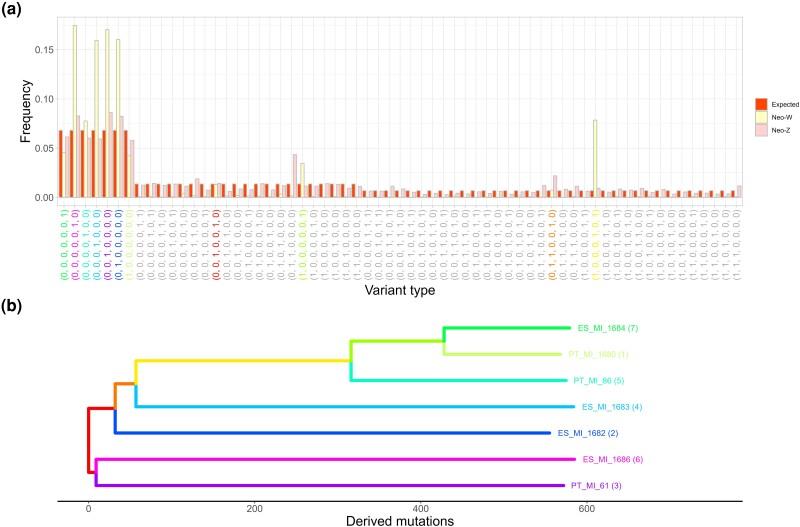
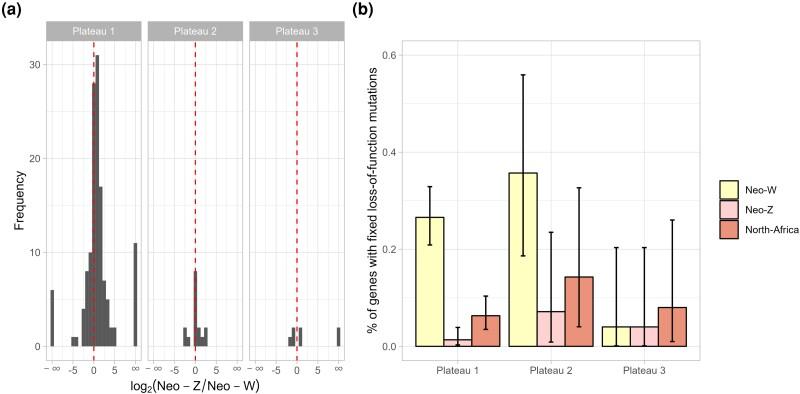
Natural selection is less efficient in the absence of recombination. As a result, nonrecombining sequences, such as sex chromosomes, tend to degenerate over time. Although the outcomes of recombination arrest are typically observed after many millions of generations, recent neo-sex chromosomes can give insight into the early stages of this process. Here, we investigate the evolution of neo-sex chromosomes in the Spanish marbled white butterfly, Melanargia ines, where a Z-autosome fusion has turned the homologous autosome into a nonrecombining neo-W chromosome. We show that these neo-sex chromosomes are likely limited to the Iberian population of M. ines, and that they arose around the time when this population split from North-African populations, around 1.5 million years ago. Recombination arrest of the neo-W chromosome has led to an excess of premature stop-codons and frame-shift mutations, and reduced gene expression compared to the neo-Z chromosome. Surprisingly, we identified two regions of ∼1 Mb at one end of the neo-W that are both less diverged from the neo-Z and less degraded than the rest of the chromosome, suggesting a history of rare but repeated genetic exchange between the two neo-sex chromosomes. These plateaus of neo-sex chromosome divergence suggest that neo-W degradation can be locally reversed by rare recombination between neo-W and neo-Z chromosomes.
自然选择在没有重组的情况下效率较低。因此,非重组序列,如性染色体,随着时间的推移往往会退化。尽管重组停止的结果通常在数百万代之后才会显现出来,但最近的新性染色体可以让我们深入了解这个过程的早期阶段。在这里,我们研究了西班牙大理石纹白蝴蝶 Melanargia ines 中新性染色体的进化,其中 Z 染色体与一条同源常染色体融合,将其变成了不重组的新 W 染色体。我们表明,这些新性染色体可能仅限于 M. ines 的伊比利亚种群,它们大约在 150 万年前该种群与北非种群分离时出现。新 W 染色体的重组停止导致过早的终止密码子和移码突变过多,并导致基因表达水平降低,与新 Z 染色体相比。令人惊讶的是,我们在新 W 染色体的一端鉴定出两个约 1Mb 的区域,它们与新 Z 染色体的差异较小,退化程度也低于染色体的其他部分,这表明两个新性染色体之间存在罕见但反复的遗传交换的历史。这些新性染色体分化的高原表明,新 W 染色体的退化可以通过新 W 染色体和新 Z 染色体之间罕见的重组来局部逆转。


 Zotero 插件