
抗菌肽样肽终止核糖体的序列多样性。
Sequence diversity of apidaecin-like peptides arresting the terminating ribosome.
机构信息
Department of Pharmaceutical Sciences and Center for Biomolecular Sciences, University of Illinois at Chicago, Chicago, IL 60607, USA.
出版信息
Nucleic Acids Res. 2024 Aug 27;52(15):8967-8978. doi: 10.1093/nar/gkae567.
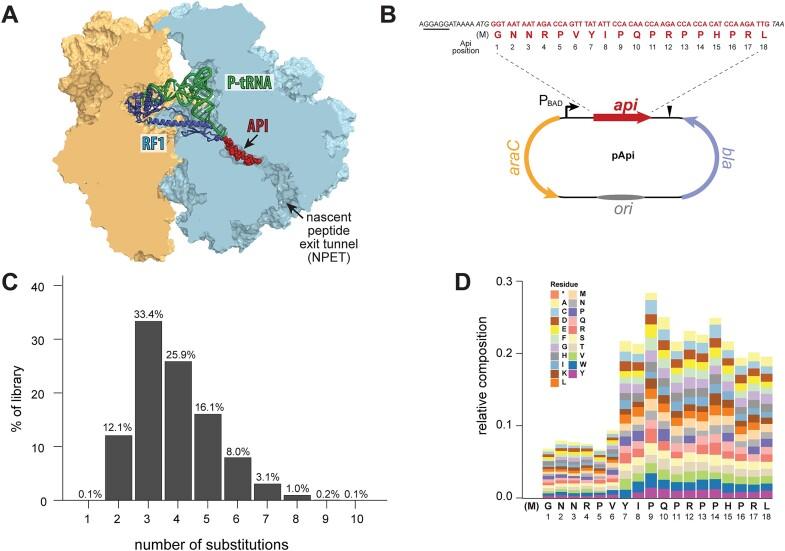
The Proline-rich Antimicrobial Peptide (PrAMP) apidaecin (Api) inhibits translation by binding in the ribosomal nascent peptide exit tunnel, trapping release factors RF1 or RF2, and arresting ribosomes at stop codons. To explore the extent of sequence variations of the native 18-amino acid Api that allows it to preserve its activity, we screened a library of synthetic mutant Api genes expressed in bacterial cells, resulting in nearly 350000 peptide variants with multiple substitutions. By applying orthogonal negative and positive selection strategies, we identified a number of multi-substituted Api variants capable of arresting ribosomes at stop codons. Our findings underscore the critical contribution of specific amino acid residues of the peptide for its on-target function while significantly expanding the variety of PrAMPs acting on the terminating ribosome. Additionally, some of the tested synthesized multi-substituted Api variants exhibit improved antibacterial activity compared to that of the wild type PrAMP and may constitute the starting point to develop clinically useful antimicrobials.
富含脯氨酸的抗菌肽 (PrAMP) 蜂肽 (Api) 通过结合核糖体新生肽出口隧道来抑制翻译,从而捕获释放因子 RF1 或 RF2,并使核糖体在终止密码子处停滞。为了探索天然 18 个氨基酸的 Api 允许其保留其活性的序列变异程度,我们筛选了在细菌细胞中表达的合成突变体 Api 基因文库,产生了近 350000 种具有多种取代的肽变体。通过应用正交的负选择和正选择策略,我们鉴定了许多能够在终止密码子处使核糖体停滞的多取代 Api 变体。我们的研究结果强调了肽的特定氨基酸残基对其靶标功能的关键贡献,同时显著扩展了作用于终止核糖体的 PrAMP 的种类。此外,一些经过测试的合成多取代 Api 变体与野生型 PrAMP 相比表现出改善的抗菌活性,并且可能构成开发临床有用的抗菌药物的起点。




 Zotero 插件