Institute for Biochemistry and Molecular Biology, University of Hamburg, Martin-Luther-King-Platz 6, 20146, Hamburg, Germany.
Department of Physical Biochemistry, Max Planck Institute for Biophysical Chemistry, Am Fassberg 11, Göttingen, 37077, Germany.
Nat Commun. 2018 Aug 3;9(1):3053. doi: 10.1038/s41467-018-05465-1.
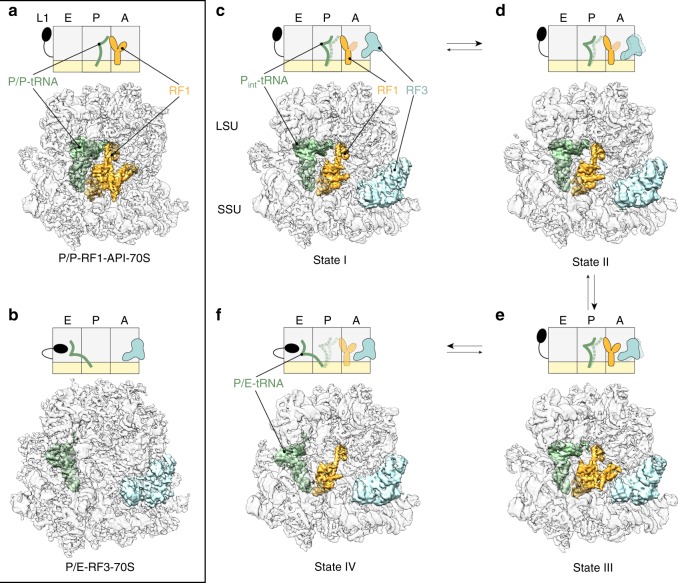
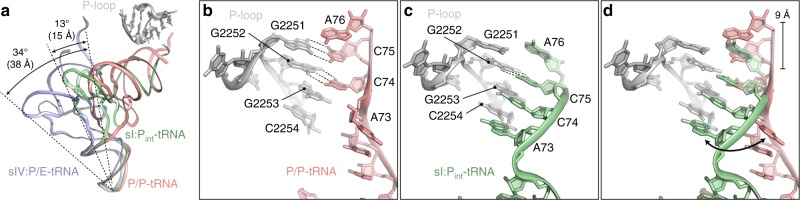
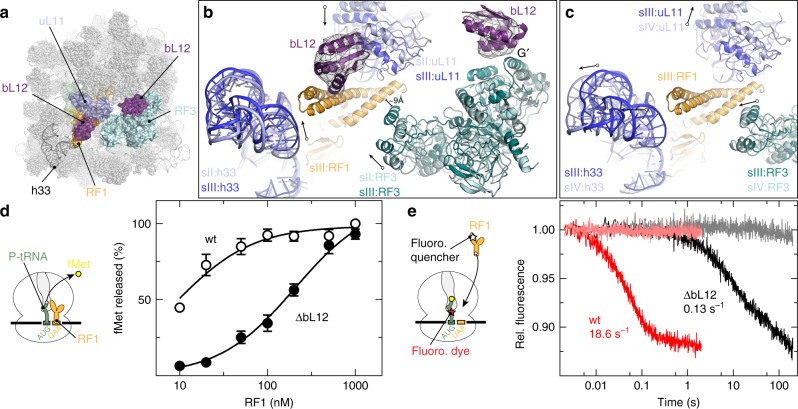
During translation termination in bacteria, the release factors RF1 and RF2 are recycled from the ribosome by RF3. While high-resolution structures of the individual termination factors on the ribosome exist, direct structural insight into how RF3 mediates dissociation of the decoding RFs has been lacking. Here we have used the Apidaecin 137 peptide to trap RF1 together with RF3 on the ribosome and visualize an ensemble of termination intermediates using cryo-electron microscopy. Binding of RF3 to the ribosome induces small subunit (SSU) rotation and swivelling of the head, yielding intermediate states with shifted P-site tRNAs and RF1 conformations. RF3 does not directly eject RF1 from the ribosome, but rather induces full rotation of the SSU that indirectly dislodges RF1 from its binding site. SSU rotation is coupled to the accommodation of the GTPase domain of RF3 on the large subunit (LSU), thereby promoting GTP hydrolysis and dissociation of RF3 from the ribosome.
在细菌的翻译终止过程中,释放因子 RF1 和 RF2 被 RF3 从核糖体上回收。虽然核糖体上各个终止因子的高分辨率结构已经存在,但 RF3 如何介导解码 RFs 的解离的直接结构见解一直缺乏。在这里,我们使用 Apidaecin 137 肽将 RF1 与 RF3 一起捕获在核糖体上,并使用冷冻电子显微镜可视化终止中间体的整体。RF3 与核糖体的结合诱导小亚基 (SSU) 旋转和头部旋转,产生 P 位 tRNA 和 RF1 构象移位的中间状态。RF3 并没有直接将 RF1 从核糖体上逐出,而是诱导 SSU 的完全旋转,间接将 RF1 从其结合位点上逐出。SSU 旋转与 RF3 的 GTPase 结构域在大亚基 (LSU) 上的适应相关联,从而促进 GTP 水解和 RF3 从核糖体上的解离。