Endo Tatsuya, Kanemura Naohiko, Ito Toshikazu, Sato Keita, Miura Takuya, Onitsuka Katsuya, Miyazawa Taku, Kubota Keisuke, Iwabuchi Masumi, Shirado Osamu
Department of Orthopaedic and Spinal Surgery, and Rehabilitation, Aizu Medical Center, Fukushima Medical University, Aizuwakamatsu, JPN.
Department of Physical Therapy, School of Health and Social Services, Saitama Prefectural University, Koshigaya, JPN.
Cureus. 2024 Jun 3;16(6):e61611. doi: 10.7759/cureus.61611. eCollection 2024 Jun.
This is a prospective cohort study.
The present study aimed to investigate the effects of residual pain after fusion surgery for lumbar degenerative diseases on quality of life (QOL).
Residual symptoms after spinal surgery often restrict patients' activities of daily living and reduce their QOL. However, few studies have comprehensively addressed physical, psychological, and social factors.
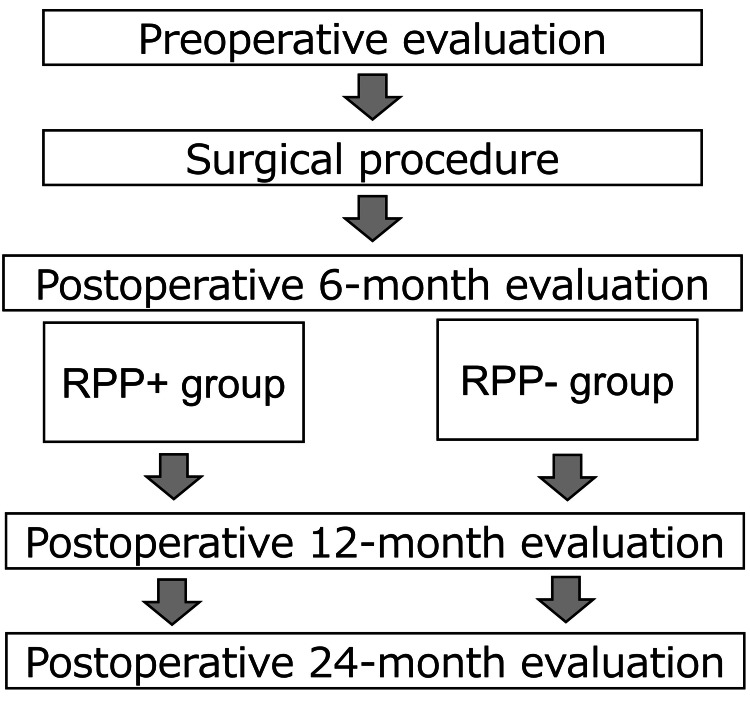
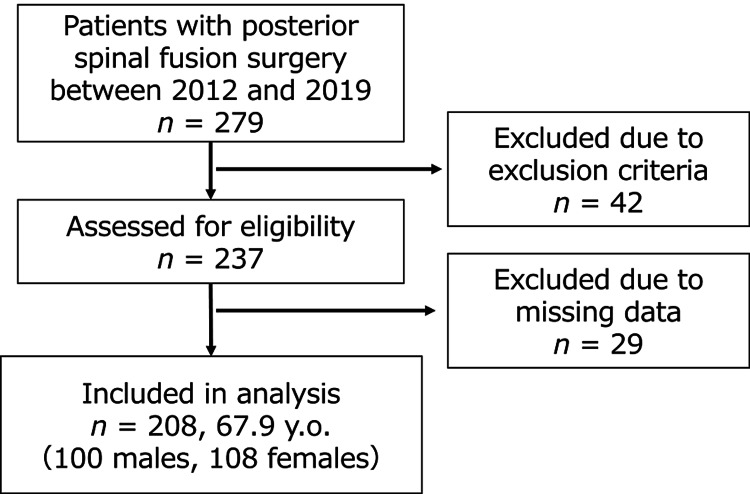
The study population included a cohort of 208 patients (mean age: 67.9 years) who had undergone posterior interbody fusion for lumbar degenerative disease between 2012 and 2019. We asked the patients to complete the Japanese Orthopaedic Association Back Pain Evaluation Questionnaire (JOABPEQ) and Short Form Health Survey (SF-36) preoperatively, as well as at six, 12, and 24 months postoperatively. The presence of residual postoperative pain (RPP) was determined using the low back pain score of the JOABPEQ at six months postoperatively, and patients with an improvement of < 20 points compared to preoperative assessment were classified as RPP+ based on a previous study.
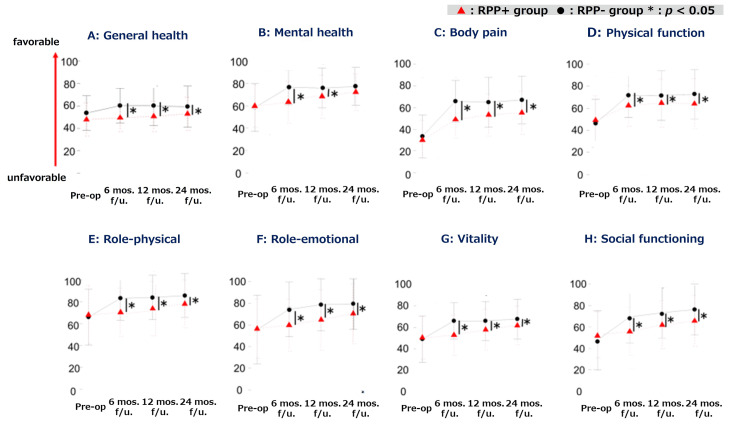
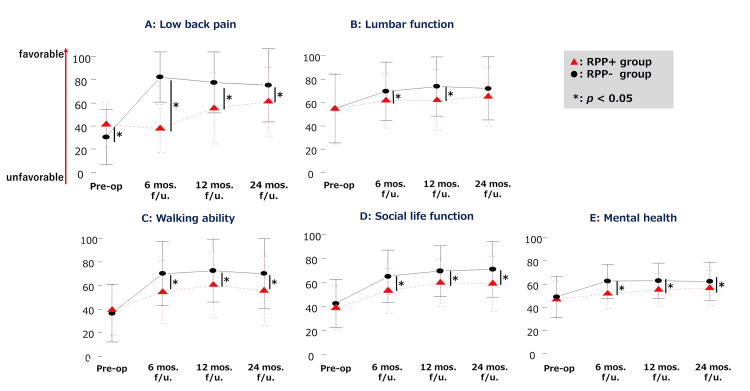
In all patients, there was a notable postoperative improvement in all JOABPEQ and SF-36 domains compared to preoperative scores. The RPP+ group comprised 60 patients (69.6 years), while the RPP- group comprised 148 patients (67.2 years). In the RPP+ group, the lumbar function in the JOABPEQ and general health in the SF-36 showed limited postoperative enhancement. The pace of improvement in the role-emotional, role-physical, social functioning, vitality, and mental health scores was slower in the RPP+ group compared to the RPP- group.
In the current study, we found that the presence of residual pain at six months postoperatively affected QOL improvement up to 24 months after surgery. Lingering postoperative pain substantially impacted functional incapacity, social engagement, and psychological well-being. Notably, the lumbar function in the JOABPEQ and general health in the SF-36 showed distinct progression patterns in the RPP+ group.
这是一项前瞻性队列研究。
本研究旨在探讨腰椎退行性疾病融合手术后残留疼痛对生活质量(QOL)的影响。
脊柱手术后的残留症状常常限制患者的日常生活活动并降低其生活质量。然而,很少有研究全面探讨身体、心理和社会因素。
研究人群包括208例患者(平均年龄:67.9岁),他们在2012年至2019年间接受了腰椎退行性疾病的后路椎间融合术。我们要求患者在术前以及术后6个月、12个月和24个月完成日本骨科协会背痛评估问卷(JOABPEQ)和简短健康调查(SF-36)。术后6个月使用JOABPEQ的腰痛评分确定术后残留疼痛(RPP)的存在,根据先前的研究,与术前评估相比改善<20分的患者被归类为RPP+。
与术前评分相比,所有患者在所有JOABPEQ和SF-36领域术后均有显著改善。RPP+组包括60例患者(69.6岁),而RPP-组包括148例患者(67.2岁)。在RPP+组中,JOABPEQ中的腰椎功能和SF-36中的总体健康状况术后改善有限。与RPP-组相比,RPP+组在角色情感、角色身体、社会功能、活力和心理健康评分方面的改善速度较慢。
在本研究中,我们发现术后6个月残留疼痛的存在影响了术后长达24个月的生活质量改善。术后持续疼痛对功能丧失、社会参与和心理健康产生了重大影响。值得注意的是,RPP+组中JOABPEQ中的腰椎功能和SF-36中的总体健康状况呈现出不同的进展模式。