• 文献检索
  • 文档翻译
  • 深度研究
  • 学术资讯
  • Suppr Zotero 插件Zotero 插件
  • 邀请有礼
  • 套餐&价格
  • 历史记录
应用&插件
Suppr Zotero 插件Zotero 插件浏览器插件Mac 客户端Windows 客户端微信小程序
定价
高级版会员购买积分包购买API积分包
服务
文献检索文档翻译深度研究API 文档MCP 服务
关于我们
关于 Suppr公司介绍联系我们用户协议隐私条款
关注我们

Suppr 超能文献

核心技术专利:CN118964589B侵权必究
粤ICP备2023148730 号-1Suppr @ 2026

文献检索

告别复杂PubMed语法,用中文像聊天一样搜索,搜遍4000万医学文献。AI智能推荐,让科研检索更轻松。

立即免费搜索

文件翻译

保留排版,准确专业,支持PDF/Word/PPT等文件格式,支持 12+语言互译。

免费翻译文档

深度研究

AI帮你快速写综述,25分钟生成高质量综述,智能提取关键信息,辅助科研写作。

立即免费体验

寻找可指示胎儿生长受限中不良神经发育结局风险的血液生物标志物。

The search for blood biomarkers that indicate risk of adverse neurodevelopmental outcomes in fetal growth restriction.

作者信息

Musco Hannah, Beecher Kate, Chand Kirat K, Boyd Roslyn N, Colditz Paul B, Wixey Julie A

机构信息

UQ Centre for Clinical Research, Faculty of Medicine, The University of Queensland, Brisbane, QLD, Australia.

Queensland Cerebral Palsy and Rehabilitation Research Centre, Child Health Research Centre, Faculty of Medicine, The University of Queensland, Brisbane, QLD, Australia.

出版信息

Front Pediatr. 2024 Jun 20;12:1396102. doi: 10.3389/fped.2024.1396102. eCollection 2024.

DOI:10.3389/fped.2024.1396102
PMID:38966491
原文链接:https://pmc.ncbi.nlm.nih.gov/articles/PMC11222567/
Abstract

UNLABELLED

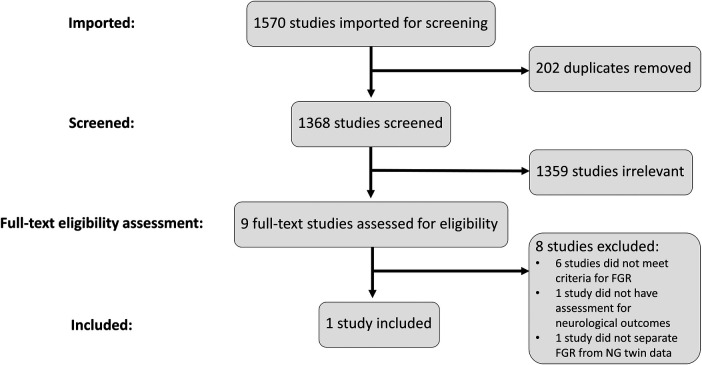
Fetal growth restriction (FGR) impacts 5%-10% of pregnancies and is associated with increased risk of mortality and morbidity. Although adverse neurodevelopmental outcomes are observed in up to 50% of FGR infants, a diagnosis of FGR does not indicate the level of risk for an individual infant and these infants are not routinely followed up to assess neurodevelopmental outcomes. Identifying FGR infants at increased risk of adverse neurodevelopmental outcomes would greatly assist in providing appropriate support and interventions earlier, resulting in improved outcomes. However, current methods to detect brain injury around the time of birth lack the sensitivity required to detect the more subtle alterations associated with FGR. Blood biomarkers have this potential. This systematic review assessed the current literature on blood biomarkers for identifying FGR infants at increased risk of adverse neurodevelopmental outcomes at >12 months after birth. Four databases were searched from inception to 22 February 2024. Articles were assessed for meeting the inclusion criteria by two reviewers. The quality of the included article was assessed using Quality Assessment of Diagnostic Accuracy Studies-2. A summary of findings is presented as insufficient articles were identified for meta-analysis. Excluding duplicates, 1,368 records were screened with only 9 articles considered for full text review. Only one article met all the inclusion criteria. Quality assessment indicated low risk of bias. Both blood biomarkers investigated in this study, neuron specific enolase and S100B, demonstrated inverse relationships with neurodevelopmental assessments at 2 years. Four studies did not meet all the inclusion criteria yet identified promising findings for metabolites and cytokines which are discussed here. These findings support the need for further research and highlight the potential for blood biomarkers to predict adverse outcomes.

SYSTEMATIC REVIEW REGISTRATION

https://www.crd.york.ac.uk/prospero/display_record.php?RecordID=369242, Identifier CRD42022369242.

摘要

未标注

胎儿生长受限(FGR)影响5%-10%的妊娠,且与死亡率和发病率增加相关。尽管高达50%的FGR婴儿会出现不良神经发育结局,但FGR的诊断并不表明单个婴儿的风险水平,并且这些婴儿未被常规随访以评估神经发育结局。识别出具有不良神经发育结局高风险的FGR婴儿将极大地有助于更早地提供适当的支持和干预,从而改善结局。然而,目前在出生时检测脑损伤的方法缺乏检测与FGR相关的更细微改变所需的敏感性。血液生物标志物具有这种潜力。本系统评价评估了关于血液生物标志物的现有文献,以识别出生后12个月以上具有不良神经发育结局高风险的FGR婴儿。从数据库创建至2024年2月22日检索了四个数据库。由两名评审员评估文章是否符合纳入标准。使用诊断准确性研究质量评估-2对纳入文章的质量进行评估。由于识别出的文章不足,无法进行荟萃分析,因此仅呈现了研究结果总结。排除重复项后,筛选了1368条记录,仅9篇文章被考虑进行全文评审。只有一篇文章符合所有纳入标准。质量评估表明偏倚风险较低。本研究中调查的两种血液生物标志物,神经元特异性烯醇化酶和S100B,在2岁时与神经发育评估均呈负相关。四项研究未符合所有纳入标准,但确定了有前景的代谢物和细胞因子研究结果,在此进行讨论。这些结果支持进一步研究的必要性,并突出了血液生物标志物预测不良结局的潜力。

系统评价注册

https://www.crd.york.ac.uk/prospero/display_record.php?RecordID=369242,标识符CRD42022369242 。
https://cdn.ncbi.nlm.nih.gov/pmc/blobs/252a/11222567/f88826e7352a/fped-12-1396102-g001.jpg

相似文献

1
The search for blood biomarkers that indicate risk of adverse neurodevelopmental outcomes in fetal growth restriction.寻找可指示胎儿生长受限中不良神经发育结局风险的血液生物标志物。
Front Pediatr. 2024 Jun 20;12:1396102. doi: 10.3389/fped.2024.1396102. eCollection 2024.
2
Folic acid supplementation and malaria susceptibility and severity among people taking antifolate antimalarial drugs in endemic areas.在流行地区,服用抗叶酸抗疟药物的人群中,叶酸补充剂与疟疾易感性和严重程度的关系。
Cochrane Database Syst Rev. 2022 Feb 1;2(2022):CD014217. doi: 10.1002/14651858.CD014217.
3
Safety and efficacy of phosphodiesterase-5 (PDE-5) inhibitors in fetal growth restriction: a systematic literature review and meta-analysis.磷酸二酯酶-5(PDE-5)抑制剂在胎儿生长受限中的安全性和疗效:系统文献回顾和荟萃分析。
J Pharm Pharm Sci. 2024 Aug 15;27:13206. doi: 10.3389/jpps.2024.13206. eCollection 2024.
4
Blood Biomarkers in the Fetally Growth Restricted and Small for Gestational Age Neonate: Associations with Brain Injury.胎儿生长受限且小于胎龄儿的血液生物标志物:与脑损伤的关系。
Dev Neurosci. 2024;46(2):84-97. doi: 10.1159/000530492. Epub 2023 May 10.
5
Predictive accuracy of cerebroplacental ratio for adverse perinatal and neurodevelopmental outcomes in suspected fetal growth restriction: systematic review and meta-analysis.脑-胎盘比值预测疑似胎儿生长受限的不良围产儿和神经发育结局的准确性:系统评价和荟萃分析。
Ultrasound Obstet Gynecol. 2018 Oct;52(4):430-441. doi: 10.1002/uog.19117. Epub 2018 Sep 5.
6
Risk of stillbirth, preterm delivery, and fetal growth restriction following exposure in a previous birth: systematic review and meta-analysis.有过暴露史的前一胎妊娠中发生死胎、早产和胎儿生长受限的风险:系统评价和荟萃分析。
BJOG. 2018 Jan;125(2):183-192. doi: 10.1111/1471-0528.14906. Epub 2017 Oct 3.
7
Neurodevelopmental outcomes of very preterm infants born following early foetal growth restriction with absent end-diastolic umbilical flow.早期胎儿生长受限且舒张末期脐血流消失的极早产儿的神经发育结局
Eur J Pediatr. 2023 Oct;182(10):4467-4476. doi: 10.1007/s00431-023-05104-y. Epub 2023 Jul 25.
8
Infant outcome after active management of early-onset fetal growth restriction with absent or reversed umbilical artery blood flow.早发型胎儿生长受限伴脐动脉血流缺失或倒置时积极管理的婴儿结局。
Ultrasound Obstet Gynecol. 2021 Jun;57(6):931-941. doi: 10.1002/uog.23101.
9
Screening for small for gestational age using third-trimester ultrasound markers: protocol for a systematic review and meta-analysis of screening test accuracy.利用孕晚期超声标志物筛查小于胎龄儿:系统评价和荟萃分析筛查试验准确性的方案。
Syst Rev. 2018 Dec 3;7(1):219. doi: 10.1186/s13643-018-0885-4.
10
Association between antenatal diagnosis of late fetal growth restriction and educational outcomes in mid-childhood: A UK prospective cohort study with long-term data linkage study.产前诊断晚期胎儿生长受限与儿童中期教育结果的关联:一项英国前瞻性队列研究与长期数据链接研究。
PLoS Med. 2023 Apr 24;20(4):e1004225. doi: 10.1371/journal.pmed.1004225. eCollection 2023 Apr.

引用本文的文献

1
Antioxidants: powering the fight against fetal hypoxia.抗氧化剂:助力对抗胎儿缺氧
Philos Trans R Soc Lond B Biol Sci. 2025 Aug 21;380(1933):20240183. doi: 10.1098/rstb.2024.0183.

本文引用的文献

1
Metabolic dynamics and prediction of sFGR and adverse fetal outcomes: a prospective longitudinal cohort study.胎儿生长受限及不良妊娠结局的代谢动力学及预测:一项前瞻性纵向队列研究。
BMC Med. 2023 Nov 23;21(1):455. doi: 10.1186/s12916-023-03134-9.
2
Blood-Based Biomarkers in Traumatic Brain Injury: A Narrative Review With Implications for the Legal System.创伤性脑损伤的血液生物标志物:一项对法律体系有影响的叙述性综述
Cureus. 2023 Jun 14;15(6):e40417. doi: 10.7759/cureus.40417. eCollection 2023 Jun.
3
Biomarkers of hypoxic-ischemic encephalopathy: a systematic review.
缺氧缺血性脑病的生物标志物:系统评价。
World J Pediatr. 2023 Jun;19(6):505-548. doi: 10.1007/s12519-023-00698-7. Epub 2023 Apr 21.
4
Brain volumes and white matter microstructure in 8- to 10-year-old children born with fetal growth restriction.8 至 10 岁胎儿生长受限儿童的脑容量和白质微观结构。
Pediatr Radiol. 2022 Nov;52(12):2388-2400. doi: 10.1007/s00247-022-05372-0. Epub 2022 Apr 22.
5
Electroencephalographic studies in growth-restricted and small-for-gestational-age neonates.生长受限和小于胎龄儿的脑电图研究。
Pediatr Res. 2022 Dec;92(6):1527-1534. doi: 10.1038/s41390-022-01992-2. Epub 2022 Feb 23.
6
Adenosine Blood Level: A Biomarker of White Matter Damage in Very Low Birth Weight Infants.腺苷血液水平:极低出生体重儿脑白质损伤的生物标志物。
Curr Pediatr Rev. 2022;18(2):153-163. doi: 10.2174/1573396318666220127155943.
7
Blood biomarkers for mild traumatic brain injury: a selective review of unresolved issues.轻度创伤性脑损伤的血液生物标志物:对未解决问题的选择性综述
Biomark Res. 2021 Sep 16;9(1):70. doi: 10.1186/s40364-021-00325-5.
8
Elevated Levels of Homocysteinesulfinic Acid in the Plasma of Patients with Amyotrophic Lateral Sclerosis: A Potential Source of Excitotoxicity?肌萎缩侧索硬化症患者血浆中同型半胱氨酸亚磺酸水平升高:兴奋性毒性的潜在来源?
Neurodegener Dis. 2020;20(5-6):200-206. doi: 10.1159/000517964. Epub 2021 Jun 21.
9
Perinatal blood biomarkers for the identification of brain injury in very low birth weight growth-restricted infants.围产期血液生物标志物在极低出生体重生长受限儿脑损伤中的应用。
J Perinatol. 2021 Sep;41(9):2252-2260. doi: 10.1038/s41372-021-01112-8. Epub 2021 Jun 3.
10
Elevated plasma levels of D-serine in some patients with amyotrophic lateral sclerosis.一些肌萎缩性侧索硬化症患者的血浆 D-丝氨酸水平升高。
Amyotroph Lateral Scler Frontotemporal Degener. 2021 May;22(3-4):206-210. doi: 10.1080/21678421.2020.1832120. Epub 2020 Oct 14.