KIT Royal Tropical Institute, Amsterdam, The Netherlands.
National Surveillance Program, Directorate of Health Security and Emergencies, Emergency Operation Center, National Public Health Agency, Wilkinso Road, Freetown City, Sierra Leone.
BMC Public Health. 2024 Jul 5;24(1):1795. doi: 10.1186/s12889-024-19221-2.
The COVID-19 pandemic had a profound impact on healthcare systems and services, including routine immunization (RI). To date, there is limited information on the effects of the COVID-19 pandemic on RI in West African countries such as Sierra Leone, which had already experienced public health emergencies that disrupted its healthcare system. Here, we describe the impact of the COVID-19 pandemic on the RI of key antigens in Sierra Leone.
We used vaccination data from the District Health Information System for BCG, measles-rubella 1 and 2, and pentavalent 1 and 3 antigens. We compared 2019, 2020, 2021, and 2022 annual coverage rates for the selected antigens at the national and district levels. We used the Pearson chi-square test to assess the difference between annual coverage rates between 2019 and 2020, 2020-2021, and 2021-2022.
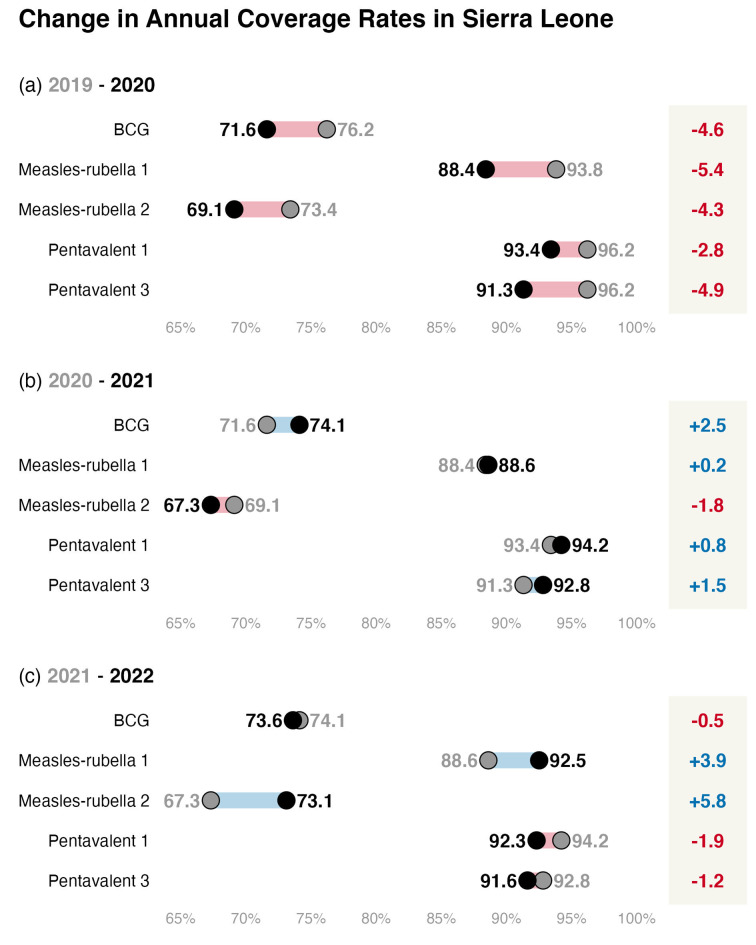
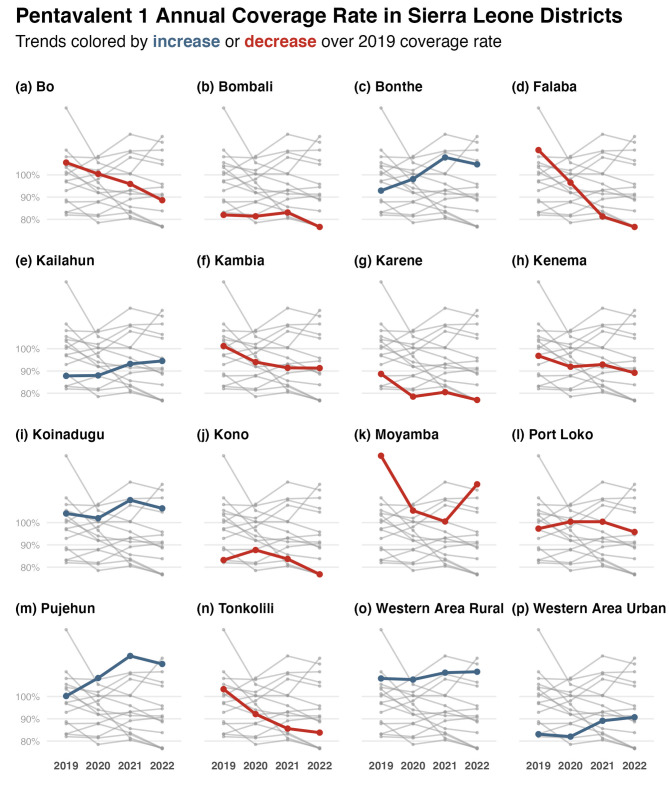
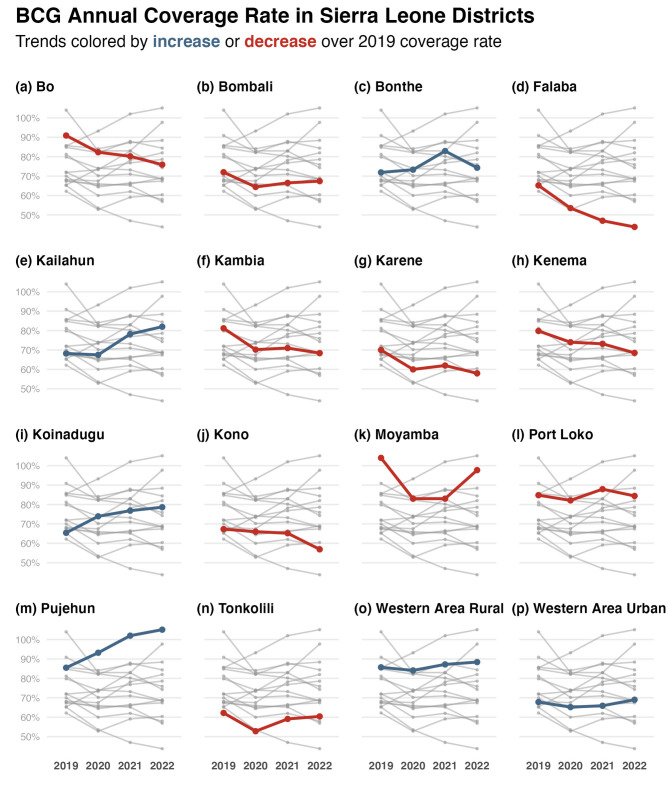
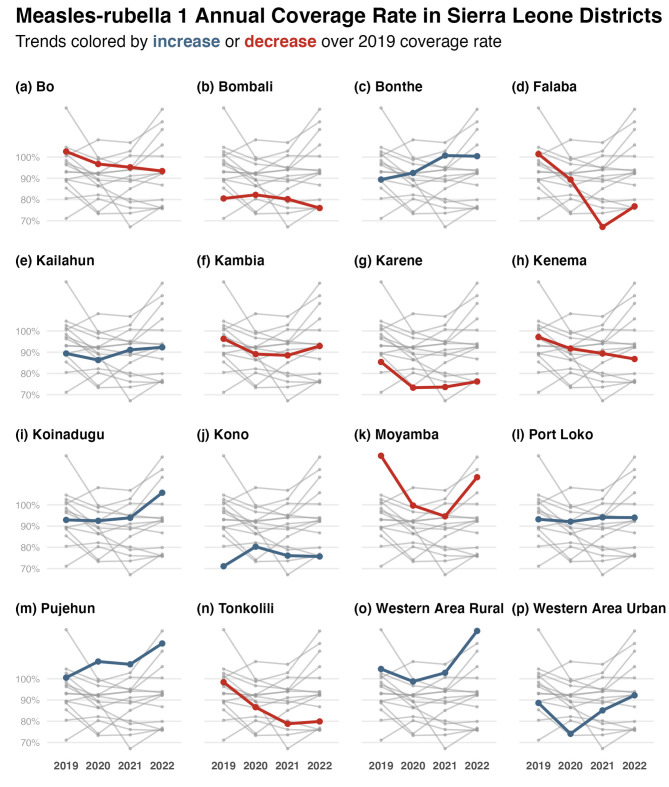
National coverage rates for all antigens declined in 2019-2020, notably measles-rubella 1 and pentavalent 3 (-5.4% and - 4.9%). Between 2020 and 2021, there was an overall increase in coverage (+ 0.2% to + 2.5%), except for measles-rubella 2 (-1.8%). Measles-rubella antigens rebounded in 2021-2022, while others decreased between - 0.5 and - 1.9% in coverage. Overall, all district-level coverage rates in 2022 were lower than those in 2019. Most districts decreased between 2019 and 2022, though a few had a continuous increase; some had an increase/recovery between 2020 and 2021; some districts had recovered 2019 levels by 2022.
The COVID-19 pandemic impacted Sierra Leone's national BCG, measles-rubella, and pentavalent antigen immunization, which were not fully restored in 2022. Most districts experienced notable coverage declines during the pandemic, though a few reached or surpassed 2019 rates in 2022. Examining pandemic impact can benefit from a focus beyond the national level to identify vulnerable regions. Sierra Leone's post-pandemic RI reestablishment needs targeted strategies and continual investments for equitable access and coverage, as well as to prevent vaccine-preventable diseases.
COVID-19 大流行对医疗保健系统和服务产生了深远影响,包括常规免疫接种(RI)。迄今为止,有关 COVID-19 大流行对西非法语国家(如塞拉利昂)RI 影响的信息有限,塞拉利昂此前已经经历过扰乱其医疗保健系统的公共卫生紧急情况。在这里,我们描述了 COVID-19 大流行对塞拉利昂关键抗原 RI 的影响。
我们使用了来自 District Health Information System 的 BCG、麻疹-风疹 1 和 2 以及五价 1 和 3 抗原的疫苗接种数据。我们比较了国家和地区层面选定抗原在 2019 年、2020 年、2021 年和 2022 年的年度覆盖率。我们使用 Pearson 卡方检验评估了 2019 年和 2020 年、2020-2021 年和 2021-2022 年之间的年度覆盖率之间的差异。
2019-2020 年,所有抗原的国家覆盖率均下降,尤其是麻疹-风疹 1 和五价 3(-5.4%和-4.9%)。2020-2021 年,除麻疹-风疹 2 外(-1.8%),覆盖率总体上有所增加(+0.2%至+2.5%)。2021-2022 年,麻疹-风疹抗原反弹,而其他抗原的覆盖率下降了-0.5%至-1.9%。总体而言,2022 年所有地区层面的覆盖率均低于 2019 年。大多数地区在 2019 年至 2022 年期间下降,尽管有几个地区连续增加;一些地区在 2020-2021 年期间有所增加/恢复;一些地区在 2022 年恢复了 2019 年的水平。
COVID-19 大流行对塞拉利昂的国家卡介苗、麻疹-风疹和五价抗原免疫产生了影响,这些影响在 2022 年并未完全恢复。大流行期间,大多数地区的覆盖率显著下降,尽管有几个地区在 2022 年达到或超过了 2019 年的水平。在国家层面之外,检查大流行的影响可以有助于确定脆弱地区。塞拉利昂的大流行后 RI 重建需要有针对性的战略和持续投资,以实现公平获得和覆盖,并预防疫苗可预防的疾病。