University of Michigan, Ann Arbor, MI, USA.
University of California Davis, Davis, CA, USA.
Environ Health. 2024 Jul 5;23(1):62. doi: 10.1186/s12940-024-01101-2.
Autism spectrum disorder (ASD) is a prevalent and heterogeneous neurodevelopmental disorder. Risk is attributed to genetic and prenatal environmental factors, though the environmental agents are incompletely characterized.
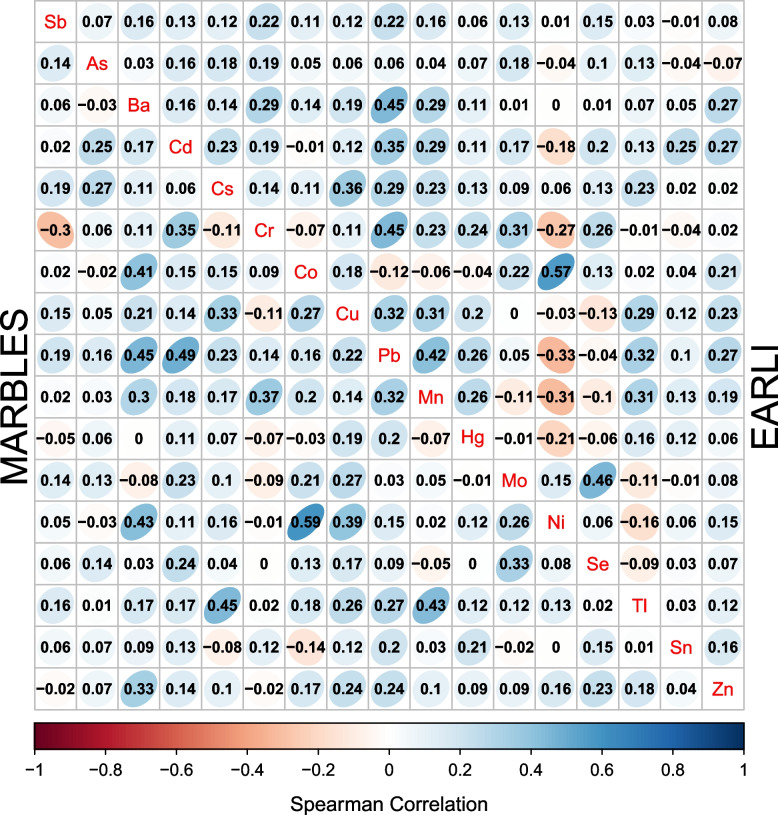
In Early Autism Risk Longitudinal Investigation (EARLI) and Markers of Autism Risk in Babies Learning Early Signs (MARBLES), two pregnancy cohorts of siblings of children with ASD, urinary metals concentrations during two pregnancy time periods (< 28 weeks and ≥ 28 weeks of gestation) were measured using inductively coupled plasma mass spectrometry. At age three, clinicians assessed ASD with DSM-5 criteria. In an exposure-wide association framework, using multivariable log binomial regression, we examined each metal for association with ASD status, adjusting for gestational age at urine sampling, child sex, age at pregnancy, race/ethnicity and education. We meta-analyzed across the two cohorts.
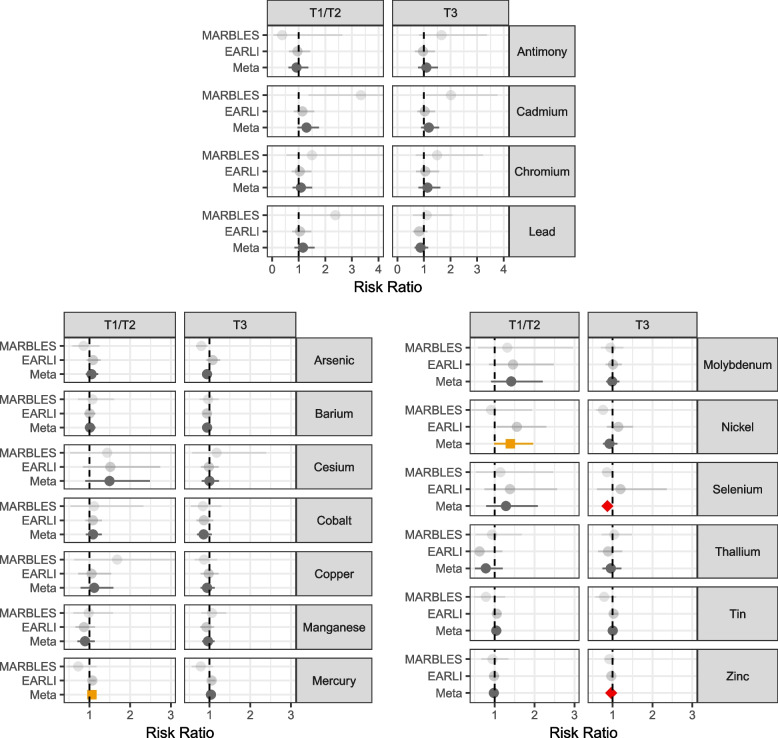
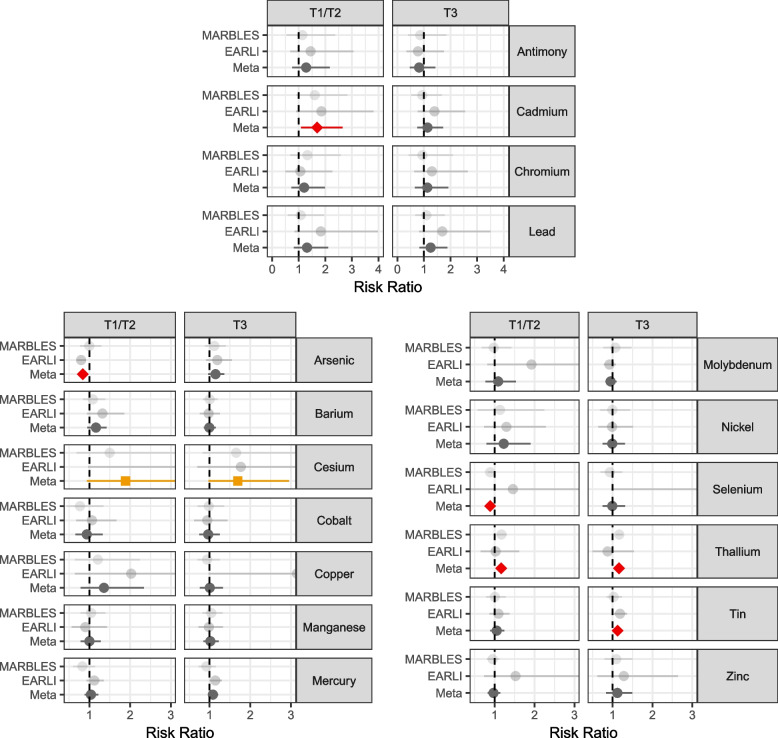
In EARLI (n = 170) 17% of children were diagnosed with ASD, and 44% were classified as having non-neurotypical development (Non-TD). In MARBLES (n = 231), 21% were diagnosed with ASD, and 14% classified as Non-TD. During the first and second trimester period (< 28 weeks), having cadmium concentration over the level of detection was associated with 1.69 (1.08, 2.64) times higher risk of ASD, and 1.29 (0.95, 1.75)times higher risk of Non-TD. A doubling of first and second trimester cesium concentration was marginally associated with 1.89 (0.94, 3.80) times higher risk of ASD, and a doubling of third trimester cesium with 1.69 (0.97, 2.95) times higher risk of ASD.
Exposure in utero to elevated levels of cadmium and cesium, as measured in urine collected during pregnancy, was associated with increased risk of developing ASD.
自闭症谱系障碍(ASD)是一种普遍存在且具有异质性的神经发育障碍。风险归因于遗传和产前环境因素,但环境因素尚未完全确定。
在早期自闭症风险纵向研究(EARLI)和婴儿学习早期自闭症风险标志物研究(MARBLES)中,我们对 ASD 儿童的兄弟姐妹进行了两项妊娠队列研究,使用电感耦合等离子体质谱法测量了两个妊娠时期(<28 周和≥28 周妊娠)的尿液金属浓度。在三岁时,临床医生根据 DSM-5 标准评估 ASD。在暴露广泛关联框架中,我们使用多变量对数二项式回归,在调整尿液采样时的胎龄、儿童性别、妊娠年龄、种族/民族和教育程度后,检查每种金属与 ASD 状态的关联。我们对两个队列进行了荟萃分析。
在 EARLI(n=170)中,17%的儿童被诊断为 ASD,44%被归类为非神经典型发育(Non-TD)。在 MARBLES(n=231)中,21%的儿童被诊断为 ASD,14%被归类为 Non-TD。在第一和第二孕期(<28 周),尿液中镉浓度超过检测水平与 ASD 风险增加 1.69(1.08,2.64)倍相关,与 Non-TD 风险增加 1.29(0.95,1.75)倍相关。第一和第二孕期铯浓度增加一倍与 ASD 风险增加 1.89(0.94,3.80)倍相关,第三孕期铯浓度增加一倍与 ASD 风险增加 1.69(0.97,2.95)倍相关。
在妊娠期间尿液中检测到的镉和铯水平升高,与 ASD 风险增加有关。