Department of Kidney Transplantation, Second Xiangya Hospital, Central South University, Changsha 410011.
Clinical Research Center for Organ Transplantation in Hunan Province, Second Xiangya Hospital, Central South University, Changsha 410011.
Zhong Nan Da Xue Xue Bao Yi Xue Ban. 2024 Mar 28;49(3):417-425. doi: 10.11817/j.issn.1672-7347.2024.230543.
Rejection remains the most important factor limiting the survival of transplanted kidneys. Although a pathological biopsy of the transplanted kidney is the gold standard for diagnosing rejection, its limitations prevent it from being used as a routine monitoring method. Recently, peripheral blood lymphocyte subpopulation testing has become an important means of assessing the body's immune system, however, its application value and strategy in the field of kidney transplantation need further exploration. Additionally, the development and utilization of routine test parameters are also important methods for exploring diagnostic strategies and predictive models for kidney transplant diseases. This study aims to explore the correlation between peripheral blood lymphocyte subpopulations and T cell-mediated rejection (TCMR) and antibody-mediated rejection (ABMR), as well as their diagnostic value, in conjunction with routine blood tests.
A total of 154 kidney transplant recipients, who met the inclusion and exclusion criteria and were treated at the Second Xiangya Hospital of Central South University from January to December, 2021, were selected as the study subjects. They were assigned into a stable group, a TCMR group, and an ABMR group, based on the occurrence and type of rejection. The basic and clinical data of these recipients were retrospectively analyzed and compared among the 3 groups. The transplant kidney function, routine blood tests, and peripheral blood lymphocyte subpopulation data of the TCMR group and the ABMR group before rejection treatment were compared with those of the stable group.
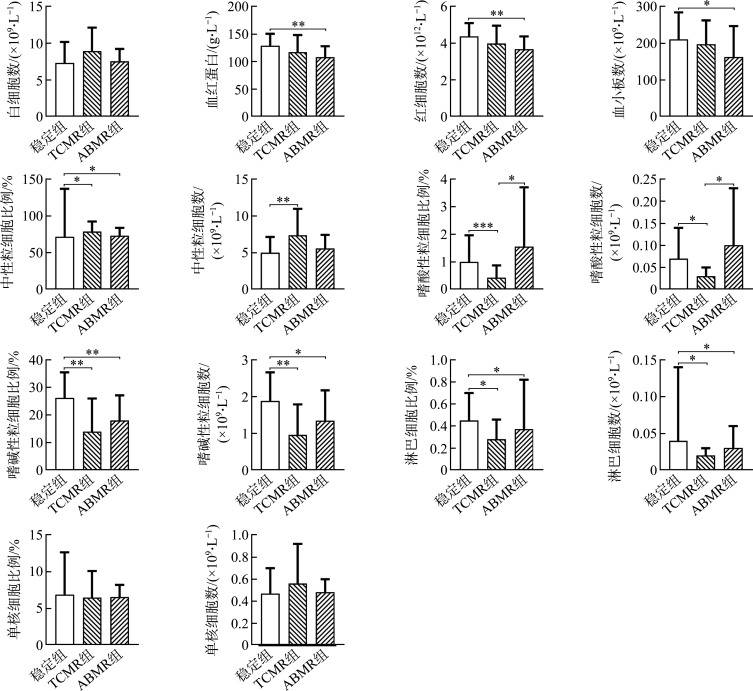
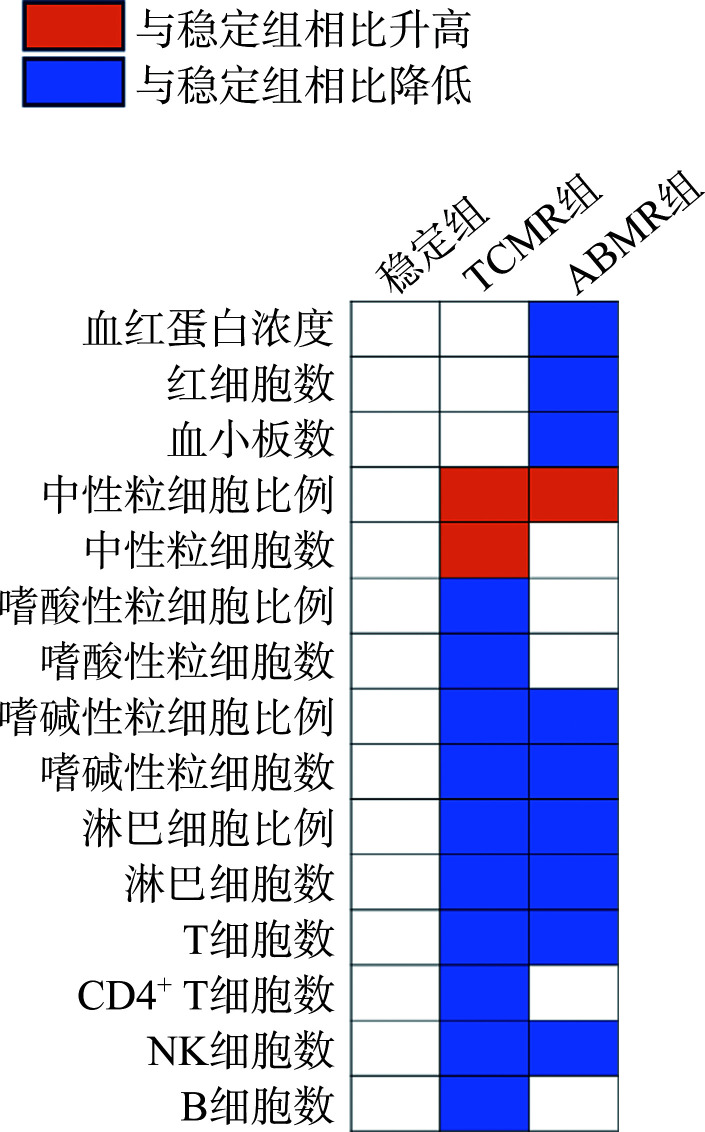
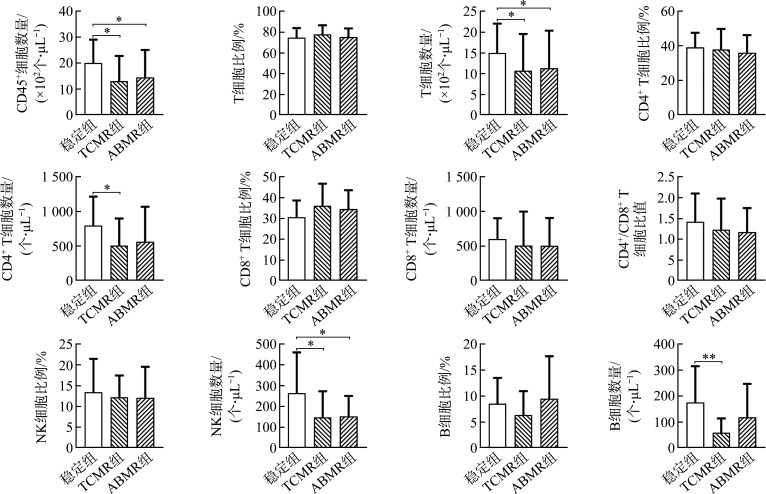
The stable, TCMR group, and ABMR group showed no statistically significant differences in immunosuppressive maintenance regimens or sources of transplanted kidneys (all >0.05). However, the post-transplant duration was significantly longer in the ABMR group compared with the stable group (<0.001) and the TCMR group (<0.05). Regarding kidney function, serum creatinine levels in the ABMR group were higher than in the stable group and the TCMR group (both <0.01), with the TCMR group also showing higher levels than the stable group (<0.01). Both TCMR and ABMR groups had significantly higher blood urea nitrogen levels than the stable group (<0.01), with no statistically significant difference between TCMR and ABMR groups (>0.05). The estimated glomerular filtration rate (eGFR) was lower in both TCMR and ABMR groups compared with the stable group (both <0.01). In routine blood tests, the ABMR group had lower hemoglobin, red blood cell count, and platelet count than the stable group (all <0.05). The TCMR group had higher neutrophil percentage (<0.05) and count (<0.05) than the stable group, and the ABMR group had a higher neutrophil percentage than the stable group (<0.05). The eosinophil percentage and count in the TCMR group were lower than in the stable and ABMR groups (all <0.05). Both TCMR and ABMR groups had lower basophil percentage and count, as well as lower lymphocyte percentage and count, compared with the stable group (all <0.05). There were no significant differences in monocyte percentage and count among the 3 groups (all >0.05). In lymphocyte subpopulations, the TCMR and ABMR groups had lower counts of CD45 cells and T cells compared with the stable group (all <0.05). The TCMR group also had lower counts of CD4 T cells, NK cells, and B cells than the stable group (all <0.05). There were no significant differences in the T cell percentage, CD4 T cell percentage, CD8 T cell percentage and their counts, CD4/CD8 T cell ratio, NK cell percentage, and B cell percentage among the stable, TCMR, and ABMR groups (all >0.05).
The occurrence of rejection leads to impaired transplant kidney function, accompanied by characteristic changes in some parameters of routine blood tests and peripheral blood lymphocyte subpopulations in kidney transplant recipients. The different characteristics of changes in some parameters of routine blood tests and peripheral blood lymphocyte subpopulations during TCMR and ABMR may help predict and diagnose rejection and differentiate between TCMR and ABMR.
排斥反应仍然是限制移植肾存活的最重要因素。虽然移植肾的病理活检是诊断排斥反应的金标准,但由于其局限性,不能作为常规监测方法。最近,外周血淋巴细胞亚群检测已成为评估机体免疫系统的重要手段,但在肾移植领域的应用价值和策略仍需进一步探索。此外,常规检测参数的开发和利用也是探索肾移植疾病诊断策略和预测模型的重要方法。本研究旨在探讨外周血淋巴细胞亚群与 T 细胞介导的排斥反应(TCMR)和抗体介导的排斥反应(ABMR)的相关性,并结合常规血液检查探讨其诊断价值。
选取 2021 年 1 月至 12 月在中南大学湘雅二医院接受治疗的符合纳入和排除标准的 154 例肾移植受者为研究对象。根据排斥反应的发生和类型,将其分为稳定组、TCMR 组和 ABMR 组。回顾性分析比较 3 组受者的基本临床资料。比较 TCMR 组和 ABMR 组治疗前与稳定组的移植肾功能、常规血液检查和外周血淋巴细胞亚群数据。
稳定组、TCMR 组和 ABMR 组的免疫抑制维持方案或移植肾来源无统计学差异(均>0.05)。然而,ABMR 组的移植后时间明显长于稳定组(<0.001)和 TCMR 组(<0.05)。在肾功能方面,ABMR 组的血清肌酐水平高于稳定组和 TCMR 组(均<0.01),而 TCMR 组也高于稳定组(<0.01)。TCMR 组和 ABMR 组的血尿素氮水平均明显高于稳定组(均<0.01),但两组之间无统计学差异(>0.05)。估算肾小球滤过率(eGFR)在 TCMR 组和 ABMR 组均低于稳定组(均<0.01)。在常规血液检查中,ABMR 组的血红蛋白、红细胞计数和血小板计数均低于稳定组(均<0.05)。TCMR 组的中性粒细胞百分比(<0.05)和计数(<0.05)高于稳定组,ABMR 组的中性粒细胞百分比高于稳定组(<0.05)。TCMR 组的嗜酸性粒细胞百分比和计数均低于稳定组和 ABMR 组(均<0.05)。TCMR 组和 ABMR 组的嗜碱性粒细胞百分比和计数以及淋巴细胞百分比和计数均低于稳定组(均<0.05)。三组间单核细胞百分比和计数无统计学差异(均>0.05)。在淋巴细胞亚群方面,TCMR 组和 ABMR 组的 CD45 细胞和 T 细胞计数均低于稳定组(均<0.05)。TCMR 组的 CD4 T 细胞、NK 细胞和 B 细胞计数也均低于稳定组(均<0.05)。稳定组、TCMR 组和 ABMR 组的 T 细胞百分比、CD4 T 细胞百分比、CD8 T 细胞百分比及其计数、CD4/CD8 T 细胞比值、NK 细胞百分比和 B 细胞百分比无统计学差异(均>0.05)。
排斥反应的发生导致移植肾功能受损,同时伴有肾移植受者一些常规血液检查和外周血淋巴细胞亚群的特征性变化。TCMR 和 ABMR 时一些常规血液检查和外周血淋巴细胞亚群参数变化的不同特征,可能有助于预测和诊断排斥反应,并区分 TCMR 和 ABMR。